Autonomous Close
Close continuously. Lock faster.
Our autonomous agents continuously work your month-end close, reconciling accounts, investigating exceptions, and preparing adjustments so your team can move toward a zero-day close without giving up review or control.
- Audited to SOC 2 Type I and II
- Zero unapproved ERP postings
- Every adjustment backed by evidence
The manual close
The close is slow because every number has to be proved by hand.
Finance teams spend days matching balances, retracing work, chasing exceptions, and finding support across spreadsheets, inboxes, and systems.
The work is repetitive, the evidence is fragmented, and the problems often surface when the clock is already running.
Illustration: a bank reconciliation workbook for March 2026, with a 45.00 bank fee and a 12,400.00 deposit in transit left as unexplained differences, and a sticky note asking who booked the deposit. Every balance is proven by hand
Export the statement, match it line by line, and explain every difference in a workbook someone has to reconstruct later.
Illustration: the preparer's bank reconciliation workbook and, on top of it, the copy the reviewer rebuilt to check it, with the sign-off still pending. The reviewer rebuilds the tie-out
To sign off, the reviewer retraces every step, so review takes as long as preparation did.
Illustration: the last six working days of March 2026, with three exceptions, a bank fee not booked, an accrual that ran short and an invoice in the wrong account, all surfacing on the 31st. Exceptions surface on the last day
The fee never booked, the accrual ran short, the invoice hit the wrong account. By the time they surface, there is barely any time left to fix them.
Illustration: where the support for March's bank fee ended up: an email thread, a Slack message, a downloaded statement and a colleague's memory. The evidence is scattered everywhere
When someone asks why an entry was made months later, the support is buried across email, chat, files, and the memory of the person who prepared it.

The continuous close
A close that is prepared before your team opens it.
24/7
The close runs with the month, not after it
Agents run on the schedules you set, at any hour, and Run all starts every task whose inputs are ready, in order, so reconciliation and review happen through the month instead of piling up at period end.
100%
Every line checked. No sampling.
Every statement line is matched, every manual entry is tested, and every control account is tied back to its source.
0.00
Unexplained difference
Every balance is tied to the cent. If something does not match, the difference is surfaced with its amount, date, source, and explanation.
0
Unapproved entries posted
The agent can prepare the entry and its support, but posting stays behind your approval controls.
How it works
Every close task, worked end to end.
Our Close Agent works the checklist throughout the month, preparing the reconciliations, investigations and entries. Your team reviews the work and makes every decision.
Checklist
Your close checklist, already in motion
Define the tasks, owners, reviewers, dependencies and deadlines once. Autonomous Close carries the checklist forward each month and starts each task when its dependencies are ready.
- Rolls forward each month with the same controls
- Tasks wait for the inputs they depend on
- Every action and hand-off stays on the task record
Illustration: the cash and bank group of the March 2026 close checklist in Autonomous Close. The operating-account bank reconciliation is signed off, the payroll account is in review, the receivables tie-out is in progress and two tasks have not started. A chip shows Run all started four tasks. March 2026 close36 tasks · working day 1Cash and bank
- Bank reconciliation: operating accountClose AgentSigned offDWD 1
- Bank reconciliation: payroll accountClose AgentIn reviewDWD 1
- Receivables control account tie-outClose AgentIn progressJWD 1
- Payroll accrualClose AgentNot startedAWD 2
- Manual journal testingAlex ChenNot startedDWD 2
Reconcile
Reconciled to the cent, with every exception named
The agent ties the ledger to bank statements, subledgers, invoices and other source systems. If something does not tie, it surfaces the exact difference with its amount, date, source and reference.
- Uses the exact accounting period
- Every figure traces back to its source
- Anything it cannot verify is stated explicitly
Illustration: the March 2026 tie-outs in Autonomous Close. The operating and payroll accounts and receivables tie to the cent; payables carries one exception, an invoice of $7,200.00 booked to accrued expenses instead of the vendor subledger. Tie-outs31 Mar 2026- 1010 · Operating accountBank statement2,184,920.000.00Tied
- 1020 · Payroll accountBank statement312,480.000.00Tied
- 1200 · Accounts receivableCustomer subledger1,642,300.000.00Tied
- 2000 · Accounts payableVendor subledger904,160.00−7,200.001 exception
Illustration: the one exception the Close Agent names on the payables tie-out, invoice INV-88213 from Brightwater Freight for $7,200.00, in the vendor subledger but posted to accrued expenses in the ledger. Reconciling item · 1 of 1
INV-88213 · Brightwater Freight
7,200.00In the vendor subledger, but posted to 2100 Accrued expenses in the ledger. Reclass to 2000 proposed.
Adjust
The fix, proposed as an entry
Autonomous Close prepares the balanced entry and the workpaper behind it. A named approver approves the exact lines before anything is posted to the ERP.
- Entries post only after approval
- Rejected entries return to the agent for correction
Illustration: journal entry RB-3F2A1C proposed by the Close Agent, $7,200.00 from 2100 Accrued expenses to 2000 Accounts payable, dated 31 March 2026, waiting for the Controller, and a chip showing it posted to NetSuite on 2 April. RB-3F2A1C31 Mar 2026Reclass INV-88213 to 2000 Accounts payable
- Dr 2100 · Accrued expenses7,200.00
- Cr 2000 · Accounts payable7,200.00
Approver: ControllerRejectApproveReview and close
A reviewer on every task. A month that closes clean.
Every task requires a named reviewer. Approve it, or send it back with a note for the agent to resolve. The month cannot lock until every task is signed off and every entry is cleared.
- The reviewer is separate from the preparer
- Closed periods stay locked
Illustration: Dana Ruiz's sign-off, as Controller, of the March 2026 payables tie-out in Autonomous Close, with her conclusion, recorded on the task. DDana RuizSigned offSubledger ties after the reclass. Nothing carried forward.
On the task's record · 2 Apr 2026, 11:20
Illustration: March 2026 closed, with all 36 tasks signed off and no entry pending. March 2026Closed- Tasks signed off36 of 36
- Entries pending0
Closed by the Controller · 2 Apr 2026
The month, in working days
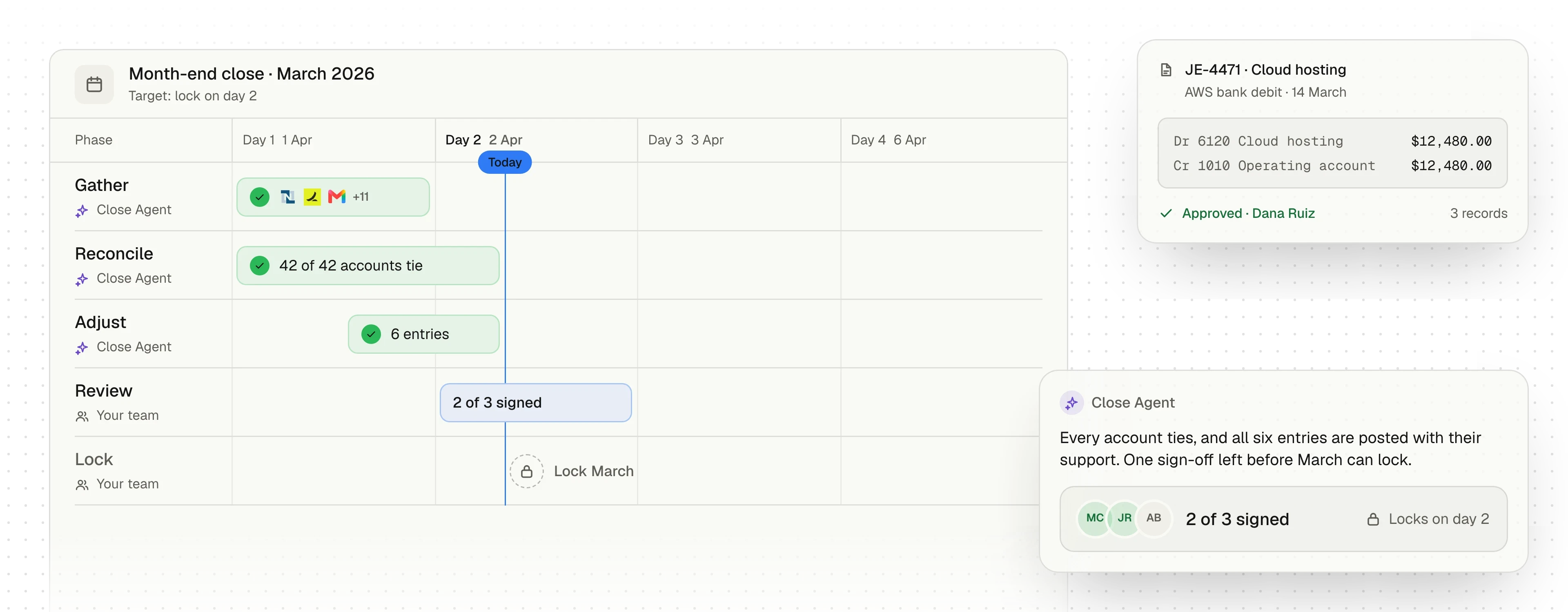
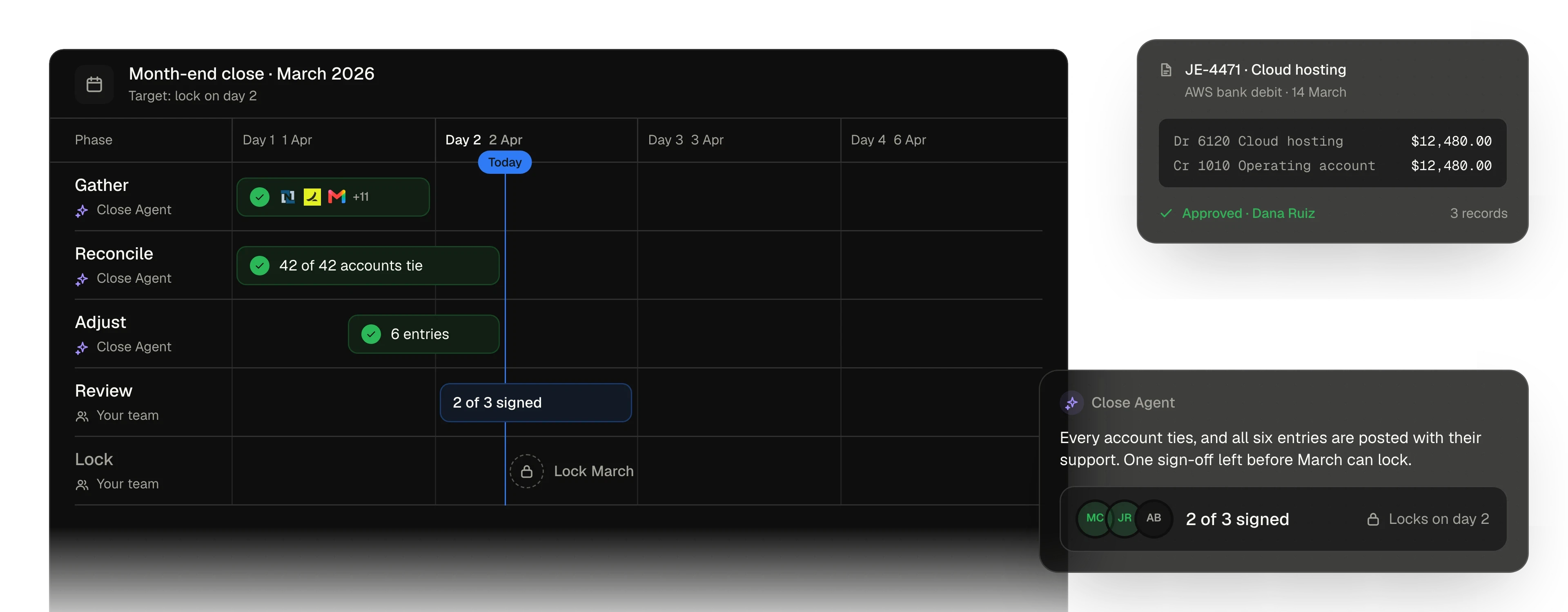
Start prepared. Close on day two.
Autonomous Close starts before the close window opens, prepares the work as inputs arrive, and keeps reviewers moving until every task is signed off and the period is locked.
- Before day 1
Roll the close forward
Tasks, owners, reviewers, dependencies and controls carry forward from the prior month. Every month starts with a ready-to-run close, not a blank checklist.
- Working day 1
The agent prepares the work
Reconciliations run, exceptions are investigated, workpapers are assembled, and proposed entries are prepared for review.
- Working days 1–2
Your reviewers decide
Approve the work or send it back with a note. The agent resolves what comes back and resubmits it for review.
- Working day 2
Lock the month
Once every task is signed off and every entry is cleared, the period locks and stays locked.
Built around your close
Whatever your close includes, agents work through it.
Your month-end work can look different from company to company. Autonomous Close handles reconciliations, accruals, journals and the rest of the tasks on your checklist.
Bring your checklist, policies, reviewers and source systems. The agent adapts to the close your team already runs.
Cash and bank
Bank and cash reconciliations
Receivables
Customer subledger and control accounts
Payables
Vendor subledger and control accounts
Payroll
Payroll, benefits and related accruals
Accruals
Recalculated, validated and adjusted
Prepaids
Schedules and amortisation
Revenue
Period recognition and tie-outs
Fixed assets
Additions, depreciation and disposals
Inventory
Inventory, COGS and related reconciliations
Intercompany
Balances and eliminations across entities
Manual journals
Support, approval, segregation, cutoff and policy checks
Other close tasks
Whatever else is on your checklist
Works with your stack
Your systems stay. Autonomous Close works across them.
It connects to the systems your finance team already uses and works across them as part of the close.
Your ERP remains the system of record. The agent only writes where you explicitly allow it, and controlled actions stay behind your approval rules.
 Trial balance
- Ledger entries
- Posts the approved entry
- Attaches the workpaper
 Trial balance
- Universal journal
- Posts the approved entry
 Trial balance
- Ledger entries
 Trial balance
- Journal entries
- Aged payables
 Trial balance
- Bank statement lines
- Journal items
 Bank transactions
- Account balances
 Card transactions
- Bills
- GL accounts
 Card transactions
- Statements
- Cash transactions
 Vendor statements
- Supporting invoices
 Reconciliation workbooks
- Close checklist
 Supporting schedules
 Posts the review update
- Reads the thread
Built for control
Autonomous work. Human authority.
Our agents prepare reconciliations, investigate exceptions, and propose entries. Your team keeps control over approvals, permissions, and what reaches the ledger.
Nothing posts without approval
Controlled entries wait for the required reviewer before they reach the ledger.
Preparers do not approve their own work
Roles and review paths follow the segregation rules you define.
Every decision stays on the record
Sources, workpapers, approvals, comments, and actions stay attached to the task.
Closed periods stay closed
Once a period is locked, agents cannot change it.
Case studyRestaurant technology and payments company
Payment reconciliation for a restaurant payments company processing $1.2 billion+ a year.
The company already closes in three days. Our AI agents take on the daily work behind those numbers: matching transactions to their settlements and proposing an explanation for each difference they investigate.
- in restaurant payments a year, and growing
- $1.2B+
- to close the books already; the daily reconciliation is the work left
- 3 days
- accountants in several of its local finance teams
- 1–2
Enterprise security
Built for finance data from day one.
Our platform is built for sensitive financial data, with controlled access, auditability, and enterprise-grade infrastructure.
Read the security page- SOC 2 Type I and Type II
- Encryption in transit and at rest
- Role-based access and permissions
- Deployment and data residency options
Questions
The questions we get asked first.
What does autonomous close mean?
Our autonomous agents continuously prepare the close as the month progresses. They gather supporting data, reconcile accounts, investigate exceptions, and prepare adjustments so your team can focus on review and approval.
Does Autonomous Close post journal entries automatically?
Not without the required approval. It can prepare an entry with its supporting evidence, but controlled entries wait for the designated approver before they reach the ledger.
Do you replace our ERP?
No. Your ERP remains the system of record. Autonomous Close works across it and the other systems involved in your close, and only writes where you explicitly allow it.
Do we have to change how we close?
No. Your checklist, policies, reviewers, and approval paths stay yours. Our Close Agent adapts to the way your team closes and works through that process continuously.
How long does it take to get started?
Your next close can run on Autonomous Close. Connect the systems involved, bring your existing checklist, and define the reviewers and approval rules the agent should follow.
What systems does Autonomous Close work with?
It works across the systems involved in the close, including ERPs, banks, expense platforms, payroll systems, email, and other financial data sources. Available integrations and supported actions vary by system.
How are review and approvals handled?
Your team defines who prepares, reviews, approves, and which actions agents are allowed to take. Preparers do not approve their own work, and approvals, comments, evidence, and actions remain attached to the task.
What happens when the agent cannot complete a close task?
It shows what is blocking the task, such as missing evidence, an unresolved exception, or an account that does not tie, and sends it to your team for review. It does not guess.
See it run on your own close.
Bring last month's checklist. We'll walk through what our Close Agent would have prepared, what it would have flagged, and what it would have left for your team.