Key takeaways
- Deferred revenue is money a customer has paid, or owes under a noncancellable contract, for goods or services you haven't delivered yet, so it sits on your balance sheet as a liability until you earn it.
- Under ASC 606, you record it as a contract liability when the customer pays or when your right to payment becomes unconditional, whichever comes first, so the contract terms decide the timing, not only the invoice date.
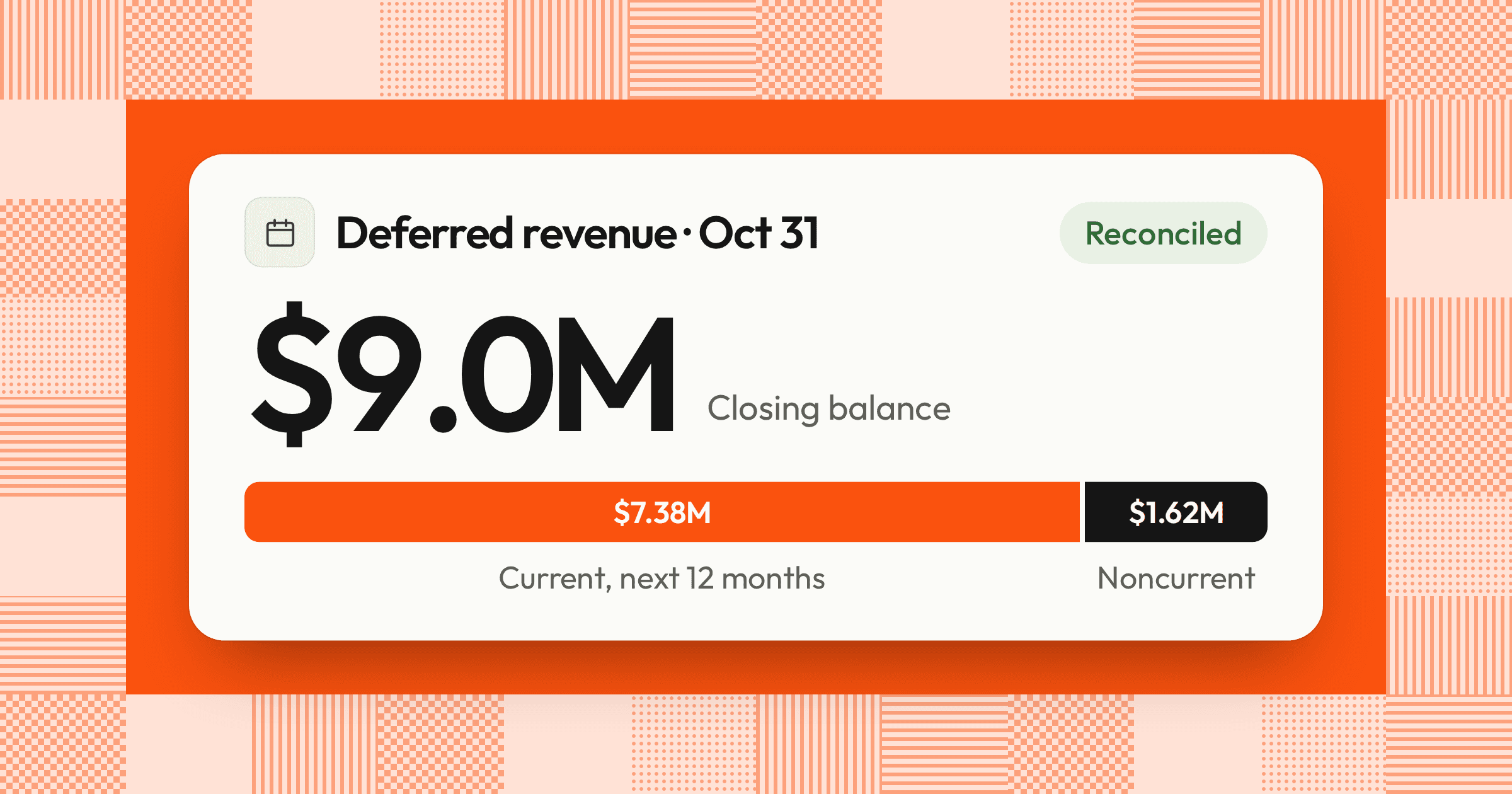
- In the worked example below, a software company's October roll-forward closes at $9,000,000, and the reconciliation finds a $28,000 credit memo that never reached the general ledger.
Deferred revenue is payment a company has received, or is owed, for goods or services it hasn't delivered yet, recorded as a liability until it's earned. Getting it right gives you accurate revenue in every period, catches billing and sync errors early, and keeps your team audit-ready. This guide covers the meaning, timing, journal entries, calculation, related terms, and month-end reconciliation.
What is deferred revenue?
Deferred revenue means a customer has paid you, or owes you under a contract it can't cancel, for something you'll deliver later. Until you deliver, you owe the customer the product, the service, or a refund, so the amount is a liability rather than revenue. Revenue is what you've earned in the period, and deferred revenue is what you've been paid or billed for but haven't earned yet.
- Payment in advanceConsideration received or due before you transfer the promised goods or services
- Revenue recognitionMoving the amount from the liability to revenue as you deliver, for example monthly over a subscription term
- Contract liabilityThe term ASC 606 uses for the same balance
Unearned revenue, deferred income, customer deposits, and contract liability all name the same kind of balance, where payment comes before performance. Common examples include annual software subscriptions, maintenance and support contracts, prepaid service retainers, and gift cards.
Is deferred revenue an asset or a liability?
Deferred revenue is a liability, because you owe the customer goods or services you've already been paid or billed for. Classifying it correctly keeps your balance sheet and your revenue accurate.
- Debit or creditIt carries a normal credit balance. A credit increases it, and a debit decreases it when you recognize revenue
- Current or long-termThe portion you expect to recognize within the next 12 months is a current liability, and the rest is noncurrent
- Balance sheet placementIt appears under liabilities, often as “Deferred revenue” or “Contract liabilities,” split between current and noncurrent where material
The split depends on when you expect to deliver, not when the customer pays. A three-year contract paid upfront will have a current portion and a long-term portion until its final year.
When should you record deferred revenue?
Record deferred revenue when the customer pays or when your right to payment becomes unconditional, whichever comes first. Following this rule from ASC 606-10-45-2 keeps your receivables and liabilities accurate, without invoices the customer can still walk away from.
Under ASC 606-10-45-4, a right to payment is unconditional when only the passage of time is required before payment is due. ASC 606 Example 38 shows how the contract terms change the entries:
| Contract terms | When the right to payment becomes unconditional | Entry at that point | When the customer pays |
|---|---|---|---|
| Cancellable until the customer pays (Example 38, Case A) | Only when the customer pays | No entry before payment | Debit cash, credit deferred revenue |
| Noncancellable, with only time left before payment is due (Example 38, Case B) | As soon as only time remains, which can be when you invoice and is no later than the due date | Debit accounts receivable, credit deferred revenue | Debit cash, credit accounts receivable |
If your billing system posts both balances the moment an invoice is sent, check the contract terms at month-end. Keep the receivable and the deferred revenue only where your right to payment is already unconditional.
What is the journal entry for deferred revenue?
The deferred revenue journal entry has two parts: a credit to the liability when payment is received or due, and a debit each period as you deliver. The second entry recognizes revenue as you deliver, which for a subscription means evenly over the term.
Example
A customer signs a noncancellable 12-month software subscription for $120,000, starting October 1, 2026. The invoice is due October 1, and the customer pays on October 15. Revenue is recognized evenly at $120,000 ÷ 12 = $10,000 a month.
| Account | Debit | Credit |
|---|---|---|
| October 1 · Payment due under the contract | ||
| Accounts receivable | $120,000 | |
| Deferred revenue | $120,000 | |
| October 15 · Customer pays | ||
| Cash | $120,000 | |
| Accounts receivable | $120,000 | |
| October 31 · Recognize October revenue | ||
| Deferred revenue | $10,000 | |
| Subscription revenue | $10,000 | |
At October 31, the balance is $120,000 − $10,000 = $110,000. The same $10,000 entry posts at the end of each month until the balance reaches $0 on September 30, 2027.
If the customer paid with no invoice due first, the first entry would debit cash and credit the liability. For how this entry fits with the rest of your month-end adjustments, see Month-end journal entries: Examples and what to review.
How do you calculate deferred revenue?
To calculate deferred revenue, subtract the revenue you've recognized from the amount the customer has paid or owes under the contract. At the company level, the same logic gives you a roll-forward: opening balance + new billings − revenue recognized − credits = closing balance.
Example
A customer pays $360,000 on October 1, 2026, for a three-year subscription. Monthly revenue is $360,000 ÷ 36 = $10,000.
| At October 31, 2026 | Calculation | Amount |
|---|---|---|
| Revenue recognized in October | 1 month × $10,000 | $10,000 |
| Balance remaining | $360,000 − $10,000 | $350,000 |
| Current portion | Next 12 months × $10,000 | $120,000 |
| Noncurrent portion | Remaining 23 months × $10,000 | $230,000 |
The current and noncurrent portions add up to $350,000, and each month $10,000 moves from noncurrent to current until the final 12 months, when the whole balance is current.
Deferred revenue vs unearned revenue, accrued revenue, and accounts receivable
Deferred and unearned revenue are the same thing, while accrued revenue and accounts receivable are assets on the other side of the timing difference. Knowing which is which helps you post every billing and revenue entry to the right account.
| Term | Payment vs delivery | Balance sheet | Example |
|---|---|---|---|
| Deferred revenue | Paid or due before you deliver | Liability | Annual subscription paid upfront |
| Unearned revenue | Another name for the same balance | Liability | Same as above |
| Contract liability | The ASC 606 term | Liability | Same as above |
| Accrued revenue (unbilled receivable or contract asset) | Delivered before you bill | Asset | Services performed in October, billed in November |
| Accounts receivable | Billed, with an unconditional right to payment | Asset | Invoice due in 30 days |
| Prepaid expense | You paid a supplier before they deliver | Asset | Annual software license you bought upfront |
A simple way to remember the difference: deferred means the cash or the billing right comes first, and accrued means the work comes first. Accrued revenue is an unbilled receivable when your right to payment is unconditional, and a contract asset when payment still depends on further performance. A prepaid expense is the same transaction seen from the customer's side.
How do you reconcile deferred revenue at month-end?
Reconcile deferred revenue by tying the general ledger balance to the contract schedule in your billing system, then explain the month's movement with a roll-forward. Doing it every month catches missed credits, duplicate invoices, and manual entries before they distort revenue.
Example
A software company with about $60 million in annual revenue reconciles the account at October 31, 2026. All amounts are illustrative.
| Roll-forward, October 2026 | Amount |
|---|---|
| Opening balance, October 1 | $8,640,000 |
| Add: New billings due or paid | $2,310,000 |
| Less: Revenue recognized | −$1,905,000 |
| Less: Credit memos | −$45,000 |
| Closing balance per billing system | $9,000,000 |
| Balance per general ledger | $9,028,000 |
| Difference | $28,000 |
The roll-forward works out as $8,640,000 + $2,310,000 − $1,905,000 − $45,000 = $9,000,000. The $28,000 difference is a credit memo for a cancelled add-on that posted in the billing system but failed to sync to the ERP. The credit memo is already in the billing system's $45,000 of credits. Because the invoice was unpaid, the fix debits the liability and credits accounts receivable for $28,000.
Prepared by Close Agent
- Billing system scheduleContract schedule at 31 Oct9,000,000.00
- GL balance24000 · Deferred revenue9,028,000.00
- Difference28,000.00
- Reconciling item · 1 of 1Credit memo not synced to the ERPCancelled add-on, posted in the billing system and never reached the ledgerCM-041228,000.00Needs review
- Unexplained difference0.00
Current, after the entry7,380,000.00
Noncurrent1,620,000.00
After the fix, the $9,000,000 splits into $7,380,000 current and $1,620,000 noncurrent, based on the expected recognition dates in the contract schedule. When the balances don't agree, check the common causes of differences in this order:
| What you see | What to check |
|---|---|
| The GL is higher than the billing system | Credit memos or cancellations that didn't sync |
| The GL is lower than the billing system | Invoices that failed to import, or duplicate revenue entries |
| A difference that reverses next month | Cutoff: invoices or credits dated on the last day of the month |
| Activity with no contract behind it | Manual journals posted straight to the account |
| A difference only in foreign currency contracts | Exchange rates applied differently in each system |
Credit memo CM-0412 · cancelled add-on, not synced to the ERP
- Dr 24000 · Deferred revenue28,000.00
- Cr 12000 · Accounts receivable28,000.00
Deferred revenue reconciliation, October 2026
For where this reconciliation sits in the close, see Month-end close process. For the task, its owner, and its reviewer, see Month-end close checklist.
Revenue and cash
- Deferred revenue reconciliationClose AgentIn reviewDWD 2
- Revenue recognition entriesClose AgentSigned offAWD 1
- Current and noncurrent splitClose AgentIn progressAWD 2
- Billing cutoff reviewClose AgentSigned offAWD 1
- Bank reconciliation · Operating accountClose AgentSigned offAWD 1
Is deferred revenue good or bad?
A growing deferred revenue balance is a good sign when new and renewed contracts drive it, because customers are committing and paying for future periods. Reading it alongside revenue gives you a view of sales momentum that revenue alone doesn't show.
- Cash flowAn increase in the balance is added back to net income in operating cash flow, so upfront customer payments bring cash in before revenue. If the invoice remains unpaid, the increase in accounts receivable offsets the deferred revenue increase in the operating cash flow reconciliation
- BillingsRevenue plus the change in the balance approximates net billings. In the example, $1,905,000 + ($9,000,000 − $8,640,000) = $2,265,000, which equals billings of $2,310,000 less $45,000 of credits
- Warning signsA shrinking balance can mean slower bookings, shorter contract terms, or a shift from annual to monthly billing
- ObligationYou still owe the customer the service, and if you can't deliver it, you may have to refund the payment
How we approach it
Our Close Agent reconciles deferred revenue as a task on your close checklist. It ties the general ledger to the contract schedule in your billing system and shows each difference with its amount, date, source, and reference. It then prepares the correcting entry and the workpaper for your reviewer. When data is missing, it stops and asks for it, and nothing posts to your ERP until a named approver signs off. If you want this reconciliation prepared before your team starts the close, explore our Close Agent.
Share this article