Key takeaways
- Prepaid expenses are payments you make in advance for goods or services you'll receive later, so they sit on your balance sheet as a current asset until you use them.
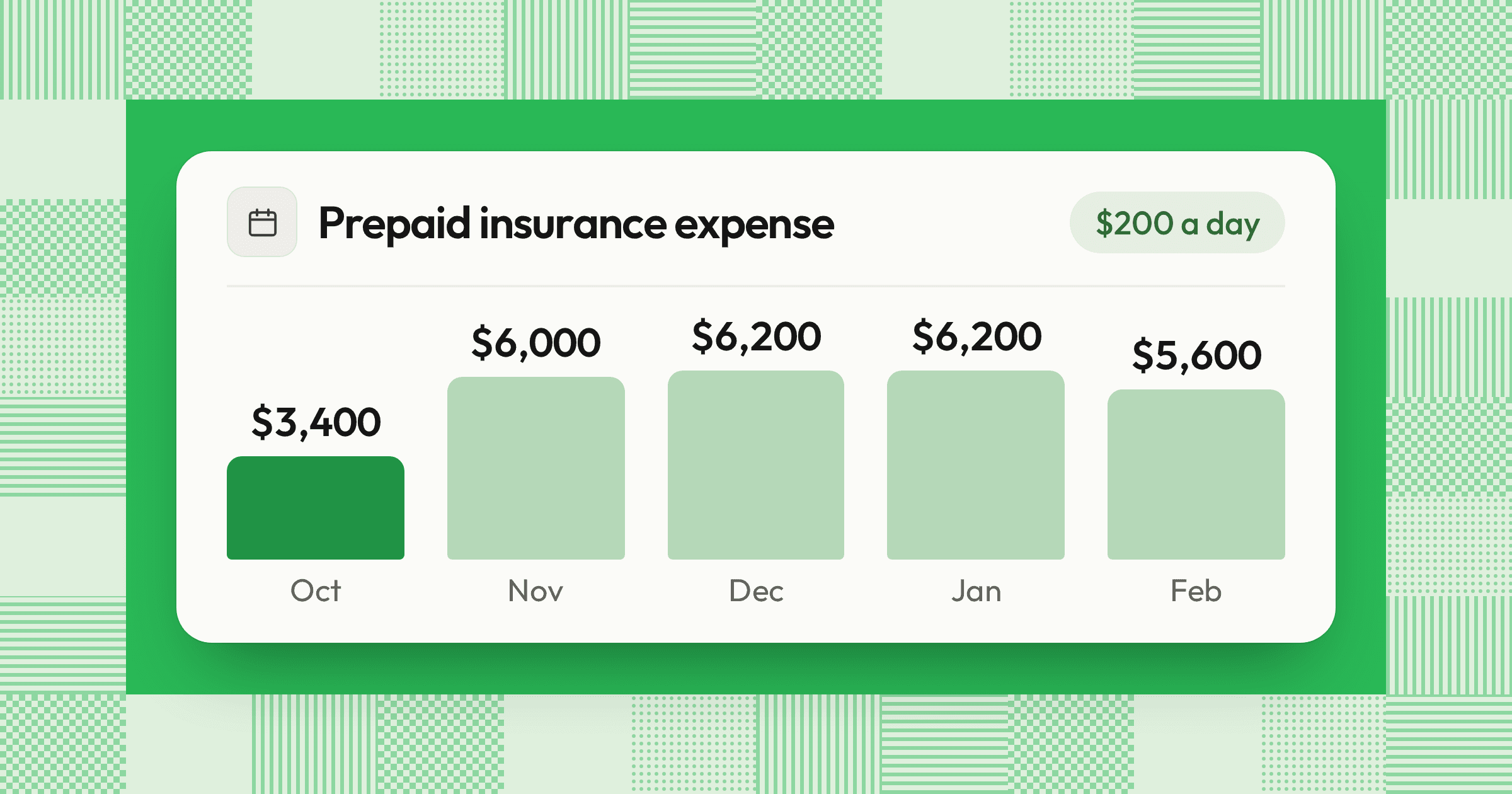
- In the worked example below, a $73,000 insurance policy that starts on October 15 is expensed at $200 a day, which puts $3,400 in the first month and $2,800 in the last.
- The 12-month rule in Treasury Regulation § 1.263(a)-4(f) exempts qualifying prepayments from capitalization for tax, but your books still spread the cost over the benefit period.
Prepaid expenses are payments you make before you receive the goods or services, recorded as an asset and expensed as you use them. Getting prepaid expenses right gives you accurate monthly costs, catches payments booked straight to expense, and keeps your team audit-ready. This guide covers the definition, the journal entry, how to build an amortization schedule, cancellations, how prepaids compare with accruals, and the month-end reconciliation.
What are prepaid expenses?
Prepaid expenses are costs you've paid for but haven't used yet, such as an annual insurance policy or software subscription paid upfront. Until the benefit is used, the payment is an asset, because it gives you something of value in future periods.
- PrepaymentCash paid, or a bill recorded, before the service period starts
- AmortizationMoving the cost from the asset to expense as each period of benefit passes
- Benefit periodThe dates the payment covers, such as a policy term or subscription term
Prepaid expenses are also called prepayments, prepaid assets, or deferred expenses. Common examples include insurance premiums, rent paid in advance, annual software subscriptions, maintenance contracts, retainers, and deposits for future events.
Are prepaid expenses an asset or a liability?
Prepaid expenses are an asset, because you've paid for a future benefit you haven't received yet. Classifying them correctly keeps both your balance sheet and your monthly expenses accurate.
- Debit or creditPrepaid expenses carry a normal debit balance. A debit increases the asset, and a credit reduces it when you amortize
- Current or noncurrentThe portion you'll use within the next 12 months is a current asset, and anything beyond that is noncurrent
- Balance sheet placementUnder current assets, as “Prepaid expenses” or “Prepaid expenses and other current assets”
A three-year contract paid upfront has a current and a noncurrent portion until its final year. The split depends on when you'll use the benefit, not when you paid.
What is the journal entry for prepaid expenses?
The prepaid expense journal entry has two parts: a debit to the asset when you pay, and a debit to expense each period as you use the benefit. The second entry is a month-end adjusting entry that you repeat until the asset reaches zero.
Example
Your company pays $73,000 on October 10, 2026, for a 12-month insurance policy that runs from October 15, 2026, to October 14, 2027.
| Account | Debit | Credit |
|---|---|---|
| October 10, 2026 · Pay the annual premium | ||
| Prepaid insurance | $73,000 | |
| Cash | $73,000 | |
| October 31, 2026 · Expense October's 17 days of coverage | ||
| Insurance expense | $3,400 | |
| Prepaid insurance | $3,400 | |
If the bill goes through accounts payable first, the first entry credits accounts payable instead of cash. Prepaid rent works the same way: debit prepaid rent when you pay the quarter, and credit it as each month passes.
For how this entry fits with the rest of your month-end adjustments, see Month-end journal entries: Examples and what to review.
How do you amortize a prepaid expense?
Amortize a prepaid expense by spreading its cost evenly over the benefit period, either by day or by month. Choosing one method in your close policy keeps every schedule consistent and easy to review.
- Daily methodCost ÷ days in the term × days used in the month. It's the most accurate when a term starts or ends mid-month
- Monthly methodCost ÷ months in the term. It's simpler, but you need a rule for partial months, such as starting in the next month when a term begins after the 15th
The $73,000 policy covers 365 days, so the daily rate is $73,000 ÷ 365 = $200. Each month's expense is $200 × the days covered that month:
| Month | Days covered | Expense | Prepaid balance at month-end |
|---|---|---|---|
| October 2026 | 17 | $3,400 | $69,600 |
| November 2026 | 30 | $6,000 | $63,600 |
| December 2026 | 31 | $6,200 | $57,400 |
| January 2027 | 31 | $6,200 | $51,200 |
| February 2027 | 28 | $5,600 | $45,600 |
| March 2027 | 31 | $6,200 | $39,400 |
| April 2027 | 30 | $6,000 | $33,400 |
| May 2027 | 31 | $6,200 | $27,200 |
| June 2027 | 30 | $6,000 | $21,200 |
| July 2027 | 31 | $6,200 | $15,000 |
| August 2027 | 31 | $6,200 | $8,800 |
| September 2027 | 30 | $6,000 | $2,800 |
| October 2027 | 14 | $2,800 | $0 |
| Total | 365 | $73,000 |
The schedule ends at $0 on October 14, 2027, and the 13 monthly amounts add up to the $73,000 paid. A prepaid schedule template needs the same columns for every item: vendor, invoice, start date, end date, cost, method, monthly expense, and remaining balance.
How do you handle a prepaid expense that's cancelled early?
When a prepaid contract is cancelled early, remove the remaining balance from the asset in the month of cancellation. Clearing it right away stops you from amortizing a benefit you no longer have.
Example
You cancel the policy above effective March 31, 2027, and the insurer agrees to refund $30,000. The remaining balance at March 31 is $39,400, so $9,400 isn't coming back.
| Account | Debit | Credit |
|---|---|---|
| Record the refund due from the insurer | ||
| Other receivables | $30,000 | |
| Prepaid insurance | $30,000 | |
| Expense the part that won't be refunded | ||
| Insurance expense | $9,400 | |
| Prepaid insurance | $9,400 | |
The two credits total $39,400, which brings the prepaid balance to $0. When the refund arrives, debit cash and credit other receivables for $30,000.
Prepaid expenses vs accrued expenses vs deferred revenue
Prepaid expenses and accrued expenses are opposite timing differences on the cost side, and deferred revenue is the same timing difference seen from the seller's side. Knowing which is which helps you post every month-end entry to the right account.
| Term | Cash vs benefit | Balance sheet | Example |
|---|---|---|---|
| Prepaid expense | You pay before you receive the benefit | Asset | Annual insurance paid upfront |
| Accrued expense | You receive the benefit before you're billed or pay | Liability | October consulting hours billed in November |
| Deferred revenue | Your customer pays before you deliver | Liability | Annual subscription a customer paid upfront |
| Deferred expense | Another name for a prepaid expense, used for longer terms | Asset | Three-year contract paid upfront |
A simple way to remember the difference: prepaid means you paid first, and accrued means the cost came first. For the other side of the accrual, see Accrued expenses. For revenue accruals, see Accrued revenue: Definition, examples, and journal entry.
How do you reconcile prepaid expenses at month-end?
Reconcile prepaid expenses by tying the general ledger to your prepaid schedule, then explaining the month with a roll-forward: opening balance + additions − amortization = closing balance. Doing it every month catches missed amortization, prepayments coded to expense, and balances that should have cleared.
Example
A software company with about $80 million in annual revenue reconciles its prepaid expenses at October 31, 2026. All amounts are illustrative.
| Prepaid item | Opening, October 1 | Added | Amortized | Closing, October 31 |
|---|---|---|---|---|
| InsuranceOctober 15, 2026 to October 14, 2027 | $0 | $73,000 | $3,400 | $69,600 |
| CRM subscriptionJuly 2026 to June 2027 | $180,000 | $0 | $20,000 | $160,000 |
| Office rentOctober to December 2026 | $0 | $54,000 | $18,000 | $36,000 |
| Conference sponsorshipFebruary 2027 event | $25,000 | $0 | $0 | $25,000 |
| Data platformJanuary 2026 to December 2028 | $81,000 | $0 | $3,000 | $78,000 |
| Total per schedule | $286,000 | $127,000 | $44,400 | $368,600 |
The roll-forward works out as $286,000 + $127,000 − $44,400 = $368,600. The general ledger shows $332,600, which is $36,000 lower.
Prepared by Close Agent
- Prepaid scheduleRoll-forward at 31 Oct368,600.00
- GL balance14200 · Prepaid expenses332,600.00
- Difference36,000.00
- Reconciling item · 1 of 1Quarterly rent coded to expenseAP bill 88412, October to December; only October belongs in expenseRB-3A7E5236,000.00Needs review
- Unexplained difference0.00
Current, after the entry326,600.00
Noncurrent42,000.00
The difference is the rent: the $54,000 quarterly payment was coded straight to rent expense, so the asset never recorded it. Only October's $18,000 belongs in expense, so the fix is a debit to prepaid rent and a credit to rent expense for $36,000.
Quarterly rent coded to expense · November and December
- Dr 14200 · Prepaid expenses36,000.00
- Cr 64100 · Rent expense36,000.00
Prepaid expenses reconciliation, October 2026
The sponsorship isn't amortized monthly, because its benefit is the event itself, so it's expensed in February 2027. The data platform has 26 months left, so $36,000 is current and $42,000 is noncurrent. That puts $326,600 of the $368,600 in current assets.
When the ledger and the schedule don't agree, check these causes first:
| What you see | What to check |
|---|---|
| The GL is lower than the schedule | Prepayments coded straight to expense |
| The GL is higher than the schedule | Amortization entries that weren't posted |
| A balance on an expired item | A schedule that ended without a final entry, or a cancellation not recorded |
| A new invoice not on the schedule | Bills coded to the prepaid account without a start and end date |
| A difference that repeats every month | A schedule built with the wrong term or amount |
For where this reconciliation sits in the close, see Month-end close process. For the task, its owner, and its reviewer, see Month-end close checklist.
Prepaids
- Prepaid expenses reconciliationClose AgentIn reviewDWD 2
- Prepaid amortization entriesClose AgentIn reviewAWD 2
- New prepayments reviewClose AgentIn progressAWD 2
- Current and noncurrent splitClose AgentNot startedAWD 3
What is the 12-month rule for prepaid expenses?
The 12-month rule exempts qualifying prepayments from capitalization, but deduction timing still depends on your tax accounting method and other applicable rules. Knowing where it applies keeps your tax treatment and your book expenses from being confused.
Under Treasury Regulation § 1.263(a)-4(f), a prepayment qualifies when the benefit doesn't extend beyond the earlier of 12 months after it begins or the end of the following tax year. The $73,000 policy above qualifies, because its coverage ends on October 14, 2027. For accrual-method taxpayers, the all-events and economic-performance tests still decide when it's deductible, and your books expense it over the 365 days of coverage either way.
For your books, you can expense a small prepayment immediately when your close policy sets a materiality threshold and the amount falls below it. US GAAP sets no dollar threshold for prepaid expenses, so write yours down, for example $5,000 per invoice, so your team applies it consistently and your auditors have one rule to test.
How do prepaid expenses affect cash flow?
Prepaid expenses move cash out before the expense reaches your income statement, so an increase in prepaid expenses reduces operating cash flow. Tracking the change explains why cash falls faster than profit in months with large prepayments.
On a cash flow statement prepared with the indirect method, an increase in prepaid expenses is subtracted from net income, and a decrease is added back. In the example, the schedule balance rose from $286,000 to $368,600, so the $82,600 increase reduces October's operating cash flow.
How we approach it
Our Close Agent handles prepaid expenses as tasks on your close checklist. It ties the general ledger to your prepaid schedule, shows each difference with its amount, date, source, and reference, and prepares the amortization or correcting entry with its workpaper. Nothing posts to your ERP until a named approver signs off. If you want your prepaid reconciliation prepared before your team starts the close, explore our Close Agent.
Share this article