Key takeaways
- You post two entries for deferred revenue: debit cash and credit deferred revenue when the customer pays, then debit deferred revenue and credit revenue each month as you deliver.
- A $120,000 annual SaaS contract paid upfront on October 1, 2026, recognizes $10,000 a month, leaves a $110,000 balance at October 31, and reaches $0 on September 30, 2027.
- A monthly roll-forward ties the general ledger to the billing schedule, and in the example below it finds a $28,000 credit memo that never reached the ledger.
Deferred revenue, also called unearned revenue, is payment you receive before you deliver the goods or services it covers, so you record it as a liability until you earn it. Getting it right gives you accurate revenue in every period, catches billing and sync errors before they reach the financials, and keeps your team audit-ready. This guide covers the journal entries, a SaaS example with a 12-month schedule, how deferred revenue compares with accounts receivable and accrued revenue, and the month-end reconciliation.
What is the journal entry for deferred revenue?
Deferred revenue takes two journal entries: debit cash and credit deferred revenue when the customer pays, then debit deferred revenue and credit revenue each period as you deliver. The first entry records what you owe, and the second moves the earned part to the income statement.
| When it happens | Debit | Credit | Effect |
|---|---|---|---|
| The customer pays before you deliver | Cash | Deferred revenue | The liability goes up |
| You deliver the service for the period | Deferred revenue | Revenue | The liability goes down and revenue goes up |
Example
On October 1, 2026, a customer pays $120,000 upfront for a 12-month software subscription that runs from October 1, 2026, to September 30, 2027. You recognize revenue evenly at $120,000 ÷ 12 = $10,000 a month.
| Account | Debit | Credit |
|---|---|---|
| October 1, 2026 · Customer pays the annual invoice | ||
| Cash | $120,000 | |
| Deferred revenue | $120,000 | |
| October 31, 2026 · Recognize October revenue | ||
| Deferred revenue | $10,000 | |
| Subscription revenue | $10,000 | |
The same $10,000 recognition entry posts at the end of every month. The schedule shows how the balance unwinds:
| Month | Revenue recognized | Cumulative revenue | Deferred revenue at month-end |
|---|---|---|---|
| October 2026 | $10,000 | $10,000 | $110,000 |
| November 2026 | $10,000 | $20,000 | $100,000 |
| December 2026 | $10,000 | $30,000 | $90,000 |
| January 2027 | $10,000 | $40,000 | $80,000 |
| February 2027 | $10,000 | $50,000 | $70,000 |
| March 2027 | $10,000 | $60,000 | $60,000 |
| April 2027 | $10,000 | $70,000 | $50,000 |
| May 2027 | $10,000 | $80,000 | $40,000 |
| June 2027 | $10,000 | $90,000 | $30,000 |
| July 2027 | $10,000 | $100,000 | $20,000 |
| August 2027 | $10,000 | $110,000 | $10,000 |
| September 2027 | $10,000 | $120,000 | $0 |
| Total | $120,000 |
This schedule spreads the fee evenly by month. If your policy prorates by day, October's share is 31 ÷ 365 × $120,000 = $10,192, rounded. The monthly recognition entry is one of the adjusting entries you post before closing the books, alongside accruals and prepaids. For how it fits with the rest of your close entries, see month-end journal entries.
What does deferred revenue mean?
Deferred revenue means a customer has paid you, or owes you under a contract it can't cancel, for something you'll deliver later. Until you deliver, you owe the customer the product, the service, or a refund, so the amount isn't revenue yet.
- Payment in advanceConsideration received or due before you transfer the promised goods or services
- Revenue recognitionMoving the amount from the liability to revenue as you deliver, for example monthly over a subscription term
- Performance obligationThe promise to deliver that the deferred balance is waiting on, such as 12 months of software access
Examples include annual and multi-year software subscriptions, maintenance and support contracts, prepaid usage credits, service retainers, and gift cards.
Is deferred revenue the same as unearned revenue?
Yes, deferred revenue and unearned revenue are two names for the same balance, and ASC 606 calls it a contract liability. Some companies also label it deferred income or customer deposits. The label on your balance sheet doesn't change the entries.
Is deferred revenue a debit or a credit?
Deferred revenue is a credit: it's a liability account with a normal credit balance, so credits increase it and debits decrease it. Knowing the direction helps you spot an entry posted backward before it reaches your reports.
| Event | Debit | Credit | Deferred revenue balance |
|---|---|---|---|
| The customer pays upfront | Cash | Deferred revenue | Increases |
| You issue a noncancellable invoice before payment | Accounts receivable | Deferred revenue | Increases |
| You deliver a period of service | Deferred revenue | Revenue | Decreases |
| You issue a credit memo or refund for undelivered service | Deferred revenue | Accounts receivable or cash | Decreases |
A debit balance in the account is a red flag. It can mean revenue was recognized before the invoice posted, or a credit memo was applied twice.
Is deferred revenue a liability?
Yes, deferred revenue is a liability, because you owe the customer goods, services, or a refund for amounts already paid or billed. You settle it by delivering the service, not by paying cash, unless the customer cancels and is owed money back.
- Balance sheet placementIt appears under liabilities as “Deferred revenue,” “Unearned revenue,” or “Contract liabilities,” split between current and noncurrent where material
- Income statementNothing reaches revenue until you deliver, so a large upfront payment doesn't inflate the month it arrives
- Real-world scaleSalesforce reported $24.3 billion of unearned revenue at January 31, 2026, up from $20.7 billion a year earlier, in its Form 10-K for the fiscal year ended January 31, 2026. The filing describes the balance as amounts invoiced in advance of revenue recognition
When should you record deferred revenue?
Record deferred revenue when the customer pays or when your right to payment becomes unconditional, whichever comes first. Following this rule from ASC 606-10-45-2 keeps your receivables and liabilities accurate, without invoices the customer can still walk away from.
Under ASC 606-10-45-4, a right to payment is unconditional when only the passage of time is required before payment is due. ASC 606 Example 38 shows how the contract terms change the entries:
| Contract terms | When the right to payment becomes unconditional | Entry at that point | When the customer pays |
|---|---|---|---|
| Cancellable until the customer pays (Example 38, Case A) | Only when the customer pays | No entry before payment | Debit cash, credit deferred revenue |
| Noncancellable, with only time left before payment is due (Example 38, Case B) | As soon as only time remains, which can be when you invoice and is no later than the due date | Debit accounts receivable, credit deferred revenue | Debit cash, credit accounts receivable |
If your billing system posts both balances the moment an invoice is sent, check the contract terms at month-end. Keep the receivable and the deferred revenue only where your right to payment is already unconditional.
Deferred revenue vs accounts receivable
Accounts receivable is an asset for amounts customers owe you, while deferred revenue is a liability for service you still owe them, and a noncancellable invoice billed in advance creates both at once. Keeping them apart stops you from counting an unpaid invoice as revenue.
| Compared | Accounts receivable | Deferred revenue |
|---|---|---|
| What it represents | Cash a customer owes you | Service you owe a customer |
| Balance sheet | Current asset | Liability, current or noncurrent |
| Normal balance | Debit | Credit |
| Created by | An invoice with an unconditional right to payment | A payment or unconditional right to payment before delivery |
| Cleared by | The customer paying | You delivering the service |
| When it increases, in operating cash flow | Subtracted from net income | Added to net income |
- Invoices billed but unpaidWhen you invoice a noncancellable contract in advance and the customer hasn't paid, the receivable and the liability sit on the balance sheet together. Revenue still follows delivery, not the invoice or the payment.
Example
Take the same $120,000 contract, but you invoice it on October 1, 2026, with 45-day payment terms. The customer pays on November 14.
| Account | Debit | Credit |
|---|---|---|
| October 1, 2026 · Invoice the noncancellable annual subscription | ||
| Accounts receivable | $120,000 | |
| Deferred revenue | $120,000 | |
| October 31, 2026 · Recognize October revenue | ||
| Deferred revenue | $10,000 | |
| Subscription revenue | $10,000 | |
| November 14, 2026 · Customer pays | ||
| Cash | $120,000 | |
| Accounts receivable | $120,000 | |
At October 31, your balance sheet shows $120,000 of accounts receivable and $110,000 of deferred revenue, and October revenue is $10,000 either way. On November 14, the receivable clears to cash, and the deferred revenue keeps unwinding on the schedule above.
Deferred revenue vs accrued revenue
Deferred revenue is payment or billing that comes before delivery, so it's a liability, while accrued revenue is delivery that comes before billing, so it's an asset. They sit on opposite sides of the same timing gap.
| Compared | Deferred revenue | Accrued revenue |
|---|---|---|
| Timing | Paid or billed before you deliver | Delivered before you bill |
| Balance sheet | Liability | Asset |
| Normal balance | Credit | Debit |
| Entry when it arises | Debit cash or accounts receivable, credit deferred revenue | Debit accrued revenue, credit revenue |
| Entry when it clears | Debit deferred revenue, credit revenue | Debit accounts receivable, credit accrued revenue, when you invoice |
| ASC 606 term | Contract liability | Contract asset or unbilled receivable |
| SaaS example | Annual subscription paid upfront | Usage overage delivered in October and billed in November |
Accrued revenue is an unbilled receivable when only time stands between you and payment, and a contract asset when payment still depends on further performance. For entries and examples, see accrued revenue. On the customer's books, the same advance payment is a prepaid expense, an asset they draw down as you deliver. See prepaid expenses for that side of the entry.
How is deferred revenue split between current and non-current?
Classify the deferred revenue you expect to recognize within the next 12 months as current and the rest as noncurrent, based on the delivery schedule, not the payment date. Getting the split right keeps your working capital and liquidity ratios accurate.
Example
A customer pays $360,000 on October 1, 2026, for a three-year subscription. Monthly revenue is $360,000 ÷ 36 = $10,000.
| At October 31, 2026 | Calculation | Amount |
|---|---|---|
| Revenue recognized in October | 1 month × $10,000 | $10,000 |
| Balance remaining | $360,000 − $10,000 | $350,000 |
| Current portion | Next 12 months × $10,000 | $120,000 |
| Noncurrent portion | Remaining 23 months × $10,000 | $230,000 |
The current and noncurrent portions add up to $350,000. Each month, $10,000 moves from noncurrent to current until the final 12 months, when the whole balance is current. If you billed the same contract one year at a time, only the billed year would sit in deferred revenue, and all of it would be current.
How does deferred revenue work for SaaS companies?
For SaaS companies, deferred revenue builds up when you bill subscriptions in advance and unwinds evenly as each month of service is delivered. Your billing terms, not your revenue, decide how large the balance gets.
| $120,000 annual contract starting October 1, 2026 | Invoice | Balance at October 31 | Balance at November 30 | Balance at December 31 |
|---|---|---|---|---|
| Billed annually in advance | $120,000 on October 1 | $110,000 | $100,000 | $90,000 |
| Billed quarterly in advance | $30,000 on October 1 | $20,000 | $10,000 | $0 |
| Billed monthly in advance | $10,000 on the 1st of each month | $0 | $0 | $0 |
Revenue is $10,000 a month in all three cases. Only the liability, and the cash you collect upfront, changes.
- Implementation feesIf the setup work isn't a distinct service, defer the fee and recognize it with the subscription. A $12,000 setup fee on the $120,000 contract means you defer $132,000 and recognize $11,000 a month. Spread it over a longer period if the fee gives the customer a material right to renew without paying it again
- Prepaid usage creditsDefer credits until customers use them. If a customer buys $24,000 of credits and uses $1,500 in October, debit deferred revenue and credit revenue for $1,500, leaving $22,500. Recognize credits you expect to expire unused in proportion to the credits customers do use, or when the chance of use becomes remote if you can't estimate it
- Cancellations and refundsIf the customer in the main example cancels after four months and you refund the unused term, debit deferred revenue and credit cash for $120,000 − $40,000 = $80,000
- Deferred revenue vs remaining performance obligationDeferred revenue counts only what you've billed or collected, while remaining performance obligation (RPO) also includes contracted revenue you haven't billed. In the same 10-K, Salesforce reported RPO of $72.4 billion at January 31, 2026, about three times its $24.3 billion unearned revenue balance
How do you reconcile deferred revenue at month-end?
Reconcile deferred revenue by tying the general ledger balance to the contract schedule in your billing system, then explaining the month's movement with a roll-forward. Doing it every month catches missed credits, duplicate invoices, and manual entries before they distort revenue.
- Export the deferred revenue schedule from your billing or revenue system at month-end
- Build the roll-forward: opening balance + new billings − revenue recognized − credits = closing balance
- Compare the closing balance with the general ledger
- Trace each difference to a contract, invoice, credit memo, or journal entry
- Post the correcting entry with the support attached
- Split the reconciled balance into current and noncurrent using the recognition waterfall
Example
A software company with about $60 million in annual revenue reconciles the account at October 31, 2026. All amounts are illustrative.
| Roll-forward, October 2026 | Amount |
|---|---|
| Opening balance, October 1 | $8,640,000 |
| Add: New billings due or paid | $2,310,000 |
| Less: Revenue recognized | −$1,905,000 |
| Less: Credit memos | −$45,000 |
| Closing balance per billing system | $9,000,000 |
| Balance per general ledger | $9,028,000 |
| Difference | $28,000 |
The roll-forward works out as $8,640,000 + $2,310,000 − $1,905,000 − $45,000 = $9,000,000. The $28,000 difference is a credit memo for a cancelled add-on that posted in the billing system but failed to sync to the ERP. The credit memo is already in the billing system's $45,000 of credits. Because the invoice was unpaid, the fix debits the liability and credits accounts receivable for $28,000.
Prepared by Close Agent
- Billing system scheduleContract schedule at 31 Oct9,000,000.00
- GL balance24000 · Deferred revenue9,028,000.00
- Difference28,000.00
- Reconciling item · 1 of 1Credit memo not synced to the ERPCancelled add-on, posted in the billing system and never reached the ledgerCM-041228,000.00Needs review
- Unexplained difference0.00
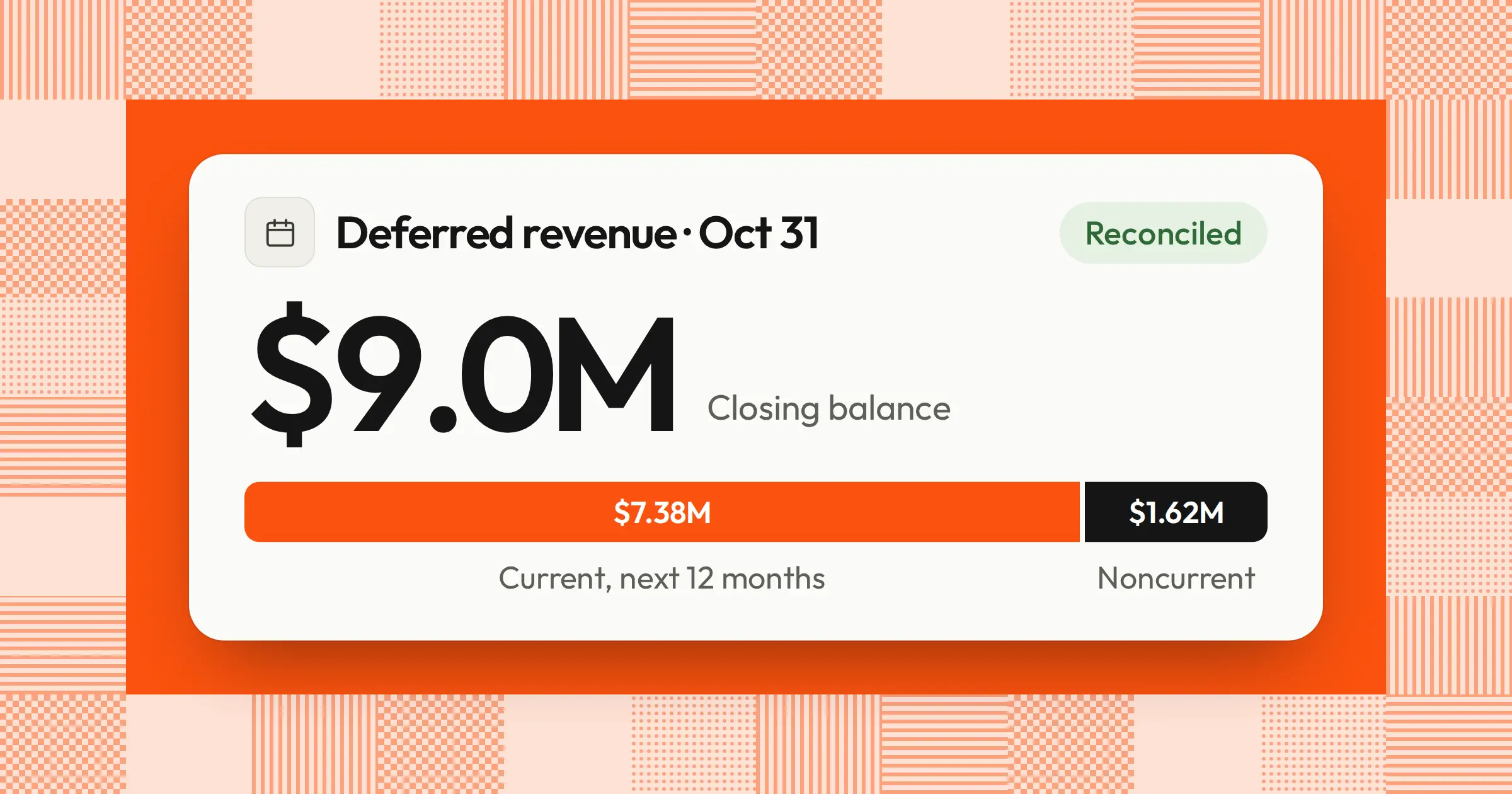
Current, after the entry7,380,000.00
Noncurrent1,620,000.00
After the fix, a deferred revenue waterfall shows when the $9,000,000 turns into revenue. Each row is a group of contracts, and each column is the period in which that balance will be recognized.
| Balance at October 31, 2026 | Total | Nov–Dec 2026 | Jan–Mar 2027 | Apr–Jun 2027 | Jul–Oct 2027 | After October 2027 |
|---|---|---|---|---|---|---|
| Annual contracts billed upfront | $5,700,000 | $2,900,000 | $1,500,000 | $850,000 | $450,000 | $0 |
| Multi-year contracts billed upfront | $2,700,000 | $180,000 | $270,000 | $270,000 | $360,000 | $1,620,000 |
| Quarterly contracts | $600,000 | $600,000 | $0 | $0 | $0 | $0 |
| Total | $9,000,000 | $3,680,000 | $1,770,000 | $1,120,000 | $810,000 | $1,620,000 |
The first four period columns add up to $7,380,000, the current portion due within 12 months. The last column, $1,620,000, is noncurrent. When the balances don't agree, check the common causes of differences in this order:
| What you see | What to check |
|---|---|
| The GL is higher than the billing system | Credit memos or cancellations that didn't sync |
| The GL is lower than the billing system | Invoices that failed to import, or duplicate revenue entries |
| A difference that reverses next month | Cutoff: invoices or credits dated on the last day of the month |
| Activity with no contract behind it | Manual journals posted straight to the account |
| A difference only in foreign currency contracts | Exchange rates applied differently in each system |
Credit memo CM-0412 · cancelled add-on, not synced to the ERP
- Dr 24000 · Deferred revenue28,000.00
- Cr 12000 · Accounts receivable28,000.00
Deferred revenue reconciliation, October 2026
For where this reconciliation sits in the close, see the month-end close process. For the task, its owner, and its reviewer, see the month-end close checklist.
Revenue and cash
- Deferred revenue reconciliationClose AgentIn reviewDWD 2
- Revenue recognition entriesClose AgentSigned offAWD 1
- Current and noncurrent splitClose AgentIn progressAWD 2
- Billing cutoff reviewClose AgentSigned offAWD 1
- Bank reconciliation · Operating accountClose AgentSigned offAWD 1
What happens to deferred revenue in an acquisition?
Under ASU 2021-08, which FASB issued on October 28, 2021, a buyer records the target's deferred revenue as if it had signed the original contracts, instead of writing it down to fair value. That keeps the acquired balance flowing into the buyer's revenue as the service is delivered.
Before the update, acquirers wrote acquired deferred revenue down on the acquisition date, so part of the target's billed revenue never reached the buyer's income statement. Cohen & Co's November 15, 2021, summary notes the update is effective for private companies in fiscal years beginning after December 15, 2023. Salesforce's fiscal 2026 roll-forward shows the effect: its billings line includes $651 million of unearned revenue from its Informatica acquisition.
How is deferred revenue treated for taxes?
For US federal income tax, an accrual-method business with an applicable financial statement can defer an advance payment only to the extent it isn't recognized as revenue in that statement, and only to the next tax year. The rule comes from section 451(c), with final regulations in T.D. 9941, published in the Federal Register on January 6, 2021.
Example
A calendar-year company receives the $360,000 three-year payment on October 1, 2026.
| Year | Book revenue | Taxable income from the payment |
|---|---|---|
| 2026 | $30,000 | $30,000 |
| 2027 | $120,000 | $330,000 |
| 2028 | $120,000 | $0 |
| 2029 | $90,000 | $0 |
| Total | $360,000 | $360,000 |
The book-tax gap from 2027 onward creates a deferred tax asset, so your tax provision needs the same recognition schedule your revenue team uses.
Is deferred revenue good or bad?
A growing deferred revenue balance is a good sign when new and renewed contracts drive it, because customers are committing and paying for future periods. Reading it alongside revenue gives you a view of sales momentum that revenue alone doesn't show.
- Cash flowAn increase in the balance is added back to net income in operating cash flow, so upfront customer payments bring cash in before revenue. If the invoice remains unpaid, the increase in accounts receivable offsets the deferred revenue increase in the operating cash flow reconciliation
- BillingsRevenue plus the change in the balance approximates net billings. In the month-end example, $1,905,000 + ($9,000,000 − $8,640,000) = $2,265,000, which equals billings of $2,310,000 less $45,000 of credits. Salesforce's fiscal 2026 numbers tie the same way: $41,525 million recognized from the balance plus a $3,574 million increase equals $45,099 million of billings and other
- Warning signsA shrinking balance can mean slower bookings, shorter contract terms, or a shift from annual to monthly billing, as the SaaS billing table shows
- ObligationYou still owe the customer the service, and if you can't deliver it, you may have to refund the payment
How we approach it
Our Close Agent reconciles deferred revenue as a task on your close checklist. It ties the general ledger to the contract schedule in your billing system and shows each difference with its amount, date, source, and reference. It then prepares the correcting entry and the workpaper for your reviewer. When data is missing, it stops and asks for it, and nothing posts to your ERP until a named approver signs off. If you want this reconciliation prepared before your team starts the close, explore our Close Agent.
Share this article