Key takeaways
- A zero-day close means your books are reconciled and ready to report on the last day of the month, because reconciliations, accruals, and reviews run during the month instead of after it.
- As of November 2026, no company has published a completed zero-day close: OpenAI's CFO called it a goal in August 2026, and Workday's finance team described it as one in 2022.
- In Ledge's 2025 survey, 18% of finance teams already close in 1–3 business days, so a one- to three-day close is a realistic step before zero for most mid-market teams.
A zero-day close means your books are reconciled, reviewed, and ready to report on the last day of the month. Getting there gives you a current view of the business, catches errors while they're easy to fix, and keeps your team out of month-end overtime. This guide covers what a zero-day close is, who has done it, what it takes, and how realistic it is for a 150-person company, with benchmarks and a worked example.
What is a zero-day close?
A zero-day close means your books are reconciled and ready to report on the last day of the month. It's the end point of a continuous close, where reconciliations, accruals, and reviews run daily or weekly instead of after month-end. For the basics of the close itself, see what is month-end close. Knowing the exact definition helps you set a target your team can measure instead of a slogan.
- Zero-day closeThe period's books are reconciled, reviewed, and ready to report on its last day
- Continuous closeClose tasks such as matching, recurring entries, and reviews run throughout the month on a schedule
- Touchless closeAnother name for the same goal, stressing that routine entries post without a person keying them
The idea has a high-profile backer. In an August 10, 2026, essay, OpenAI CFO Sarah Friar wrote, “We set two bold ambitions: a zero-day close and automated, continuously updated forecasting.” She described the goal as “a real-time, reconciled, and traceable view of the company's financial position.”
Her description of the end state matters more than the name. “The close does not disappear,” she wrote. “What begins to disappear is the scramble to reconstruct the business after the period ends.” People still own the result: “Finance validates the numbers, applies judgment, and owns the final sign-off.”
Zero-day close vs traditional month-end close: What's the difference?
The difference is when the work happens. A traditional close starts after month-end and runs until sign-off, while a zero-day close does the same work during the month so only review and sign-off remain. Comparing the two side by side shows you which tasks have to move before the calendar can shrink.
| Compared on | Traditional month-end close | Zero-day close |
|---|---|---|
| When reconciliations run | After month-end, in one batch | Daily or weekly, as transactions land |
| How accruals and recurring entries post | Prepared by hand during the close | Posted from schedules and open purchase orders during the month |
| When errors surface | Days or weeks after the transaction | Within days, while the context is fresh |
| What's left at period-end | Most of the work | True-ups, the final review, sign-off, and the period lock |
| Typical length | 4–7 business days for 55% of teams (Ledge, 2025) | The last day of the month |
Both still need the same controls. A named approver signs off every entry, the preparer doesn't review their own work, and the period locks after sign-off.
Which finance teams have achieved a zero-day close?
As of November 2026, no company has publicly reported a completed zero-day close. Knowing who has actually done it helps you tell a real benchmark from a marketing claim. The best-known examples describe it as a goal they're working toward:
- OpenAICFO Sarah Friar set a zero-day close as an ambition in August 2026 and told CFO Dive, “We are still building toward both ambitions”
- WorkdayIn a May 2022 Q&A, the company called a zero-day close “the goal our own finance team is working quickly toward,” and reported cutting quarterly board updates “from three days to just a few hours”
- Software vendorsVendors now market zero-day close tooling, but the launch materials checked for this guide name no customer that has completed one
What teams do report is progress on the parts. Workday says pulling data from over 15 sources into one system saves “over 50 hours during the close.” Treat any claim of a finished zero-day close as something to verify. Ask which tasks still happen after month-end.
What does it take to close the books on day zero?
Closing on day zero takes data that arrives daily, matching that runs without a person, and reviews that happen during the month. Breaking the goal into its requirements helps you see which ones you already meet and which ones block you. Each requirement removes a reason to wait for month-end:
- Daily data feedsBank, card, payment processor, payroll, and billing data flow into your ledger every day, not in month-end exports
- Automated matchingBank and processor lines match to ledger entries as they arrive, and only exceptions reach a person
- Scheduled entriesPrepaids, depreciation, and recurring accruals post from schedules, and estimates come from open purchase orders
- Exceptions explained in the monthEach unmatched item is investigated within days, so nothing waits for the close
- Continuous reviewReviewers approve reconciliations and entries weekly, so month-end review covers only what changed
- A period-end lockTrue-ups, the final completeness check, sign-off, and the period lock happen on the last day
The hardest items are usually the inputs you don't control, such as late supplier invoices, payroll files, and revenue data from other teams. Gartner's February 2024 survey of 497 controllership staff found errors “closely linked to concerns about low capacity,” which is why removing steps matters as much as moving them.
Is a zero-day close realistic for a 150-person company?
For most 150-person companies, a one- to three-day close is realistic this year. A true zero-day close depends on data feeds you may not control. The bank, card, and processor work can move into the month quickly, while revenue cutoff, payroll, and late invoices usually still need period-end time. Testing the goal against a company your size helps you set a target you can actually hit this year.
Example
A 150-person SaaS company has a five-person finance team and closes in three business days. During those three days, the team logs 150 hours:
| Close work | Hours in the 3 days | Can it move into the month? |
|---|---|---|
| Bank, card, and processor matching | 45 | Yes, with weekly or daily matching |
| Prepaids, depreciation, and recurring accruals | 25 | Yes, posted from schedules |
| Balance sheet reconciliation prep | 40 | Mostly, reconciled weekly |
| Revenue cutoff, payroll, and late invoices | 25 | No, the inputs arrive after month-end |
| Review, sign-off, and the period lock | 15 | No |
Moving the first three rows takes 45 + 25 + 40 = 110 hours out of the close window, leaving 25 + 15 = 40 hours. Five people working 8-hour days cover 40 hours in one business day, so the close drops from three days to one. The last day disappears only once revenue and payroll data arrive daily too.
The 110 hours don't vanish when they move into the month, though. They only fall if something removes steps, such as matching that runs without a person or accruals that post from a schedule.
How many days does month-end close take? Close speed benchmarks
Most finance teams close in 4–7 business days, and fewer than one in five closes in three days or less. Comparing your close with published benchmarks helps you see how far a zero-day target is from where you are now.
| Source | What it measures | Result |
|---|---|---|
| Ledge survey of 100 finance professionals, 2025 | Business days to close the month | 18% in 1–3 days, 32% in 4–5, 23% in 6–7, and 27% in more than 7 |
| The Hackett Group, June 2025 | Digital World Class finance teams compared with peers | “35%-57% shorter close cycles,” with “up to 42% fewer full-time equivalents” |
For timelines and what a good close looks like, see how long should month-end close take.
Is days to close the right measure of an efficient close?
Days to close is the right measure of speed, but it's incomplete as a measure of efficiency. It counts elapsed time and ignores the hours your team spends before, during, and after the close. Separating speed from effort shows you whether your close is getting easier or just more compressed.
- Close timeBusiness days from month-end until the statements are signed off
- Close effortTotal hours your team spends on close tasks, from the first pre-close task to the last reconciliation
- Hidden workClose effort that days to close does not reveal, such as pre-close prep, overtime, and post-sign-off clean-up
Speed and effort can move in different directions. In Ledge's 2025 survey, cash reconciliation alone took 20–50 hours a month on average, and 37% of respondents named understaffing or capacity gaps as a blocker. A fast close and a heavy workload can both be true.
Does a continuous close reduce work or just move it?
A continuous close moves work first, and it only reduces work when steps get shorter or disappear. Moving bank matching from month-end to every week spreads the same hours across the month. Hours fall only when something removes steps: matching that runs without a person, accruals that post from a schedule, or exceptions explained before anyone investigates them. Measuring hours tells you whether a continuous close is saving your team time or only spreading it out.
If the close drops from six days to three while total hours stay flat, you've changed the calendar, not the workload. If it drops to three days and total hours fall, the process improved. For where automated matching helps and where it doesn't, see does AI make the month-end close more accurate.
How do you measure close effort, not just close days?
Measure close effort by logging hours by task for one full close, then tracking a few ratios every month. A baseline of hours shows you whether changes save time or only shift it.
| Metric | How to calculate it | What it tells you |
|---|---|---|
| Days to close | Business days from month-end to sign-off | How fast the books close |
| Close hours | All hours logged to close tasks, including pre-close work and overtime | The total cost of the close |
| Hours outside the window | Hours before day 1 or after sign-off ÷ close hours | How much work the calendar doesn't show |
| Work finished after sign-off | Reconciliations or entries completed after sign-off | Whether “closed” means done |
| Aged reconciling items | Items older than one month on any reconciliation | Clean-up work carried forward |
| Share reconciled automatically | Transactions matched without a person ÷ all transactions | Whether hours can actually fall |
Example
The same five-person team closes in three business days. Here's where all of its close hours go:
- Week before month-endTwo people spend half their time on close prep: 2 × 4 hours × 5 days = 40 hours
- Close days 1–3All five work 10-hour days: 5 × 10 × 3 = 150 hours, including 5 × 2 × 3 = 30 hours of overtime
- Week after sign-offTwo people finish 12 reconciliations at 2.5 hours each and spend 10 hours on reclasses: 30 + 10 = 40 hours
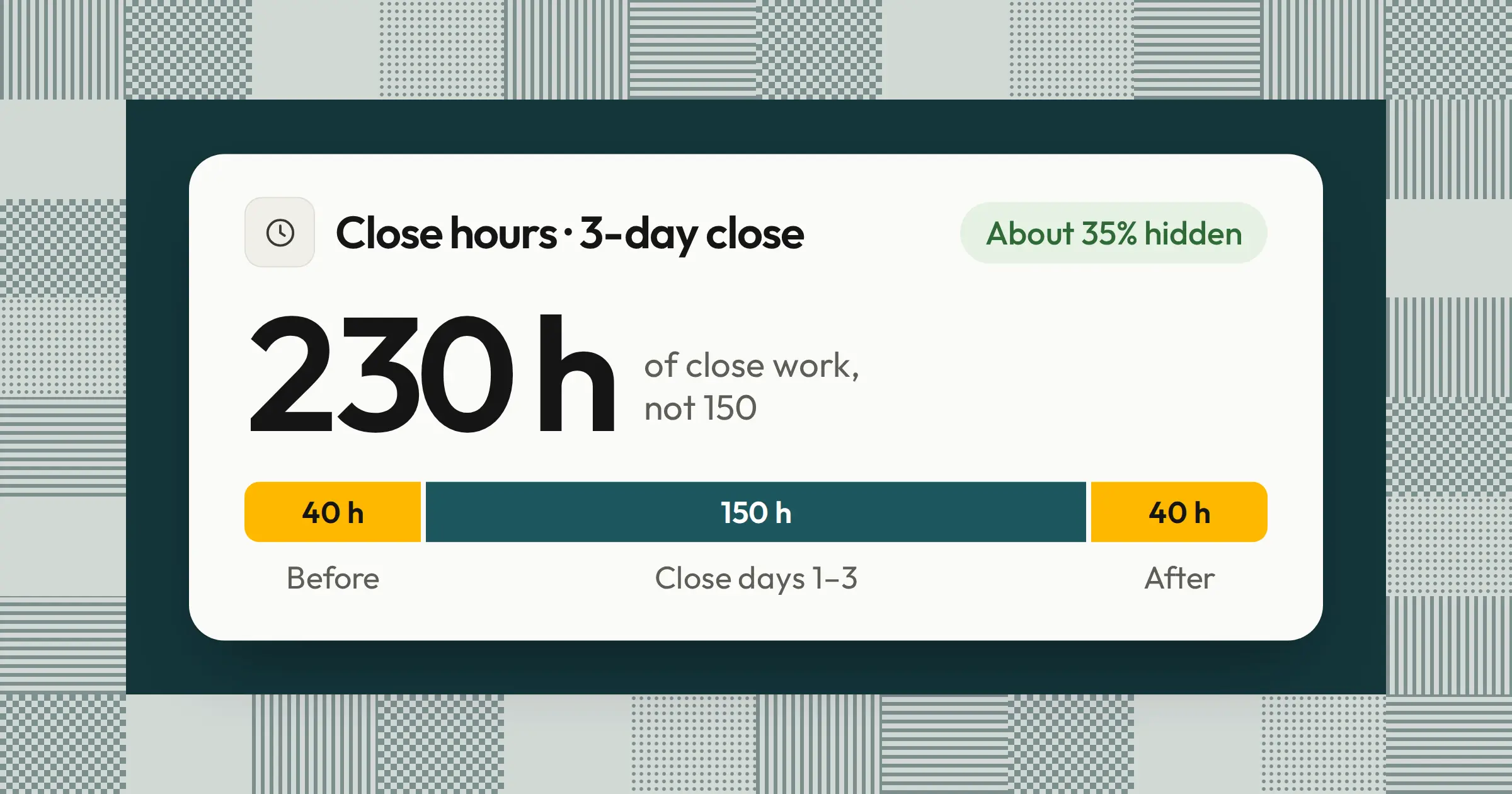
Your close hours are 40 + 150 + 40 = 230. Only 150 of them, about 65%, fall inside the three days. The other 80 hours, about 35%, equal two full 40-hour weeks that days to close never shows.
How do I speed up month-end close without losing controls?
Speed up the close by moving preparation into the month while keeping review, approval, and the period lock at month-end. Separating what can move from what has to wait protects your controls as the close gets shorter.
| Work | What can move into the month | What still happens at period-end |
|---|---|---|
| Bank and card reconciliations | Matching and exception review, daily or weekly | The final statement days and sign-off |
| Recurring entries | Prepaids and depreciation on a schedule | Review of anything that changed |
| Accruals | Estimates from open purchase orders and recurring suppliers | True-ups and the final completeness check |
| Supplier advances | Matching each advance to its invoice as invoices arrive | Review of unmatched advances |
| Management reporting | Commentary drafted on preliminary numbers | Final numbers and CFO review |
- Weekly matching completeTransactions through June 7 matched and exceptions reviewed
- Weekly matching completeTransactions through June 14 matched and exceptions reviewed
- Workpaper submitted for reviewFinal statement days reconciled; named reviewer notified
For the full order of work, see the month-end close process. For each task with its owner and reviewer, see the month-end close checklist.
How we approach it
Our Close Agent works your close checklist through the month on the schedules you set, so matching, reconciliation prep, and scheduled entries happen before month-end. Every task has a named reviewer who's separate from the preparer. If you want to see the preparation move off your team's calendar instead of just earlier in it, explore our Close Agent.
Cash and bank
- Bank reconciliation: operating accountClose AgentSigned offDWD 1
- Bank reconciliation: payroll accountClose AgentIn reviewDWD 1
- Receivables control account tie-outClose AgentIn progressJWD 1
- Payroll accrualClose AgentNot startedAWD 2
- Manual journal testingAlex ChenNot startedDWD 2
Share this article