Key takeaways
- Intercompany accounting records transactions between legal entities in the same group, then removes them on consolidation, because ASC 810 requires intra-entity balances and transactions to be eliminated.
- A group with 6 entities has up to 15 entity pairs to reconcile each month, so you match by pair, account, and currency instead of by total.
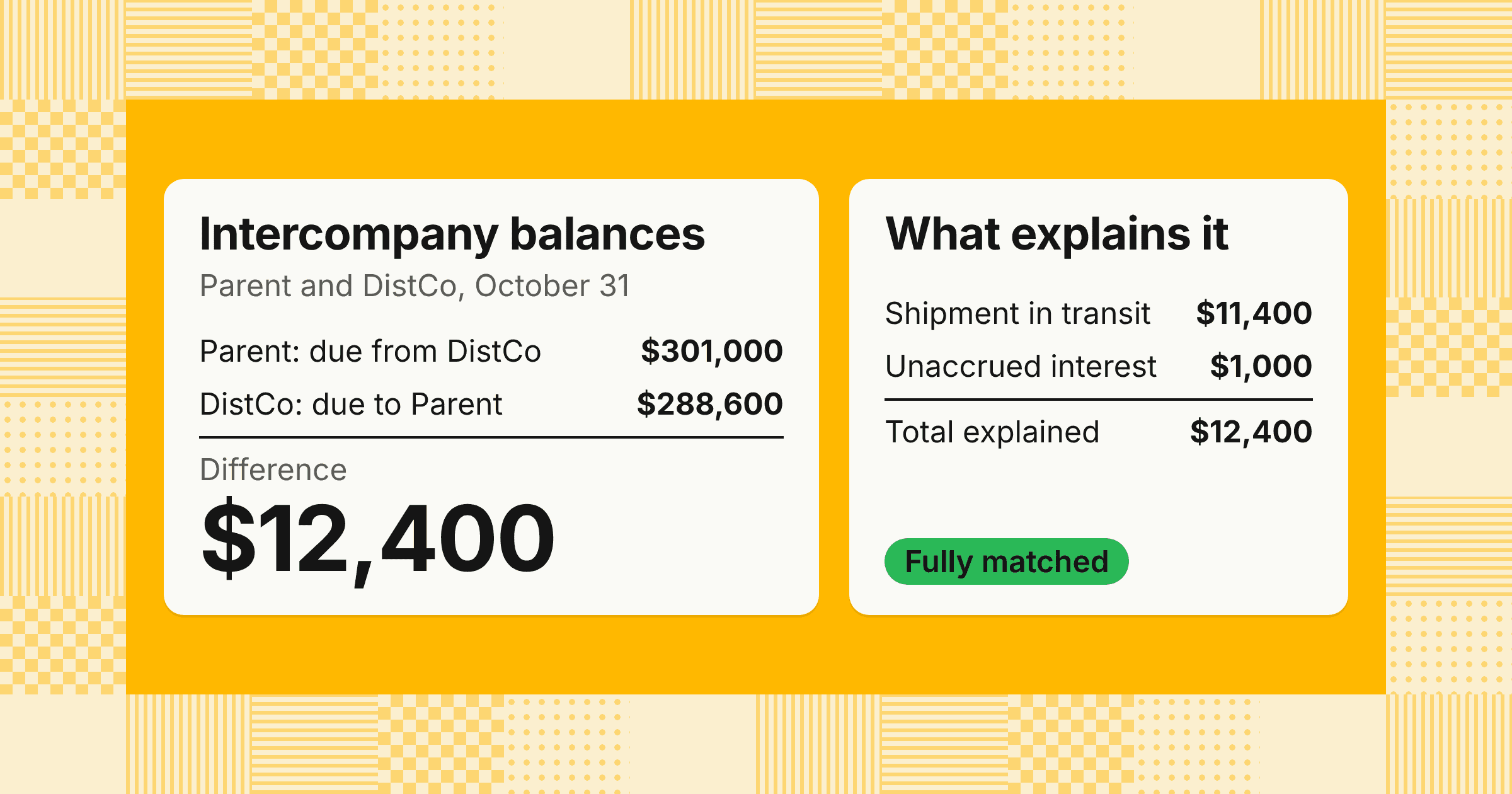
- In the worked example below, a $12,400 mismatch traces to an $11,400 shipment in transit and $1,000 of unaccrued interest, both found by matching at the transaction level.
Intercompany accounting is how you record, reconcile, and eliminate transactions between legal entities that belong to the same corporate group, such as a parent and its subsidiaries. Intercompany reconciliation is the step in the middle, where you confirm that one entity's receivable matches the other entity's payable before you consolidate. Getting this right gives you group statements that show only business with outside parties, catches posting errors before your auditors do, and keeps your close on schedule. This guide covers the journal entries, a step-by-step reconciliation process, eliminations, FX, transfer pricing, and a full worked example across three entities.
What is intercompany accounting?
Knowing exactly what counts as intercompany helps you tag transactions correctly when they happen, instead of sorting them out at month-end.
Intercompany accounting covers any transaction where one entity in your group sells to, buys from, lends to, or charges another entity in the same group. Each entity books the transaction in its own ledger as if it were dealing with an outside party. At consolidation, you remove both sides so the group reports only what it did with customers, suppliers, and lenders outside the group.
- Intercompany transactionA sale, charge, loan, or transfer between two legal entities under common control. You'll also see it called an intragroup or inter-entity transaction.
- Intercompany balanceThe amount one entity owes another at a point in time, recorded as a due-from (receivable) on one side and a due-to (payable) on the other.
- Intercompany eliminationThe consolidation entry that removes matching intercompany balances, revenue, expense, and unrealized profit from the group's statements.
How does intercompany accounting work?
Running the same three steps every month helps your team catch differences while they're still small.
- RecordBoth entities post the transaction in the same period, for the same amount, to mapped intercompany accounts.
- ReconcileEach pair of entities matches its receivables and payables, investigates differences, and posts corrections.
- EliminateYour consolidation team removes the agreed balances and transactions so the group statements show one economic entity.
The rule behind step 3 comes from US GAAP. ASC 810-10-45-1 says “intra-entity balances and transactions shall be eliminated” in consolidated statements, including open account balances, sales, interest, and dividends (PwC Viewpoint, Consolidation guide, section 8.2). IFRS 10 sets the same requirement for groups that report under IFRS.
What are the three main types of intercompany transactions?
Classifying a transaction by direction tells you which entity holds any unrealized profit when you eliminate it.
| Type | Direction | Example |
|---|---|---|
| Downstream | Parent to subsidiary | The parent sells inventory to a distribution subsidiary |
| Upstream | Subsidiary to parent | A subsidiary sells components to the parent or pays it a dividend |
| Lateral | Subsidiary to subsidiary | A UK subsidiary charges a US subsidiary for shared IT support |
Direction matters most when a subsidiary isn't wholly owned. You eliminate the full intercompany profit, whether or not there's a noncontrolling interest. For an upstream sale by a partly owned subsidiary consolidated under the voting interest model, you can make an accounting policy choice to attribute part of that elimination to the noncontrolling interest. That choice isn't available for a variable interest entity (VIE), where the full elimination goes to the parent (PwC Viewpoint, sections 8.2.1 and 8.2.4).
By nature, the transactions you'll handle fall into five groups:
- GoodsInventory sold between entities, often at a markup
- ServicesManagement fees, shared services, and cost allocations
- FinancingIntercompany loans, interest, and cash pooling
- Assets and IPFixed asset transfers, royalties, and license fees
- EquityDividends and capital contributions
What are intercompany expenses?
Intercompany expenses are costs one entity in your group charges another, such as management fees, shared IT or HR services, rent, royalties, and interest on intercompany loans. The charging entity books income, the receiving entity books an expense, and both lines come out on consolidation because the group didn't pay anyone outside itself.
What is the journal entry for intercompany transactions?
Seeing both sides of each entry helps you set up mirrored accounts, which makes matching mechanical.
Every intercompany journal entry has a mirror. One entity debits an intercompany receivable and credits income or cash. The counterparty debits an expense, asset, or cash and credits an intercompany payable for the same amount.
| Transaction | Entity that sells or lends | Entity that buys or borrows |
|---|---|---|
| $50,000 management fee | Dr Intercompany receivable $50,000Cr Management fee income $50,000 | Dr Management fee expense $50,000Cr Intercompany payable $50,000 |
| $200,000 loan | Dr Intercompany loan receivable $200,000Cr Cash $200,000 | Dr Cash $200,000Cr Intercompany loan payable $200,000 |
| $100,000 inventory sale (cost $60,000) | Dr Intercompany receivable $100,000Cr Sales $100,000Dr Cost of goods sold $60,000Cr Inventory $60,000 | Dr Inventory $100,000Cr Intercompany payable $100,000 |
Give each counterparty its own intercompany accounts, or use one shared account with a required counterparty field. Sage Intacct, for example, records inter-entity transactions separately from other receivables and payables. Its Advanced mapping plan assigns accounts to each pair of entities (Sage Intacct Help, Map inter-entity accounts, updated October 23, 2026). For more entry patterns, see month-end journal entries.
Do intercompany transactions need invoices?
You can record an intercompany journal entry without an invoice. Cross-border charges often require an invoice and an intercompany agreement to support VAT, withholding tax, and the transfer price. The rules vary by country, transaction, and tax regime, so confirm local requirements with your tax advisers. Invoices also give both entities a shared reference number, which makes transaction-level matching much faster at month-end.
Worked example: One month of intercompany accounting across three entities
Following one group through a full month shows how each step connects, from the first entry to the final elimination.
Example
Your group has three wholly owned entities:
- Parent (US, USD)Provides management services and funds the group
- DistCo (US, USD)A distribution subsidiary that buys inventory from Parent
- UK Sub (UK, GBP)A sales subsidiary that pays Parent a monthly fee
| Transaction in October | From | To | Amount |
|---|---|---|---|
| Monthly management fee | Parent | UK Sub | $50,000 |
| Loan advanced on October 1 at 6% a year | Parent | DistCo | $200,000 |
| October interest on the loan ($200,000 × 6% ÷ 12) | Parent | DistCo | $1,000 |
| Inventory at a $60,000 cost, in two shipments of $88,600 and $11,400 | Parent | DistCo | $100,000 |
- Loan principalAdvanced October 1 at 6% a year200,000.00
- Loan interestOctober: 200,000.00 × 6% ÷ 121,000.00
- Inventory saleTwo shipments: 88,600.00 and 11,400.00100,000.00
- Management feeBooked October 1 at $1.25 per £150,000.00
4 transactions across 2 pairs, pulled from each entity's ledger
Step 1: Compare balances by pair and account
On October 31, Parent's balances with DistCo don't agree with DistCo's balances with Parent.
| Account | Parent: due from DistCo | DistCo: due to Parent | Difference |
|---|---|---|---|
| Loan principal | $200,000 | $200,000 | $0 |
| Interest | $1,000 | $0 | $1,000 |
| Trade (inventory) | $100,000 | $88,600 | $11,400 |
| Total | $301,000 | $288,600 | $12,400 |
Comparing by account instead of by total tells you right away that the loan agrees and the problem sits in interest and trade.
Step 2: Match at the transaction level
Matching DistCo's ledger to Parent's invoice list shows that DistCo booked the first shipment of $88,600 but not the second of $11,400. Parent shipped the second load on October 31 under FOB shipping point terms, so title passed in October. The goods and paperwork reached DistCo on November 2. DistCo also didn't accrue October interest, because its team waits for Parent's statement.
Example
$11,400 shipment in transit + $1,000 unaccrued interest = $12,400, the full difference.
Step 3: Correct the side that's wrong
Both items belong in DistCo's October books, so DistCo posts the corrections:
| Account | Debit | Credit |
|---|---|---|
| Goods in transit | ||
| Inventory | $11,400 | |
| Intercompany payable (Parent) | $11,400 | |
| Interest accrual | ||
| Interest expense | $1,000 | |
| Intercompany interest payable (Parent) | $1,000 | |
After posting, both sides show $301,000. Fixing the entity that made the error, instead of plugging the difference, keeps each entity's standalone books accurate.
Step 4: Reconcile the cross-currency pair
UK Sub keeps its books in GBP. On October 1 the rate was $1.25 per £1, so UK Sub booked the $50,000 fee as £40,000 of expense and payable. On October 31 the rate was $1.28 per £1, so UK Sub remeasures the USD payable to £39,062.50 ($50,000 ÷ 1.28) and books a £937.50 FX gain.
Reconcile this pair in the transaction currency first: Parent shows a $50,000 receivable, and UK Sub still owes $50,000. The FX gain stays in consolidated net income because the fee is a trade balance due to settle. ASC 830 makes one exception: balances of a long-term-investment nature, where settlement isn't planned in the foreseeable future. FX gains and losses on those go to the cumulative translation adjustment instead (PwC Viewpoint, Foreign currency guide, section 7.5).
When you translate UK Sub's income statement at an average rate of $1.26, its £40,000 expense becomes $50,400 against Parent's $50,000 of income. That $400 is a translation difference, not a posting error, and it goes to a translation or elimination-difference account. NetSuite, for example, posts these exchange rate differences to a Cumulative Translation Adjustment-Elimination (CTA-E) account when it runs elimination (NetSuite Help, Intercompany Elimination Overview).
Step 5: Eliminate on consolidation
Posting eliminations from agreed balances means nothing is left to plug on the group balance sheet.
By October 31, DistCo had sold inventory that cost it $75,000 to outside customers and still held $25,000. Parent's margin on the sale was 40% ($40,000 ÷ $100,000), so $10,000 of profit ($25,000 × 40%) is still unrealized in DistCo's inventory.
| Elimination | Amount |
|---|---|
| Balances with DistCoDr Intercompany payables (DistCo)Cr Intercompany receivables (Parent) | $301,000 |
| Balances with UK SubDr Intercompany payable (UK Sub)Cr Intercompany receivable (Parent) | $50,000 |
| Management feeDr Management fee incomeCr Management fee expense | $50,000 |
| Loan interestDr Interest incomeCr Interest expense | $1,000 |
| Intercompany saleDr SalesCr Cost of goods sold | $100,000 |
| Unrealized profitDr Cost of goods soldCr Inventory | $10,000 |
Example
Combined cost of goods sold before elimination is $135,000 (Parent's $60,000 + DistCo's $75,000). After removing $100,000 and adding back $10,000, consolidated cost of goods sold is $45,000. That equals the group's original cost of the 75% of goods sold to customers ($60,000 × 75%). DistCo's $25,000 of inventory drops to $15,000, the group's cost of the 25% still on hand ($60,000 × 25%).
These entries live in the consolidation worksheet or an elimination entity. They never change Parent's, DistCo's, or UK Sub's own ledgers.
- Balances with DistCoAgreed by both sides after DistCo's corrections301,000.00
- Balances with UK SubAgreed in USD, the transaction currency50,000.00
- Management feeParent's income against UK Sub's expense50,000.00
- Loan interestParent's income against DistCo's accrual1,000.00
- Intercompany saleBoth shipments: 88,600.00 and 11,400.00100,000.00
- Unrealized profit40% margin on 25,000.00 still in DistCo's inventory10,000.00
No residual difference on the consolidated balance sheet
How to prepare an intercompany reconciliation, step by step
A fixed sequence with deadlines helps every entity finish its side before consolidation starts.
- Set a cutoff and a calendarAgree on the last posting date for intercompany charges so both sides book in the same period.
- Pull balances by pairBuild a matrix with every entity on both axes. Six entities give you up to 15 pairs (6 × 5 ÷ 2).
- Match by account and currencyCompare loans, interest, trade, and fees separately, in the transaction currency first.
- Match transactionsUse invoice or reference numbers first, then amount and date windows for items without a shared reference.
- Classify and assign differencesTag each item as timing, missing entry, wrong amount, wrong counterparty, duplicate, or FX, and name an owner.
- Post corrections and confirmThe entity at fault books the fix, and both sides confirm the agreed balance in writing.
- Eliminate and reviewPost eliminations, then check that no residual difference remains on the consolidated balance sheet.
- Set a cutoff and a calendarLast intercompany posting date: October 31Done
- Pull balances by pairParent and DistCo, Parent and UK Sub, DistCo and UK SubDone
- Match by account and currency2 pairs agree · Parent and DistCo differ by 12,400.00Done
- Match transactionsTwo items missing from DistCo's ledgerDone
- Classify and assign differencesGoods in transit 11,400.00 · Missing accrual 1,000.00 · Owner: DistCoDone
- Post corrections and confirmDistCo's two entries posted · both sides confirm 301,000.00Done
- 7Eliminate and review6 eliminations waiting on the Controller's approvalNeeds review
The same discipline applies to every balance sheet account, as covered in account reconciliation. To see where intercompany work sits among the other close tasks, use the month-end close process and the month-end close checklist.
What causes intercompany reconciliation differences?
Knowing the common causes helps you search for them in order instead of reviewing every line.
| Cause | What it looks like | Where to look first |
|---|---|---|
| Timing and cutoff | One side books in October, the other in November | The last 3 and first 3 days around month-end |
| Goods or cash in transit | A shipment or payment was sent but not yet received | Shipping terms and bank value dates |
| Missing accruals | Interest, fees, or allocations booked by one side only | Recurring monthly charges |
| Wrong counterparty or account | A charge posted to the wrong entity or a third-party account | Intercompany lines with no counterparty tag |
| FX | Same transaction-currency amount, different functional-currency amount | Rates used and revaluation runs |
| Duplicates and reversals | An entry posted twice, or last month's accrual never reversed | Manual journals |
Three quick tests narrow the search. Look for a single entry equal to the full difference, then for one equal to half of it, because an entry posted to the wrong side doubles the gap. A $6,200 entry recorded as a debit instead of a credit, for instance, creates a $12,400 difference. If the difference divides evenly by 9, check for transposed digits.
Why is intercompany reconciliation important?
Intercompany reconciliation matters because elimination only works when both sides agree. An unmatched balance either blocks the elimination or leaves a plug that misstates the group's assets, liabilities, revenue, or expense. Reconciled balances also give your auditors and tax team the evidence they need.
Unresolved differences pile up quickly. In an August 2026 thread on r/Accounting, one accountant described spending about four hours on a single intercompany transaction and still leaving a $1,900 difference with an explanatory note. In an earlier r/Accounting discussion from July 2022, a commenter with CPA flair put most intercompany problems down to groups running multiple ERPs, which makes matching hard to automate.
How to settle or restructure intercompany balances
Settling balances regularly reduces revaluation work, FX exposure, and the number of open items you reconcile each month.
An intercompany balance comes off the books only when it's extinguished. Under ASC 405-20-40-1, that happens when the debtor pays the creditor or is legally released from the obligation, either judicially or by the creditor (Deloitte Roadmap, Issuer's Accounting for Debt, section 9.2). Any other change affects how the balance is presented, not whether it still exists.
That leaves four options, and only the first three settle the balance:
- Cash paymentThe debtor pays the creditor, and the balance is extinguished
- NettingTwo entities offset what they owe each other under a netting agreement that legally discharges the offset amounts, and only the net amount is paid
- Capital contributionThe parent legally releases its receivable and contributes it to the subsidiary's equity, with board approval and documented release
- Loan reclassificationA trade payable moves into a documented intercompany loan with terms and interest, which restructures the balance but doesn't settle it
NetSuite's help shows how netting works. When Subsidiary A owes Subsidiary B $1,000 and B owes A $5,000, netting leaves a single $4,000 balance owed by B and cuts four open transactions to two (NetSuite Help, Intercompany Netting). A reclassified loan, by contrast, stays an intercompany balance that you reconcile and eliminate every month.
Each option has tax and accounting effects, including withholding tax, thin capitalization rules, and how FX on the balance is treated. Agree the method with your tax team before you book it.
How does transfer pricing affect intercompany accounting?
Transfer pricing sets the amounts in your intercompany entries, so it shapes both entity results and what auditors test.
Transfer pricing is the price one entity charges another, and tax authorities expect it to match what unrelated parties would charge. In the US, Treasury Regulation § 1.482-1 sets this arm's length standard so that controlled transactions clearly reflect each entity's income. During the close, book charges at the policy rate, compare actual margins with the approved range, and post true-ups before year-end.
Auditors and tax examiners expect the following support for intercompany transactions:
- AgreementsCurrent intercompany agreements, or other evidence of terms, for each recurring charge, loan, and license
- Transfer pricing studyThe method chosen, why, and the benchmarking behind it
- CalculationsHow each charge was computed, tied to invoices and entries
- ReconciliationsMatched balances by pair with preparer and reviewer sign-off
- Elimination supportThe entries posted and how they tie to agreed balances
Timing matters for US filers. To protect against transfer pricing penalties, the IRS says your documentation “must be in existence when the return is filed.” You must also provide it within 30 days of a request (IRS, Transfer pricing documentation FAQs, reviewed June 28, 2026).
How to do intercompany reconciliation in Excel
Excel works when you have a few entities and a few hundred intercompany lines each month.
- Export the detailPut every intercompany line from every entity on one tab with Entity, Counterparty, Account, Currency, Amount, Reference, and Date columns.
- Build the matrixOn a second tab, total each pair with SUMIFS, for example
=SUMIFS(Amount, Entity, "Parent", Counterparty, "DistCo", Account, "IC receivable"), next to the mirror total from DistCo. - Match referencesUse XLOOKUP on the Reference column to find each line's partner and flag lines with no match.
- Show the differenceAdd a difference column for each pair and filter for anything above your rounding tolerance.
Spreadsheets get harder to maintain as entities and volume grow. In a February 2025 thread on r/Netsuite, one user said no single report showed every intercompany account, and another described pulling the general ledger into Excel through ODBC queries just to build sender and receiver pairs.
How to record intercompany transactions in NetSuite, Sage Intacct, QuickBooks, and SAP
Using your ERP's built-in intercompany features gives both sides of each entry the same source, which removes many differences before they start.
- NetSuite OneWorldGo to Transactions > Financial > Make Advanced Intercompany Journal Entries to post one entry with an originating subsidiary and several receiving subsidiaries. At period end, Eliminate Intercompany Transactions is the last task on the Period Close Checklist, after Revalue Open Foreign Currency Balances and Calculate Consolidated Balances.
- Sage IntacctGo to Company > Admin > Subscriptions, select Multi-Entity Management, then Configure, and choose a Basic or Advanced inter-entity account mapping plan. Basic gives each entity one receivable and one payable account, while Advanced maps accounts to each pair of entities.
- QuickBooks (Intuit Enterprise Suite)In the parent company, go to Multi-entity > Overview > Intercompany elimination accounts to choose the accounts removed on consolidation. To post an entry, select + Create > Journal entry and turn on Intercompany transaction, which adds a Company column.
- SAP S/4HANAIntercompany Matching and Reconciliation (ICMR) matches documents across company codes and tracks differences to resolution before consolidation.
Challenges of intercompany accounting
Naming the friction points helps you decide which ones to fix with policy and which ones need better tools.
- VolumePairs grow quickly, from 3 with three entities to 15 with six
- Multiple ERPsEntities on different systems use different account codes, references, and close calendars
- FXRates, revaluation runs, and translation create differences that aren't errors
- OwnershipEach side waits for the other, so no one owns the difference
- DocumentationMissing agreements weaken both the audit file and the transfer price
Best practices for intercompany accounting
A written set of rules helps every entity book the same transaction the same way.
- Write an intercompany policySet who bills, cutoff dates, the transaction currency, settlement terms, and how disputes are resolved
- Tag the counterparty on every lineMapped accounts or a required counterparty field make pair-level reporting possible
- Reconcile during the monthMatching weekly leaves only the last few days of activity for month-end
- Settle or net every monthFewer open balances mean less revaluation and fewer FX differences
- Bill in one currency per chargeReconcile in that currency before you compare functional-currency amounts
- Keep agreements currentDocument the terms of each recurring charge in an intercompany agreement that matches the transfer pricing policy
- Never plugPost only supported corrections, and carry any open item forward with an owner and a due date
Can AI automate intercompany reconciliation?
AI can handle most of the matching and preparation work, while your team keeps the judgment calls and approvals.
AI agents can pull detail from each entity's ledger and match transactions even when references don't line up. They can also classify differences as timing, FX, or missing entries, and draft corrections and eliminations. Your team should still review low-confidence matches, approve every posting, decide disputed or material items, and own transfer pricing, tax, and accounting judgments.
When you compare intercompany reconciliation software, test it on one real month of your own data and check four things:
- Data accessIt pulls detail from every ERP and entity you run, not only one
- MatchingIt matches at the transaction level, across currencies and partial references
- ExceptionsIt routes each difference to an owner with the evidence attached
- Audit trailIt prepares eliminations and records who did what, when, and why
If you want to see how AI agents can match intercompany activity and prepare eliminations for your team, explore our Close Agent.
Share this article