Key takeaways
- Cash reconciliation ties every cash account in your general ledger to an independent record (bank statements, processor reports, and physical counts), while a bank reconciliation covers one bank account.
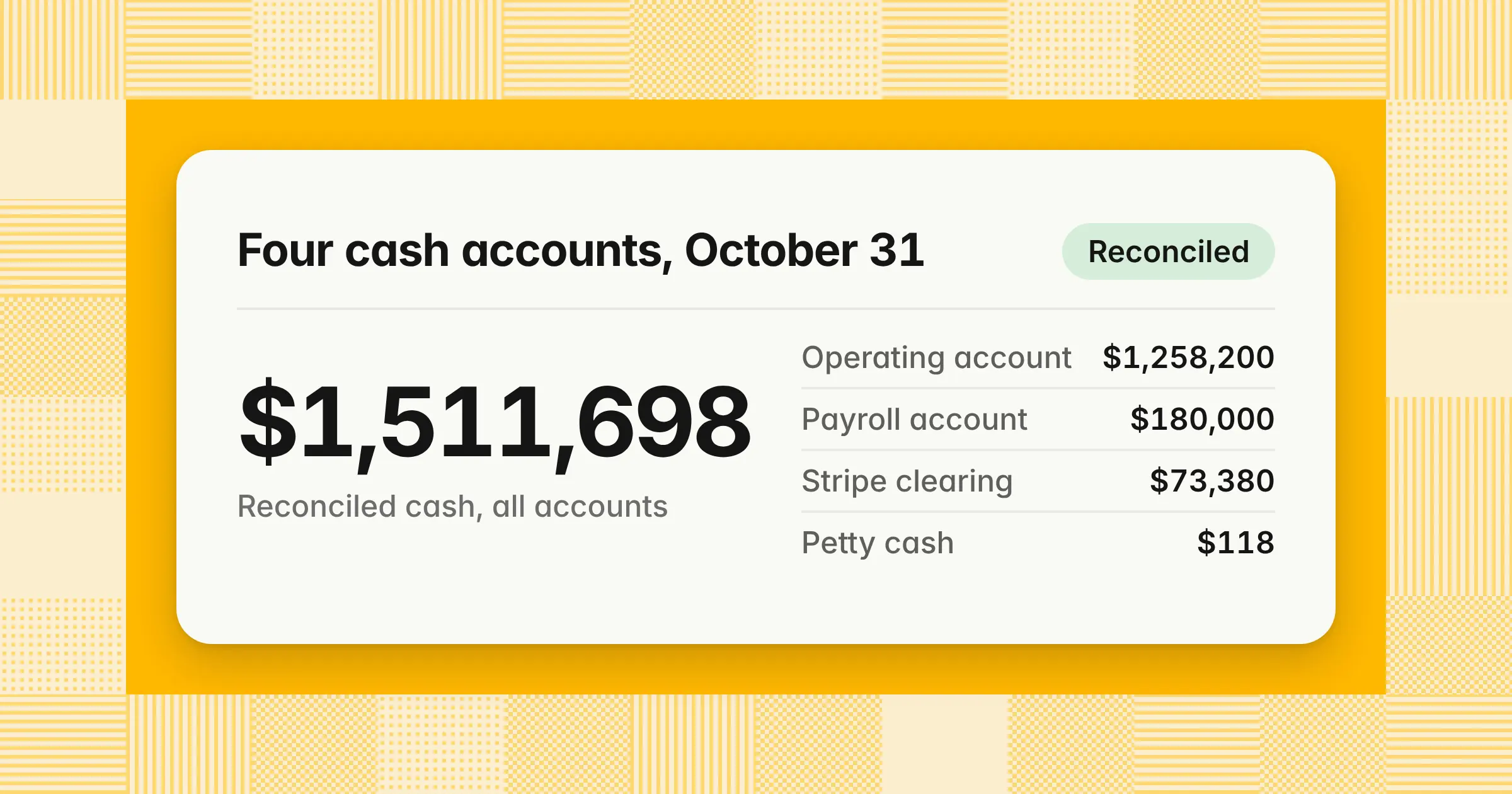
- In the worked example, four cash accounts start $26,238 away from their outside balances, and seven journal entries bring book cash from $1,517,110 to a reconciled $1,511,698.
- A common practice is to reconcile processors, high-volume bank accounts, and cash drawers daily and every cash account at least monthly; the ACFE's 2026 Report to the Nations found a lack of internal controls was the primary weakness in 33% of 2,402 fraud cases.
Cash reconciliation is the process of comparing the cash balances in your general ledger with an independent record, such as a bank statement, a payment processor report, or a cash count, and explaining every difference. Getting it right gives you a cash number leadership can trust, catches errors and theft early, and keeps your close audit-ready. This guide works through one company's month-end close across two bank accounts, Stripe, and petty cash. It then covers the process, a template, daily and retail reconciliations, and the controls that make the numbers hold up.
What is cash reconciliation in accounting?
In accounting, cash reconciliation proves that each ledger cash account agrees with an outside source on the same date, with every difference explained. It's one type of account reconciliation, and a reconciliation of cash is a good place to start your balance sheet reconciliation at month-end, because receivables, payables, and payroll all run through cash.
- Cash accountsEvery ledger account that holds cash or near-cash: operating and payroll bank accounts, money market accounts, processor clearing accounts, petty cash, cash drawers, and cash in transit
- Reconciling itemA difference between the book balance and the outside balance, either a timing difference that clears on its own or a book-side item that needs a journal entry
- Adjusted balanceThe balance both sides agree on after reconciling items. It's the figure that goes on the balance sheet.
Whether a processor balance, such as funds held in Stripe, counts as cash depends on whether it meets the definition of cash, which the FASB's glossary describes as currency on hand and demand deposits with banks or other financial institutions. Your rights to the funds and any restrictions in the processor agreement decide it. If the balance doesn't meet that definition, present it as a receivable, and if an agreement restricts it, present it as restricted cash. Either way, you reconcile it with the same method and the same rigor.
Cash reconciliation example: One company's October close
This example shows a full month-end cash reconciliation across four accounts, so you can see how bank, processor, and petty cash items fit together.
Example
A subscription software company with about $40 million in annual revenue closes October 2026. It holds cash in an operating account, a payroll account, a Stripe clearing account, and a $500 petty cash fund. All amounts are illustrative.
Cash reconciliation summary, October 31, 2026
| Account | Balance per books | Balance per outside source | Adjusted balance | Book-side items |
|---|---|---|---|---|
| 10100 Operating accountBank statement | $1,247,900 | $1,284,600 | $1,258,200 | 3 |
| 10200 Payroll accountBank statement | $180,000 | $186,450 | $180,000 | 0 |
| 10300 Stripe clearingStripe balance report | $88,710 | $72,180 | $73,380 | 4 |
| 10400 Petty cashCash count | $500 | $118 | $118 | 1 |
| Total cash | $1,517,110 | $1,543,348 | $1,511,698 | 8 |
The eight book-side items need seven journal entries, because one Stripe payout appears on both the operating and Stripe reconciliations. This example assumes the company can withdraw its Stripe balance on demand and no agreement restricts it, so the balance is included in cash. On that assumption, the $1,511,698 adjusted total is the cash figure for the October 31 balance sheet.
Operating account: Bank statement to general ledger
The operating account has two timing items on the bank side and three unrecorded items on the book side.
| Operating account (10100) | Amount |
|---|---|
| Balance per bank statement, October 31 | $1,284,600 |
| Add: deposit in transit, customer checks deposited October 30, credited by the bank November 2 | 36,000 |
| Less: outstanding payments, vendor ACH run released October 30 ($54,000) and check 2215 ($8,400) | (62,400) |
| Adjusted bank balance | $1,258,200 |
| Balance per books, October 31 | $1,247,900 |
| Add: Stripe payout received October 30, not yet recorded | 9,370 |
| Add: October interest credited by the bank | 1,240 |
| Less: October bank service fees | (310) |
| Adjusted book balance | $1,258,200 |
Both sides agree at $1,258,200, and the deposit in transit and outstanding payments clear in November with no entry. The three book-side items need journal entries.
Payroll account: Timing only
The payroll account shows $186,450 at the bank and $180,000 on the books. The $6,450 gap is October payroll checks that employees haven't cashed yet. The adjusted balance is $180,000 on both sides, and no entry is needed.
Stripe clearing: Processor report to general ledger
The Stripe clearing account holds card sales recorded from the billing system that Stripe hasn't paid out yet. Fees, refunds, and chargebacks come out of the Stripe balance first, so they show up as book-side items.
| Stripe clearing (10300) | Amount |
|---|---|
| Ending balance per Stripe balance report, October 31 | $72,180 |
| Add: card charge captured at 9:40 p.m. Pacific on October 31, dated November 1 in a report run in UTC | 1,200 |
| Adjusted processor balance | $73,380 |
| Balance per books, October 31 | $88,710 |
| Less: October 30 payout to the operating account, not yet recorded | (9,370) |
| Less: October processing fees per Stripe | (3,870) |
| Less: customer refunds issued in Stripe but not in the billing system | (1,450) |
| Less: chargeback lost in a customer dispute | (640) |
| Adjusted book balance | $73,380 |
The $1,200 charge is a cutoff difference, not an error. Stripe's payout reconciliation documentation (accessed November 2026) says report dates use UTC unless you request a time zone. Run the report in your ledger's time zone.
Petty cash: Count to general ledger
Petty cash runs on an imprest fund of $500, so the cash in the box plus the receipts should total $500.
| Petty cash (10400) | Amount |
|---|---|
| Fund balance per books | $500 |
| Cash counted October 31 | 118 |
| Receipts in the box: office supplies $214, team meals $97, postage $60 | 371 |
| Cash plus receipts | 489 |
| Shortage | 11 |
The entry records $371 of expenses and the $11 shortage, which brings the book balance down to the $118 counted. A $382 replenishment check in November restores the fund to $500.
Journal entries from the reconciliation
These seven entries clear every book-side item and total $17,262 in debits and credits.
| Account | Debit | Credit |
|---|---|---|
| 1. Stripe payout received | ||
| 10100 Operating account | 9,370 | |
| 10300 Stripe clearing | 9,370 | |
| 2. Interest earned | ||
| 10100 Operating account | 1,240 | |
| Interest income | 1,240 | |
| 3. Bank service fees | ||
| Bank fees expense | 310 | |
| 10100 Operating account | 310 | |
| 4. Processing fees | ||
| Merchant processing fees | 3,870 | |
| 10300 Stripe clearing | 3,870 | |
| 5. Customer refunds | ||
| Sales refunds (contra revenue) | 1,450 | |
| 10300 Stripe clearing | 1,450 | |
| 6. Lost chargeback | ||
| Chargeback losses (or contra revenue, per policy) | 640 | |
| 10300 Stripe clearing | 640 | |
| 7. Petty cash expenses | ||
| Office supplies | 214 | |
| Meals | 97 | |
| Postage | 60 | |
| Cash over and short | 11 | |
| 10400 Petty cash | 382 | |
| Total | 17,262 | 17,262 |
The entries reduce total cash by $5,412: $1,240 of interest less $6,652 of fees, refunds, chargebacks, and petty cash expenses ($310 + $3,870 + $1,450 + $640 + $382). The change takes book cash from $1,517,110 to $1,511,698. Entry 1 moves cash between two of the company's own accounts, so it doesn't change the total.
How do you do a cash reconciliation?
To do a cash reconciliation, pull an outside balance for every cash account at one cutoff, match it to the ledger, explain each difference, book the entries, and get a review. Following the same seven steps each period keeps the cash reconciliation process consistent across preparers.
- List every cash account in scopeBank, money market, processor clearing, petty cash, drawers, and cash in transit, each with an owner and a frequency
- Pull the outside balance for eachBank statements, processor balance reports, and counts, all at the same cutoff date and time zone
- Match transactionsPair ledger entries with bank and processor lines, including one payout to many charges
- Classify each differenceTiming items that clear on their own, book-side items that need an entry, and errors to investigate
- Post journal entriesRecord fees, interest, refunds, chargebacks, and unrecorded receipts in the period they belong to
- Prove the totalsConfirm each adjusted balance agrees and total cash ties to the trial balance
- Review and sign offA reviewer who didn't prepare it checks the support, approves the entries, and ages the open items
Each account uses the same pair of formulas:
- Adjusted outside balanceOutside balance + receipts in transit − outstanding payments ± outside errors
- Adjusted book balanceBook balance + unrecorded receipts − unrecorded charges ± book errors
The cash reconciliation is complete when the two agree. Put each cash account on your month-end close checklist with its preparer, reviewer, and due date.
Is a bank reconciliation the same as a cash reconciliation?
No, a bank reconciliation covers one bank account, while a cash reconciliation covers every place you hold cash, including processors, petty cash, and drawers. Only the cash reconciliation proves the total cash on the balance sheet.
| Aspect | Cash reconciliation | Bank reconciliation |
|---|---|---|
| Scope | Every cash account: bank, processor balances, petty cash, drawers, and cash in transit | One bank account |
| Outside record | Bank statements, processor reports, POS reports, and physical counts | The bank statement |
| Typical reconciling items | Processor fees, refunds, chargebacks, payout timing, and count shortages, plus every bank item | Deposits in transit, outstanding checks, bank fees, interest, and returned checks |
| How often | Commonly daily for drawers and processors, and at least monthly for every account | Commonly at least monthly |
| Output | A total cash position that ties to the balance sheet | An adjusted balance for one account |
The terms overlap in practice: AccountingTools (May 2026) defines cash reconciliation as verifying the cash in a register at the close of business. In retail, the term can mean the drawer count alone. For the statement format and a single-account walkthrough, see the guide to bank reconciliation.
Daily vs. monthly cash reconciliation
Daily cash reconciliation catches problems on high-volume accounts within a day, while monthly cash reconciliation is the signed reconciliation of every cash account behind the balance sheet. You'll often need both, at different depths.
| Aspect | Daily cash reconciliation | Monthly cash reconciliation |
|---|---|---|
| What you compare | Yesterday's bank activity, processor payouts, and drawer counts against what posted | Every cash account's ending balance against statements, reports, and counts |
| Who does it | Treasury, accounts receivable, or store managers | General accounting, reviewed by the controller |
| Output | An exceptions list and a daily cash position | A signed reconciliation per account, with support and journal entries |
| Best for | Operating accounts, processor clearing, and cash drawers | All cash accounts, including low-activity accounts and petty cash |
| What it catches | Failed payouts, duplicate debits, unexpected ACH debits, and drawer shortages | Unrecorded fees and interest, cutoff errors, and stale open items |
Daily matching shortens the month-end work, but it doesn't replace the signed month-end reconciliation for each account.
How do you reconcile cash position across banks and payment processors?
Cash position reconciliation ties total cash across every bank and processor to the general ledger at one cutoff, so treasury's cash report matches the balance sheet. Four habits keep it accurate.
- Use one cutoff and time zoneStripe's documentation (accessed November 2026) says its payout report groups payouts by estimated arrival date, not the date your bank posts the deposit
- Break payouts into their partsA payout is the net of charges, refunds, disputes, and fees. Stripe's itemized payout report lists every transaction behind each one.
- Record both sides of internal transfersMoney moving between your own accounts should leave one and arrive in the other in the same period, or sit in a cash-in-transit account
- Reconcile foreign accounts in their own currency firstThen translate the reconciled balance at the period-end rate
In the example, the $9,370 payout was in the bank on October 30 but still sat in Stripe clearing on the books. Reconciling each account alone would flag it twice, while reconciling the cash position shows it's one transfer and one entry.
What is 3-way reconciliation?
A three-way reconciliation compares three records that should agree, instead of two. In trust accounting, it compares the adjusted bank balance, the trust account journal, and the total of the individual client ledgers.
The State Bar of California's Monthly Trust Account Reconciliation and Review Certification form (accessed November 2026) lists exactly those three balances and asks whether all three agree. The same method works for any account that holds client funds, such as escrow or property management trust accounts.
Companies that sell through a processor run a similar check: billing system to processor, and processor to bank. In the example, that means October's invoices in the billing system, the Stripe balance report, and the payouts that landed in the operating account. Don't confuse it with the three-way match in accounts payable, which compares a purchase order, a receipt, and an invoice.
How do you do a petty cash reconciliation?
To reconcile petty cash, count the cash in the box, add up the receipts, and compare the total with the fund balance in the general ledger. Any gap is recorded as cash over and short.
- Count the cashHave someone other than the custodian count it, with the custodian present
- Total the receiptsGroup them by expense account and confirm each one is approved
- Compare with the fundCash plus receipts should equal the imprest balance
- Record the entryDebit each expense and any shortage, and credit petty cash or the bank account used to replenish
- Replenish and signWrite the replenishment check for the amount that restores the imprest balance (receipts plus any shortage) and have the custodian and reviewer sign
A petty cash reconciliation template needs six lines: fund balance, cash counted, receipts by expense account, cash plus receipts, over or short, and replenishment amount. The petty cash example above shows the first five lines, and its $382 replenishment is the sixth.
How do you reconcile a cash drawer?
To reconcile a cash drawer, count it at the end of the shift, subtract the opening float, and compare the result with cash sales less cash refunds on the point-of-sale (POS) report.
Example
A store opens a register with a $200.00 float. The POS report shows $1,846.50 of cash sales and $40.00 of cash refunds, so the drawer should hold $2,006.50. The count is $2,001.50, a $5.00 shortage.
| Line | Amount |
|---|---|
| Opening float | $200.00 |
| Add: cash sales per POS | 1,846.50 |
| Less: cash refunds per POS | (40.00) |
| Expected cash in drawer | 2,006.50 |
| Counted cash | 2,001.50 |
| Over (short) | (5.00) |
| Deposit (counted cash less the $200 float) | 1,801.50 |
The entry debits cash for the $1,801.50 deposit, cash over and short for $5.00, and sales refunds for $40.00, and credits sales for $1,846.50. Have the cashier and a supervisor count together and sign, and set a dollar threshold above which a shortage gets written up.
How do you do a proof of cash?
A proof of cash reconciles four columns between the bank and your books: the beginning balance, receipts, disbursements, and ending balance. It catches errors that an ending-balance reconciliation can hide.
Example
The operating account from the October example, proved in four columns.
| Operating account (10100) | September 30 | October receipts | October disbursements | October 31 |
|---|---|---|---|---|
| Per bank statement | $1,102,400 | $2,410,000 | $2,227,800 | $1,284,600 |
| Deposit in transit, September 30 | 22,000 | (22,000) | ||
| Deposit in transit, October 31 | 36,000 | 36,000 | ||
| Outstanding payments, September 30 | (41,500) | (41,500) | ||
| Outstanding payments, October 31 | 62,400 | (62,400) | ||
| Adjusted bank | $1,082,900 | $2,424,000 | $2,248,700 | $1,258,200 |
| Per books | $1,082,900 | $2,413,390 | $2,248,390 | $1,247,900 |
| Unrecorded Stripe payout | 9,370 | 9,370 | ||
| Unrecorded interest | 1,240 | 1,240 | ||
| Unrecorded bank fees | 310 | (310) | ||
| Adjusted books | $1,082,900 | $2,424,000 | $2,248,700 | $1,258,200 |
Each row proves across: beginning balance plus receipts less disbursements equals the ending balance. If receipts and disbursements were both overstated by the same amount, the ending balances would still agree, but the receipts and disbursements columns wouldn't. AccountingTools (September 2026) notes that auditors often request a proof of cash to verify cash transactions.
Cash reconciliation template: What to include
A cash reconciliation template, or format, needs seven parts: a header, the outside balance and its adjustments, the book balance and its adjustments, a zero difference line, open items, proposed entries, and sign-offs. Copy this format into a spreadsheet, with one tab per account and a summary tab like the one in the example.
| Section | Line | What goes here |
|---|---|---|
| Header | Account | Name, number, bank or processor, and currency |
| Period | Cutoff date and time zone | |
| Preparer and reviewer | Names and sign-off dates | |
| A. Outside side | Balance per outside source | Statement, processor report, or count, with the file attached |
| Add: receipts in transit | Each item with date and reference | |
| Less: outstanding payments | Each item with date and reference | |
| Adjusted outside balance | Formula: balance + receipts in transit − outstanding payments | |
| B. Book side | Balance per books | From the trial balance for the same date |
| Add: unrecorded receipts | Interest, payouts, and deposits not yet booked | |
| Less: unrecorded charges | Fees, refunds, chargebacks, and returned items | |
| Adjusted book balance | Formula: balance + unrecorded receipts − unrecorded charges | |
| C. Proof | Difference | Adjusted outside balance less adjusted book balance. Must be $0. |
| D. Open items | Item list | Date, description, amount, type (timing, book, or error), age, and owner |
| E. Entries | Proposed journal entries | Entry number, accounts, amounts, and support |
| F. Sign-off | Preparer and reviewer | Signatures and dates |
For a cash reconciliation template in Excel, lock the prior month's tab after sign-off. Pull the book balance from the trial balance export instead of typing it. Add an age column so the reviewer sees stale open items.
What controls keep cash reconciliation reliable?
The core control is segregation of duties: the person who handles cash or records it shouldn't be the person who reconciles it, and a separate reviewer should approve the result. In the ACFE's Occupational Fraud 2026: A Report to the Nations, a lack of internal controls was the primary weakness in 33% of 2,402 cases.
| Duty | Who does it | Who shouldn't |
|---|---|---|
| Custody | Cashier, office manager, or treasury: handles drawers, petty cash, deposits, and processor settings | Anyone who reconciles the same account |
| Recording | Accounts receivable or accounts payable accountant: posts receipts and payments | The custodian of the same cash |
| Reconciling | Staff or senior accountant: prepares the cash reconciliation | Anyone with custody or posting rights for that account |
| Reviewing | Controller or accounting manager: approves the reconciliation and its entries | The preparer |
Add these controls on top of the split:
- Get statements straight from the sourceUse bank feeds or portal downloads, never PDFs forwarded by someone with custody
- Run surprise counts and auditsThe ACFE's 2026 report found a median loss of $74,000 at organizations with surprise audits, against $149,000 without
- Count drawers and petty cash with two peopleBoth sign the count sheet
- Limit payment accessRestrict who can add payees, change bank details, or release ACH and wire payments
- Age and escalate open itemsInvestigate items past an age your policy sets as a review trigger, such as 30 days, and write off nothing without approval
- Set a deadlineFinish cash reconciliations within a fixed number of business days after month-end
In a small team where you can't split every duty, the owner or CFO should review bank statements and the reconciliation directly each month.
What are red flags on bank statements?
Red flags on bank statements are transactions that don't fit your normal pattern: unknown payees, round-dollar transfers, missing or out-of-sequence checks, duplicate payments, and transfers between your own accounts near month-end. Each one deserves a question during review.
- Unknown payees or new ACH debitsPayments to names that aren't in your vendor master
- Round-dollar or repeated amountsTransfers of exactly $5,000 or the same odd amount every few days
- Check problemsMissing numbers, checks out of sequence, or a cleared payee name that differs from the one in your books
- Duplicate paymentsThe same vendor, amount, and invoice paid twice
- Deposits that lag salesCash sales recorded today but deposited days later, or deposits smaller than the POS totals
- Transfers around month-endMoney moved between your own accounts on the last day and back on the first
- Altered statementsFonts, totals, or running balances that don't add up on a PDF
The ACFE's 2026 report shows why cash gets this scrutiny: each of these cash schemes appeared in 8–10% of the 2,402 cases it studied.
| Scheme (ACFE, 2026) | Share of cases | Median loss |
|---|---|---|
| Check and payment tampering | 10% | $114,000 |
| Theft of cash on hand | 10% | $20,000 |
| Skimming (taking cash before it's recorded) | 9% | $45,000 |
| Cash larceny (taking cash after it's recorded) | 8% | $45,000 |
What should cash reconciliation software do?
Cash reconciliation software should pull bank and processor data, match it to the ledger with rules, route exceptions to a reviewer, and log every sign-off. That moves your team's time from ticking to investigating.
Look for direct bank feeds, processor files such as Stripe payout reports, and one-to-many matching. You also want proposed entries for fees and interest, aging of open items, and reviewer sign-offs. For a comparison of tools, see the guide to the best account reconciliation software.
Is cash reconciliation the same as cash flow reconciliation?
No, cash reconciliation proves cash balances against outside records, while cash flow reconciliation ties net income to cash from operations on the cash flow statement.
The two meet at month-end. The cash flow statement's ending total should reconcile to cash, cash equivalents, and restricted cash across the balance sheet, which the FASB's ASU 2016-18 (November 2016) requires the statement to explain. In this simplified example, that total is $1,511,698.
How we approach it
We built our Close Agent to prepare your bank and cash reconciliations, matching every statement line to the ledger and drafting a balanced entry for anything missing, such as a bank fee. A named approver signs off on the exact lines before the entry posts to NetSuite, Oracle, SAP S/4HANA, Microsoft Dynamics 365, Business Central, or QuickBooks. If you want cash reconciled before your team starts the close, explore our Close Agent.
Share this article