Key takeaways
- Balance sheet reconciliation compares every asset, liability, and equity balance in the general ledger to independent support, explains each difference, and gets a second person's sign-off before the period locks.
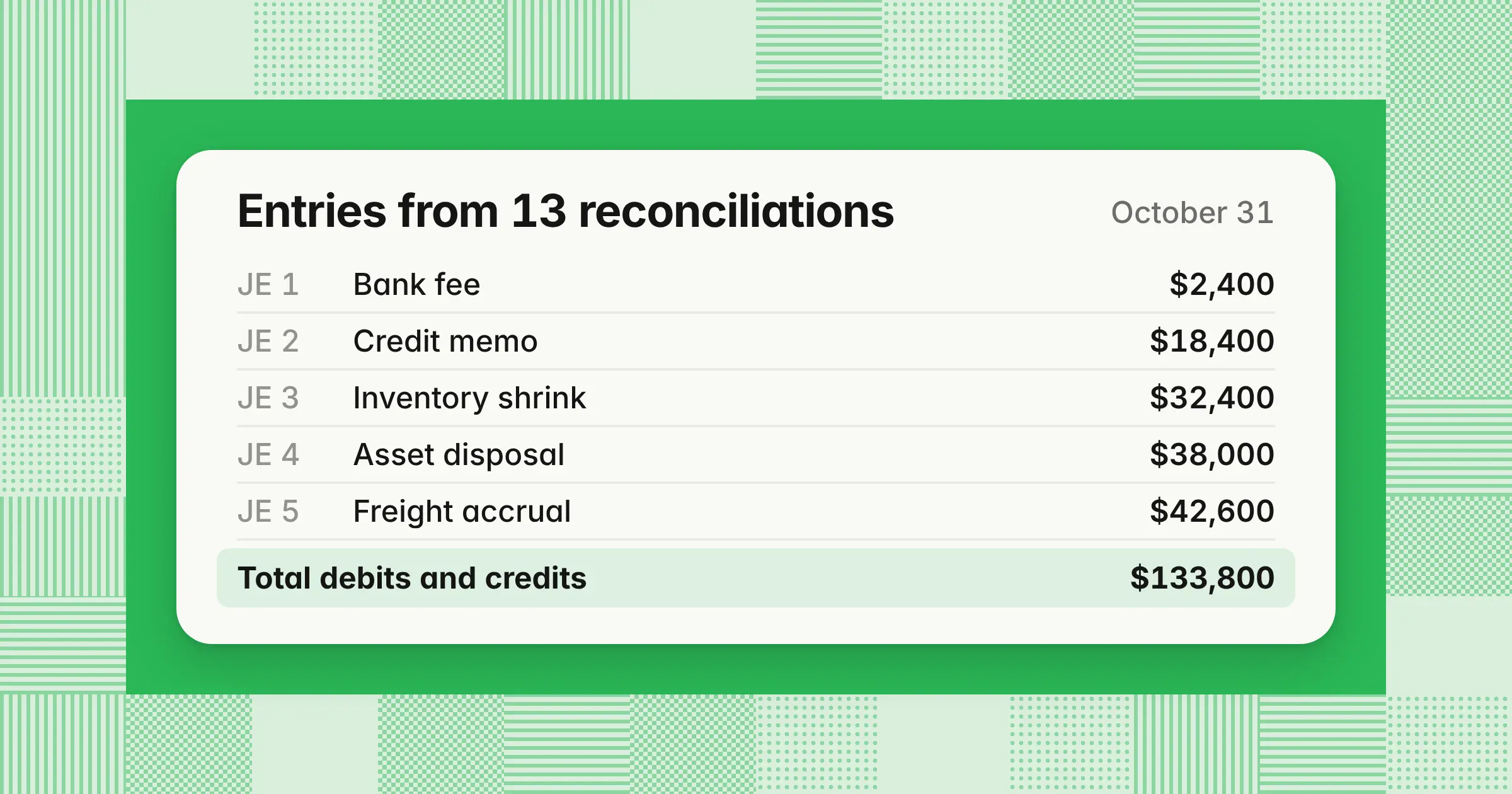
- In the worked example, reconciling 13 accounts at October 31, 2026, produces five journal entries totaling $133,800, lowers pre-tax income by $95,800, and leaves one $640 difference documented under a $5,000 threshold.
- Reconcile high-risk accounts such as cash, receivables, inventory, accruals, and intercompany every month, reconcile low-risk accounts at least quarterly, and write down your thresholds for investigating differences and escalating aged items.
Balance sheet reconciliation is the month-end control of comparing each balance sheet account in the general ledger to independent support, such as a bank statement or subledger, and explaining every difference. Getting it right gives you financial statements you can stand behind, catches missed entries before they reach your reporting, and keeps your close audit-ready. This guide covers which accounts to reconcile, a full October example with journal entries, a template, and a reviewer checklist.
What is balance sheet reconciliation?
Balance sheet reconciliation proves that every asset, liability, and equity balance at period end is backed by evidence from outside the general ledger. It's one type of account reconciliation, run across the whole balance sheet as a month-end close control. Teams also call it balance sheet account reconciliation or reconciliation of balance sheet accounts.
- Supporting balanceThe balance from an independent source, such as a bank statement, AR aging, fixed asset register, or lender statement
- Reconciling itemA specific, documented reason the GL and the support differ, such as a deposit in transit or an entry that wasn't posted
- Unexplained differenceWhat's left after every reconciling item, which must be zero or under your written threshold before sign-off
Which balance sheet accounts need reconciliation?
Every balance sheet account with a balance or activity in the period needs a reconciliation, but the support and the frequency differ by account. Use this table to set up your account list.
| Account | Reconcile it against | How often | Common reconciling items |
|---|---|---|---|
| Cash and cash equivalents | Bank and investment statements | Monthly, or daily for high-volume accounts | Deposits in transit, outstanding checks, unrecorded bank fees |
| Accounts receivable | AR aging subledger, plus customer confirmations for large balances | Monthly | Credit memos that didn't post, unapplied cash, integration errors |
| Inventory | Perpetual inventory valuation report, tied to physical or cycle counts | Monthly, plus after each count | Shrink, receipts not yet costed, goods in transit |
| Prepaid expenses | Prepaid amortization schedule and the underlying invoices | Monthly | Missed amortization, new prepayments expensed in full |
| Fixed assets and accumulated depreciation | Fixed asset register and the depreciation run | Monthly | Disposals not removed, assets in service but not capitalized |
| Accounts payable | AP aging subledger, plus vendor statements for key vendors | Monthly | Invoices posted directly to the GL, invoices not yet entered |
| Accrued liabilities | Accrual schedule with a calculation and support for each line | Monthly | Missing accruals, accruals that didn't reverse |
| Deferred revenue | Deferred revenue schedule by contract or customer order | Monthly | Revenue recognized late, billings that weren't deferred |
| Payroll liabilities | Payroll register, benefit invoices, and payroll tax filings | Monthly | Benefit true-ups, withholding paid after period end |
| Debt | Lender statements and the debt schedule | Monthly | Interest not accrued, principal payments not posted |
| Intercompany | The counterparty entity's ledger | Monthly, before consolidation | One-sided entries, exchange rate differences |
| Equity | Cap table, board minutes, and the prior year-end audited balance | Quarterly, and in any month with equity activity | Stock compensation, issuances not recorded |
| Clearing and suspense accounts | Zero, with every open item listed | Monthly | Payments parked while waiting for coding |
| Income taxes payable | Tax provision and filed returns | Quarterly | Estimated payments, provision true-ups |
Reconcile accounts with a zero balance too if they had activity in the month. Two offsetting errors can net to zero and still misstate the income statement.
Balance sheet reconciliation example: One company's October close
In this example, reconciling 13 accounts at October 31, 2026, produces five journal entries totaling $133,800 and one $640 difference under the threshold.
Example
A consumer products company with about $60 million in annual revenue and one Canadian subsidiary closes October 2026. Its policy says to investigate any unexplained difference over $5,000. Every reconciling item is cleared or logged with an owner and a due date. All amounts are illustrative. Differences are GL balance minus supporting balance, with negative amounts in parentheses.
Reconciliation summary, October 31, 2026 ($)
| Account | GL balance | Supporting balance | Difference | Adjusted GL balance |
|---|---|---|---|---|
| 1010 Cash | 4,212,600 | 4,382,750 | (170,150) | 4,210,200 |
| 1200 Accounts receivable | 6,845,300 | 6,826,900 | 18,400 | 6,826,900 |
| 1400 Inventory | 9,318,750 | 9,286,350 | 32,400 | 9,286,350 |
| 1500 Prepaid expenses | 486,000 | 486,000 | 0 | 486,000 |
| 1700 Fixed assets, cost | 7,678,000 | 7,640,000 | 38,000 | 7,640,000 |
| 1790 Accumulated depreciation | 2,996,000 | 2,958,000 | 38,000 | 2,958,000 |
| 1900 Intercompany receivable, Canada | 1,204,500 | 1,191,300 | 13,200 | 1,204,500 |
| 2000 Accounts payable | 3,926,400 | 3,926,400 | 0 | 3,926,400 |
| 2100 Accrued liabilities | 1,148,200 | 1,190,800 | (42,600) | 1,190,800 |
| 2300 Deferred revenue | 612,000 | 612,000 | 0 | 612,000 |
| 2400 Payroll liabilities | 538,900 | 538,260 | 640 | 538,900 |
| 2600 Line of credit | 5,000,000 | 5,000,000 | 0 | 5,000,000 |
| 3000 Common stock and paid-in capital | 6,000,000 | 6,000,000 | 0 | 6,000,000 |
What explains each difference, with where each supporting balance comes from and the entry it needs:
| Account | Supporting balance from | What explains it | Entry |
|---|---|---|---|
| 1010 Cash | Bank statement | Deposits in transit 146,200, outstanding payments (318,750), bank fee not booked 2,400 | JE 1 |
| 1200 Accounts receivable | AR aging | Credit memo in billing that didn't sync to the GL | JE 2 |
| 1400 Inventory | Valuation after cycle counts | Cycle count shrink | JE 3 |
| 1500 Prepaid expenses | Prepaid schedule | None | None |
| 1700 Fixed assets, cost | Asset register | Scrapped forklift still in the GL | JE 4 |
| 1790 Accumulated depreciation | Asset register | Same forklift | JE 4 |
| 1900 Intercompany receivable, Canada | Canada ledger | October management fee not yet booked in Canada | Canada books it |
| 2000 Accounts payable | AP aging | None | None |
| 2100 Accrued liabilities | Accrual schedule | October freight not accrued | JE 5 |
| 2300 Deferred revenue | Customer deposit schedule | None | None |
| 2400 Payroll liabilities | Payroll register | Unexplained, under the $5,000 threshold | None, logged as an open item |
| 2600 Line of credit | Lender statement | None | None |
| 3000 Common stock and paid-in capital | Cap table | None | None |
How each difference was resolved
Each difference gets a cause, a fix, and evidence attached to the reconciliation.
- CashThe bank statement shows $4,382,750. Adding $146,200 of October 31 receipts deposited November 2 and subtracting $318,750 of payments that hadn't cleared gives $4,210,200. The GL matches once the $2,400 October bank fee is booked: $4,212,600 − $2,400 = $4,210,200. For the full method, see bank reconciliation.
- Accounts receivableAn $18,400 credit memo issued October 30 reached the AR aging, but the sync to the GL failed. Repost it through the billing integration, dated October 30, instead of a manual journal to the control account, so the subledger and GL stay tied.
- InventoryOctober cycle counts found $32,400 less product on hand than the perpetual records showed. The controller approves the count results, and the shrink posts to cost of goods sold.
- Prepaid expensesThe schedule rolls forward cleanly: $432,000 opening balance + $96,000 of new prepayments − $42,000 of October amortization = $486,000, which matches the GL. For how to build the schedule, see prepaid expenses.
- Fixed assetsA fully depreciated forklift with a $38,000 cost was scrapped in October with no proceeds. The register removed it, but the GL didn't. Removing it from both cost and accumulated depreciation leaves net book value at $4,682,000, with no gain or loss.
- IntercompanyThe US entity billed the Canadian subsidiary a $13,200 management fee on October 31, and Canada hadn't recorded it. Canada books the payable in October, so both sides match before eliminations. For the full process, see intercompany reconciliation.
- Accrued liabilitiesThe carrier bills October freight in mid-November. The schedule includes a $42,600 accrual based on October shipments and contracted rates, but it was never posted. For how to calculate and support accruals, see accrued expenses.
- Payroll liabilitiesAfter tying withholdings, benefits, and payroll taxes to the register, $640 is still unexplained. It's under the $5,000 threshold, so the preparer logs it as an open item with an owner and a November 30, 2026, due date instead of holding up the sign-off.
Journal entries from the reconciliation
The reconciliation produces five entries in the US entity's books, all dated October 31, 2026, except the credit memo, which posts on October 30.
| Account | Debit | Credit |
|---|---|---|
| JE 1. Bank fee | ||
| 6810 Bank fees | 2,400 | |
| 1010 Cash | 2,400 | |
| JE 2. Credit memo, through the billing integration | ||
| 4100 Sales returns and allowances | 18,400 | |
| 1200 Accounts receivable | 18,400 | |
| JE 3. Inventory shrink | ||
| 5100 Inventory shrinkage (cost of goods sold) | 32,400 | |
| 1400 Inventory | 32,400 | |
| JE 4. Asset disposal | ||
| 1790 Accumulated depreciation | 38,000 | |
| 1700 Fixed assets | 38,000 | |
| JE 5. Freight accrual, reverses November 1 | ||
| 6400 Freight-out expense | 42,600 | |
| 2100 Accrued liabilities | 42,600 | |
| Total | 133,800 | 133,800 |
Four of the entries lower October pre-tax income by $95,800 ($2,400 + $18,400 + $32,400 + $42,600). The disposal entry has no income effect. In Canada's books, the local controller debits management fee expense and credits the intercompany payable for $13,200. That entry has no consolidated effect, because it eliminates against the US entity's fee income.
Sign-off
Each reconciliation carries two signatures and two dates. The staff accountant prepares all 13 by November 4, 2026 (business day 3), and the accounting manager reviews them by November 5 (business day 4). The controller adds a second review on cash, receivables, inventory, accrued liabilities, and intercompany, the five high-risk accounts.
The period locks only after the five entries post and the last reconciliation is signed. Any entry posted to these accounts after sign-off reopens the affected reconciliation.
What is the format of a balance sheet reconciliation?
A balance sheet reconciliation format has four parts: a header, a balance section that compares the GL to support, a reconciling items list, and a sign-off block. Using the same format for every account keeps preparers consistent and makes review faster.
Header: Entity, account number and name, period end date, risk rating, threshold, preparer, reviewer, and due date.
Balance section, filled in with the accrued liabilities account from the example:
| Line | Description | Amount | Source |
|---|---|---|---|
| A | GL balance at period end | 1,148,200 | Trial balance |
| B | Supporting balance | 1,190,800 | Accrual schedule, attached |
| C | Difference (A − B) | (42,600) | Formula |
| D | Total reconciling items | (42,600) | Sum of the items list |
| E | Unexplained difference (C − D) | 0 | Must be zero or under the threshold |
Reconciling items list, with a sample row:
| Column | Sample row |
|---|---|
| # | 1 |
| Description | October freight not accrued; carrier bills mid-November |
| Date originated | 10/31/2026 |
| Amount | (42,600) |
| Type | Missing entry |
| Age (days) | 0 |
| Action or entry | JE 5, reverses 11/1/2026 |
| Owner | Staff accountant |
| Clear by | 11/4/2026 |
Sign-off: Prepared by and date, reviewed by and date, and a second reviewer and date for high-risk accounts.
For accounts supported by a schedule, such as prepaids, accruals, and deferred revenue, add a roll-forward: opening balance + additions − reductions = closing balance. The closing balance becomes line B.
Balance sheet reconciliation template in Excel or Google Sheets
You can build the template in one sheet with five formulas. Put the inputs at the top and the items list from row 12 down.
| Cell | Contents | Formula |
|---|---|---|
| B2 | Period end date | Input, such as 10/31/2026 |
| B3 | Threshold | Input, such as 5,000 |
| B5 | GL balance | Input from the trial balance |
| B6 | Supporting balance | Input from the attached support |
| B7 | Difference | =B5-B6 |
| B8 | Total reconciling items | =SUM(D12:D40) |
| B9 | Unexplained difference | =B7-B8 |
| B10 | Status | =IF(OR(B5="",B6=""),"Incomplete",IF(ABS(B9)>B3,"Investigate","Within threshold")), so an empty reconciliation never shows as within threshold |
| F12 down | Age of each item in days | =IF(C12="","",$B$2-C12), with the date originated in column C, so blank rows stay blank |
Make one tab per account, plus a summary tab that pulls B5, B6, B9, and the sign-off dates from each one.
How do you do a balance sheet reconciliation?
You do a balance sheet reconciliation in eight steps, from pulling the trial balance after cutoff to a reviewer's sign-off before the period locks. Following the same order each month keeps reconciliations comparable across preparers and periods.
- Pull the trial balance after cutoffRun it once subledgers close and recurring entries post, and list every balance sheet account with a balance or activity
- Assign each accountGive it a preparer, a reviewer, a risk rating, a threshold, and a due date by business day
- Gather independent supportBank and lender statements, subledger reports, registers, and schedules, all dated as of the period end
- Calculate the differenceGL balance minus supporting balance
- Identify and classify reconciling itemsTiming items that clear on their own, errors to correct, and missing entries to post
- Post entries and log the restBook corrections in the period, and log timing items with an owner and an expected clear date
- Confirm what's leftThe adjusted GL balance matches support, and the unexplained difference is zero or under the threshold
- Review and sign offA second person checks the support and each item, then signs and dates the reconciliation before the period locks
These steps sit in the reconciliation block of your month-end close checklist, after subledgers close and before flux review and reporting.
How do you reconcile GL accounts?
To reconcile a GL account, compare its balance to a subledger, a third-party statement, or a schedule that rolls forward from the last reconciled balance. Knowing which kind applies tells you where errors tend to hide.
| Support type | Used for | What to watch for |
|---|---|---|
| Subledger | AR, AP, inventory, and fixed assets | Manual journals posted to the control account, and subledger transactions that failed to post |
| Third-party statement | Cash, debt, investments, and key customer and vendor balances | Statement dates that don't match your period end |
| Schedule or roll-forward | Prepaids, accruals, deferred revenue, and equity | A schedule that isn't tied to invoices, contracts, or calculations |
A GL to SL reconciliation ties a control account in the general ledger to the detail in its subledger, as in the receivables example.
How often should balance sheet accounts be reconciled?
Reconcile high- and medium-risk balance sheet accounts monthly and low-risk accounts at least quarterly, based on a written risk rating. A risk rating puts your team's hours where errors are most likely.
Published guidance follows the same pattern. In a February 2016 Journal of Accountancy article, Marc Ursick recommends ranking balance sheet accounts as high, medium, or low risk. Higher-risk accounts then get closer reconciliation. Vanderbilt University's account reconciliations policy, effective January 2018, schedules reconciliations daily, monthly, or quarterly by risk level. The University of Minnesota's reconciliation policy, last amended January 2020, requires balance sheet accounts to be reconciled quarterly at a minimum.
| Risk tier | What puts an account here | Example accounts | Frequency | Review |
|---|---|---|---|---|
| High | Large balances, high volume, judgment, or past errors | Cash, AR, inventory, accrued liabilities, and intercompany | Monthly, with cash daily or weekly at high volume | Reviewer plus controller |
| Medium | Moderate activity driven by schedules | Prepaids, fixed assets, deferred revenue, payroll liabilities, and debt | Monthly | Reviewer |
| Low | Stable balances with little activity | Deposits, equity, and inactive investments | Quarterly, and in any month with activity | Reviewer |
Re-rate every account each year, and move an account up a tier after a material error. Set due dates by business day so reviewers have time before the period locks. Ursick's article uses business day 6 as an example due date.
What materiality threshold should you use for balance sheet reconciliations?
Set two written thresholds per account: a dollar amount that triggers investigation before sign-off, and an age at which open items escalate to the controller. Written thresholds stop your team from chasing pennies on low-risk accounts.
Ursick's 2016 article notes that "not every account can be reconciled to the penny" and recommends setting tolerances and materiality thresholds across the organization. Vanderbilt's policy requires a documented resolution plan for reconciling items over $10,000 that are more than 90 days old. It ages items in 0–30, 31–60, 61–90, and over-90-day buckets, starting the first calendar day after month end.
Example
The threshold policy used by the company in the worked example:
- Investigate an unexplained difference before sign-offOver $5,000, or any amount on cash and intercompany
- Escalate an open reconciling item to the controllerOlder than 60 days
- Require a written resolution planOver $10,000 and older than 90 days
- Write off a small unexplained differenceUnder $5,000, with controller approval, after two months of investigation
Set the investigation threshold well below the materiality level your auditors use for the financial statements, because small differences across many accounts add up. A difference under the threshold still gets documented, as the $640 payroll item was in the example.
Who prepares and reviews balance sheet reconciliations?
A staff or senior accountant prepares the reconciliation, and a different, more senior person, such as an accounting manager or controller, reviews and signs it. Separating the two roles is what makes the reconciliation a control.
| Role | Responsibility |
|---|---|
| Preparer | Pulls the balances and support, lists reconciling items, drafts entries, and signs and dates the reconciliation |
| Reviewer | Checks the support and each item, approves the entries, and signs and dates the reconciliation |
| Second reviewer | Reviews high-risk accounts, such as cash and intercompany, and approves write-offs |
| Close lead | Tracks completion against due dates and follows up on late reconciliations |
Vanderbilt's policy states that "the preparer and approver cannot be the same person." It adds that some accounts may need an extra certification by an accounting manager. Ursick's 2016 article adds that the person tracking completion doesn't have to be in management.
Weak review also shows up in audit findings. KPMG's 2025 study of material weaknesses reviewed 3,307 annual reports filed in fiscal 2025. Of those, 238 companies (7%) disclosed material weaknesses as of June 30, 2025. The most frequently cited financial close issue was "lack of precision, timeliness, and adequate oversight of management review controls."
Balance sheet reconciliation checklist for reviewers
Before you sign a reconciliation, confirm the balance, the support, every reconciling item, and the unexplained difference. Working through the same list on every account makes your review precise and repeatable.
- The GL balance matches the final trial balance for the right entity and period end
- The support is independent of the GL, dated as of period end, and attached
- The supporting balance on the reconciliation matches the attached document
- The difference and unexplained difference are calculated correctly
- Each reconciling item has a description, date, amount, and evidence
- Timing items clear in the next period, such as deposits in transit on the next bank statement
- Errors and missing entries have posted journal entries, referenced by number
- No item is older than your escalation age without a resolution plan
- The unexplained difference is zero or under the threshold, and documented
- The balance is reasonable against last month and the account's normal activity
- The preparer signed and dated it, and you aren't the preparer
What are common balance sheet reconciliation mistakes?
Common balance sheet reconciliation mistakes include aged reconciling items no one clears, balances with no real support, and plugs that force a reconciliation to zero. Each one makes a reconciliation look complete when the balance is still wrong.
| Mistake | What it looks like | How to fix it |
|---|---|---|
| Aged reconciling items | The same $3,000 item carried forward for six months | Age every item from the day after period end, escalate at your threshold, and clear it or write it off with approval |
| Unsupported balances | A prepaid or accrual schedule that repeats the GL number with no invoices or calculations behind it | Tie each schedule line to an invoice, contract, or calculation |
| Plugs | An "other" or "unreconciled" line that brings the difference to zero | Show any amount you can't explain as an unexplained difference, never as a reconciling item |
| Support taken from the GL | AR reconciled to a GL detail report instead of the aging | Use the subledger or a third-party statement |
| Reconciling too early | Entries post after sign-off and the balance changes | Reconcile after cutoff, and reopen any reconciliation whose balance changes |
| Netting differences | A $20,000 overstatement and a $19,500 understatement shown as one $500 item | List each item at its gross amount |
| Skipping zero-balance and suspense accounts | Clearing accounts with activity that no one reviews | Reconcile every account with activity, even when it ends at zero |
| Signing without reviewing | A reviewer signs within minutes without opening the support | Require reviewer notes on high-risk accounts |
Why does my balance sheet not match my bank reconciliation?
Balance sheet cash and your bank reconciliation differ when the GL changed after the reconciliation or the balance sheet line combines several cash accounts. Checking these causes in order finds the gap quickly.
- Bank reconciliation adjustments not bookedFees, interest, or returned items found on the reconciliation were never posted to the GL
- Entries posted after the reconciliationA backdated payment or journal changed the GL balance after sign-off
- More than one accountThe balance sheet cash line combines operating, payroll, savings, and petty cash accounts
- Different dates or entitiesThe report and the reconciliation use different period ends or subsidiaries
- ReclassificationsOverdrafts moved to liabilities, or restricted cash shown on its own line
Re-run the GL balance for each cash account as of the reconciliation date and compare it to the reconciliation's adjusted book balance. The account that doesn't match is where the difference sits.
What is the purpose of balance sheet reconciliation?
The purpose of balance sheet reconciliation is to prove each reported balance exists, is complete, and is accurate before the financial statements go out. It also gives your auditors signed evidence for every balance.
- Accurate statementsIn the example, $95,800 of October expenses and sales returns would have been missing from the income statement
- Error and fraud detectionIndependent support and a second reviewer make unauthorized or duplicate entries visible
- Audit readinessEach signed reconciliation, with support attached, is evidence your auditors can test without extra requests
Balance sheet reconciliation best practices
The best practices for monthly balance sheet account reconciliation are one standard template, support kept with each reconciliation, completion metrics, and fixes for recurring items. They build on the risk ratings, deadlines, and thresholds above.
- StandardizeUse one template and one policy across every entity. Ursick's 2016 article recommends standard policies, processes, and templates company-wide.
- Keep support with the reconciliationAttach statements, schedules, and entries so the next preparer and your auditors find them in one place
- Track metricsReview overdue reconciliations, material reconciling items, and completion by person or department, as Ursick suggests, then adjust assignments or due dates
- Fix root causesWhen the same reconciling item comes back each month, change the upstream process, such as the billing integration in the receivables example
Can you automate balance sheet reconciliation?
Yes, software can pull GL and supporting balances, match transactions, roll schedules forward, and route reconciliations for review. That leaves your team the exceptions. In Ledge's 2025 survey of 100 finance professionals, teams reported spending an average of 20–50 hours a month on cash reconciliation alone.
High-volume, rules-based accounts such as cash, receivables, and intercompany gain the most from automation. Judgment accounts, such as accruals and reserves, still need a preparer who understands the estimate. For a comparison of tools, see best account reconciliation software.
How we approach it
Our Close Agent prepares each reconciliation on your close checklist, ties it to source, drafts any entries, and sends the workpaper to a named reviewer. The period can't lock until every reconciliation is signed off. If you want reconciliations prepared before your team starts the close, explore our Close Agent.
Share this article