BlogGuide
Post-closing trial balance: Example, accounts, and how it differs from the adjusted trial balance
11 min read
Key takeaways
- A post-closing trial balance lists only permanent accounts (assets, liabilities, and equity) after closing entries, and it's the last of three trial balances, after the unadjusted and adjusted versions.
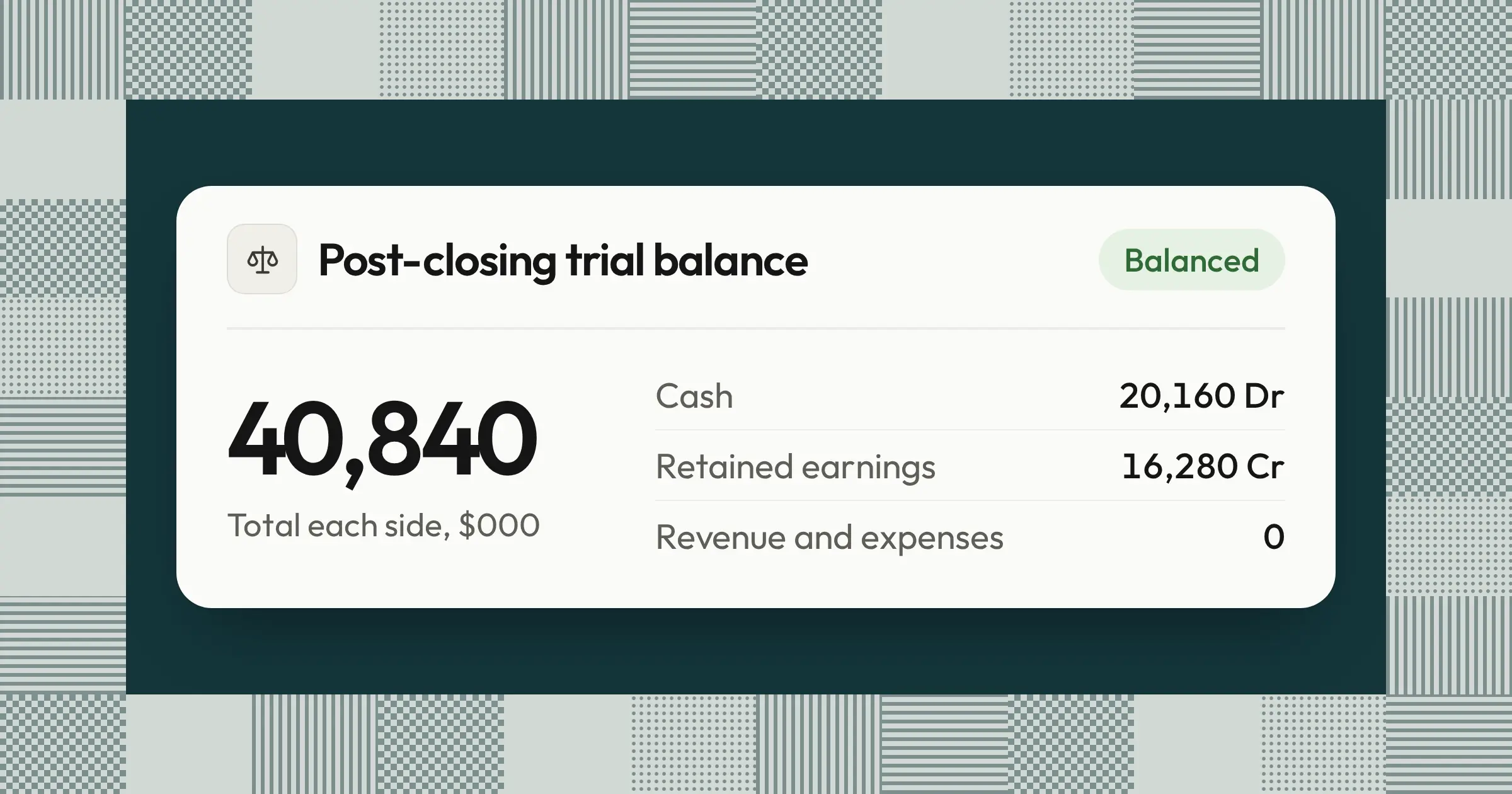
- In the worked example, closing zeroes $80.3 million of revenue, $75.6 million of expenses, and $1.0 million of dividends, which takes the trial balance from $117.4 million to $40.8 million and retained earnings from $12.6 million to $16.3 million.
- Each month's close stops at the adjusted trial balance, the post-closing trial balance follows the year-end close, and some ERPs, such as NetSuite, don't post a closing entry at all.
A post-closing trial balance lists every account balance after closing entries are posted, so only permanent accounts (assets, liabilities, and equity) appear, and every revenue, expense, and dividend account is zero. It's sometimes called a closing trial balance or an after-closing trial balance. It's the last of three trial balances in the accounting cycle, and it proves that debits still equal credits before the new year opens. This guide shows one company's adjusted and post-closing trial balances side by side, the four closing entries between them, and what to check when one won't balance.
| Aspect | Unadjusted trial balance | Adjusted trial balance | Post-closing trial balance |
|---|---|---|---|
| When you prepare it | After the period's transactions post, before adjusting entries | After adjusting entries, before closing entries | After the year-end closing entries |
| Temporary accounts included? | Yes, with balances to date | Yes, with final balances for the period | No, revenue, expense, and dividend accounts are zero |
| Retained earnings | Opening balance for the year | Opening balance for the year | Ending balance: opening + net income − dividends |
| What it's for | Finding missing entries and starting reconciliations | Preparing the financial statements | Proving the ledger balances and setting next year's opening balances |
| Which statement it feeds | None directly | Income statement, statement of retained earnings, and balance sheet | None directly, but its accounts match the year-end balance sheet |
| How often | Every month | Every month | Once a year |
Which accounts appear on a post-closing trial balance?
Only permanent accounts appear on a post-closing trial balance: assets, liabilities, and equity, with retained earnings updated for the year's net income and dividends. Checking for the right accounts tells you whether the closing entries ran completely.
- AssetsCash, receivables, prepaid expenses, and fixed assets, with contra accounts such as accumulated depreciation listed separately
- LiabilitiesPayables, accrued salaries and expenses, deferred revenue, and loans
- EquityCommon stock, additional paid-in capital, and retained earnings. A sole proprietorship shows owner's capital instead, with drawings closed into it.
Temporary accounts never appear with a balance: revenue, expenses, gains and losses, dividends or owner's drawings, and income summary. Most systems leave zero-balance accounts off the report, so a revenue or expense line on a post-closing trial balance means a closing entry is missing or incomplete.
Post-closing trial balance example
In this example, closing entries move $80,280 of revenue, $75,600 of expenses, and $1,000 of dividends into retained earnings, and the post-closing trial balance totals $40,840 on each side.
Example
A software company with about $80 million in annual revenue closes its fiscal year on December 31, 2026. All amounts are illustrative and shown in thousands of dollars ($000).
Adjusted and post-closing trial balance, December 31, 2026 ($000)
| Account | Adjusted debit | Adjusted credit | Post-closing debit | Post-closing credit |
|---|---|---|---|---|
| 10100 Cash | 20,160 | 20,160 | ||
| 11000 Accounts receivable | 12,600 | 12,600 | ||
| 13000 Prepaid insurance | 880 | 880 | ||
| 15000 Equipment | 7,200 | 7,200 | ||
| 15900 Accumulated depreciation | 2,280 | 2,280 | ||
| 20000 Accounts payable | 4,880 | 4,880 | ||
| 21000 Accrued salaries | 2,480 | 2,480 | ||
| 21500 Accrued expenses | 360 | 360 | ||
| 24000 Deferred revenue | 6,560 | 6,560 | ||
| 30000 Common stock | 8,000 | 8,000 | ||
| 32000 Retained earnings | 12,600 | 16,280 | ||
| 33000 Dividends | 1,000 | 0 | ||
| 40000 Revenue | 80,280 | 0 | ||
| 60000 Salaries expense | 48,680 | 0 | ||
| 61000 Rent expense | 5,760 | 0 | ||
| 61400 Software and hosting expense | 18,760 | 0 | ||
| 62000 Insurance expense | 960 | 0 | ||
| 63000 Depreciation expense | 1,440 | 0 | ||
| Total | 117,440 | 117,440 | 40,840 | 40,840 |
What closing changed:
- Temporary accountsAll seven go to zero: revenue, five expense accounts, and dividends. A real post-closing report would omit them.
- Net income$80,280 revenue − $75,600 expenses ($48,680 + $5,760 + $18,760 + $960 + $1,440) = $4,680
- Retained earnings$12,600 opening + $4,680 net income − $1,000 dividends = $16,280
- Everything elseThe other ten permanent accounts carry the same balances on both reports
- Proof it balances$20,160 + $12,600 + $880 + $7,200 = $40,840 of debits, and $2,280 + $4,880 + $2,480 + $360 + $6,560 + $8,000 + $16,280 = $40,840 of credits
Where the adjusted balances came from
The unadjusted trial balance totaled $114,480 on each side. Five adjusting entries produced the adjusted balances above:
- Accrued salariesDecember salaries of $2,480 are earned but paid in January, so debit salaries expense and credit accrued salaries
- Insurance$80 of prepaid insurance is used up in December, so debit insurance expense and credit prepaid insurance
- DepreciationDecember depreciation is $120, so debit depreciation expense and credit accumulated depreciation
- Deferred revenue$1,280 of subscriptions billed in advance is earned in December, so debit deferred revenue and credit revenue
- Hosting accrualThe December hosting bill of $360 hasn't arrived, so debit software and hosting expense and credit accrued expenses
December hosting accrual · bill not yet received
- Dr 61400 · Software and hosting360,000.00
- Cr 21500 · Accrued expenses360,000.00
Hosting accrual workpaper, December 2026
The five entries total $4,320 on each side and change ten accounts, two of which, accrued salaries and accrued expenses, had no balance before. That's the whole difference between the unadjusted and adjusted trial balance. For how each type is built and reviewed, see adjusting entries.
How do you post closing entries?
You post four closing entries at year-end: close revenue to income summary, close expenses to income summary, close income summary to retained earnings, and close dividends to retained earnings. With the example's numbers ($000):
| Account | Debit | Credit |
|---|---|---|
| 1. Close revenue | ||
| Revenue | 80,280 | |
| Income summary | 80,280 | |
| 2. Close expenses | ||
| Income summary | 75,600 | |
| Salaries expense | 48,680 | |
| Rent expense | 5,760 | |
| Software and hosting expense | 18,760 | |
| Insurance expense | 960 | |
| Depreciation expense | 1,440 | |
| 3. Close income summary | ||
| Income summary | 4,680 | |
| Retained earnings | 4,680 | |
| 4. Close dividends | ||
| Retained earnings | 1,000 | |
| Dividends | 1,000 | |
After entry 2, income summary holds a $4,680 credit, which equals net income, and entry 3 brings it to zero. In a loss year, entry 3 runs the other way: debit retained earnings and credit income summary. Dividends skip income summary because they're a distribution to owners, not an expense.
Many accounting systems skip income summary and close revenue and expense accounts directly to retained earnings in one entry. The ending balances are the same. For the full set of month-end and year-end entries with what to review in each, see closing journal entries.
What is the difference between an adjusted trial balance and a post-closing trial balance?
An adjusted trial balance includes revenue, expense, and dividend accounts and is the source of the financial statements, while a post-closing trial balance lists only balance sheet accounts after those accounts are closed. Retained earnings also changes: it shows the opening balance before closing and the ending balance after.
In the example, the adjusted trial balance lists 18 accounts and totals $117,440, and the post-closing trial balance lists 11 and totals $40,840. The $76,600 gap is the closed accounts. On the debit side, that's $75,600 of expenses plus $1,000 of dividends. On the credit side, it's $80,280 of revenue less the $3,680 increase in retained earnings.
You build the income statement from the revenue and expense lines of the adjusted trial balance, and the balance sheet from its asset, liability, and equity lines with retained earnings rolled forward. The post-closing trial balance comes after the statements and confirms the books are ready for the new year.
What is the difference between a pre-closing and post-closing trial balance?
A pre-closing trial balance is another name for the adjusted trial balance: it's run after adjusting entries and before closing entries, so it still carries the revenue, expense, and dividend balances that the post-closing version doesn't.
The only entries that should post between the two reports are the closing entries. Two checks confirm that:
- Retained earningsThe change from pre-closing to post-closing equals net income minus dividends, $3,680 in the example
- Every other permanent accountSame balance on both reports. A difference means a non-closing entry posted after the statements were built, so rerun the pre-closing trial balance and the statements before you sign off.
How do you prepare a post-closing trial balance?
You don't record a post-closing trial balance as a journal entry. You prepare it as a report after the closing entries post, then confirm that debits equal credits and every temporary account is zero.
- Start from a final adjusted trial balanceFix errors here, because anything wrong carries into next year's opening balances
- Post the closing entriesRevenue, expenses, and dividends to retained earnings, directly or through income summary
- Run the trial balance as of year-endIn most systems, it's the standard trial balance report run after closing
- Confirm the totals matchTotal debits equal total credits
- Confirm only permanent accounts remainAny revenue, expense, dividend, or income summary balance means a closing entry is missing
The report has a three-line heading: the company name, “Post-closing trial balance,” and the date of the balances, such as December 31, 2026. Below it come columns for account number, account name, debit, and credit, with totals at the bottom.
A balanced post-closing trial balance doesn't prove your books are accurate. An accrual that was never recorded, or an expense posted to the wrong account, still leaves debits and credits equal.
Do you prepare a post-closing trial balance every month?
Not usually. Closing entries are a year-end step, so the post-closing trial balance follows the year-end close, and each month's close stops at the adjusted trial balance. During the year, revenue and expense accounts keep their year-to-date balances for monthly, quarterly, and year-to-date reporting.
Some ERPs don't post a closing entry even at year-end. “In NetSuite, an entry to close Profit or Loss to Retained Earnings is not required,” according to a May 2021 article by NetSuite partner Sikich. Instead, the balance sheet calculates retained earnings from prior years' net income. Your year-end check is that the new year's opening retained earnings equals last year's retained earnings plus net income, minus dividends.
Some teams use “post-close trial balance” for the final adjusted trial balance after the month is locked. If yours does, write that definition into your close policy so preparers and reviewers mean the same report.
Is the post-closing trial balance the same as the balance sheet?
No. It holds the same accounts, but the trial balance lists debit and credit balances to prove the ledger balances, while the balance sheet groups and nets them for readers.
In the example, the post-closing trial balance totals $40,840, but total assets on the balance sheet are $38,560. The $2,280 difference is accumulated depreciation, which the balance sheet nets against equipment: $20,160 + $12,600 + $880 + ($7,200 − $2,280) = $38,560. Liabilities of $14,280 and equity of $24,280 add up to the same $38,560.
Why doesn't my trial balance balance?
Modern accounting systems won't post a journal entry unless its debits equal its credits, so an out-of-balance trial balance usually points to report settings or data, not arithmetic. Checking these causes in order narrows the search quickly.
| What you see | What to check |
|---|---|
| Debits don't equal credits | An import or integration that loaded only one side of an entry, or a trial balance built in a spreadsheet |
| The trial balance doesn't match the balance sheet | Different periods, subsidiaries, accounting books, or account ranges in the two reports |
| Consolidated totals look wrong | Intercompany eliminations and currency translation posted only at the consolidated level |
| An expected entry is missing | Journals saved as drafts, waiting for approval, or posted to the wrong period |
| A balance that should be zero isn't | Suspense, clearing, and intercompany accounts that weren't cleared before close |
If you prepare the trial balance by hand or in a spreadsheet, the size of the difference helps. A difference divisible by 9 often means transposed digits, such as $540 entered as $450. A difference equal to twice one entry's amount often means that entry was posted to the wrong side.
How do you review the trial balance at month-end?
Review the adjusted trial balance before you lock the period, because it's the last point where you can correct a balance without reopening the month. Following the same steps each month keeps the review consistent across preparers.
- Run it for the right scopeEach subsidiary first, then consolidated, for the period you're closing
- Tie each balance sheet accountMatch every balance to an approved reconciliation with support
- Review movementsCompare each account with the prior month and the budget, and explain changes above your threshold
- Check balances that should be zeroSuspense and clearing accounts, and intercompany balances that should eliminate
- Sign off and lockLock the period after review, and at year-end confirm opening retained earnings for the new year
Prepared by Close Agent
- Suspense balance29990 Suspense · bank feed import, 30 DecIMP-20261230-04$8,240.00Needs input
- AP control-account difference20000 Accounts payable against the AP agingAP-AGING-1231$14,600.00Needs review
- Intercompany differenceUS 13100 against UK 23100IC-1231-02$3,150.00Needs review
For where this review sits in the close, see Month-end close process. For each task with its owner and reviewer, see Month-end close checklist. If you're new to the close, start with What is month-end close?
How we approach it
Our Close Agent runs the trial balance and control-account review as a task on your close checklist. It ties every control account to source, prepares the workpaper, and sends it to a named reviewer. The month can't lock until every task is signed off. If you want that review prepared before your team starts it, explore our Close Agent.
Review and sign-off
- Balance sheet reconciliationsClose AgentSigned offAWD 1
- Intercompany eliminationsClose AgentIn progressAWD 2
- Trial balance and control-account reviewClose AgentIn reviewDWD 2
- Flux reviewClose AgentIn progressDWD 3
Share this article