Key takeaways
- Accrued revenue, also called accrued income, is revenue you've earned but haven't invoiced by period-end. It sits on the balance sheet as a current asset until you bill the customer.
- The adjusting entry debits accrued revenue and credits revenue. When you invoice, you debit accounts receivable and credit accrued revenue, and when the customer pays, you debit cash and credit accounts receivable.
- Under ASC 606, an unbilled amount is a receivable when “only the passage of time is required” before payment is due, and a contract asset when payment still depends on something else, such as a milestone.
Accrued revenue, also called accrued income, is revenue your company has earned by delivering goods or services but hasn't billed or collected by the end of the period. Usage billed in arrears, unbilled consulting hours, and interest earned but not yet paid are all accrued revenue. This guide covers the journal entry with a worked example, a table of common examples, how accrued revenue compares with receivables and deferred revenue, and one company's month-end schedule.
What does accrued revenue mean?
Accrued revenue means you've delivered the work or the goods and have a right to be paid, but the invoice hasn't gone out yet. Recording it in the month you earn it keeps each month's revenue in the month you delivered, as accrual accounting requires.
- Accrued revenueRevenue earned in the period but not invoiced at period-end, also called accrued income, unbilled revenue, or accrued receivables
- Unbilled receivableThe asset you record when only invoicing and time stand between you and payment
- Contract assetThe asset you record when payment still depends on something else, such as a milestone or customer acceptance
Accrued revenue is one of the two types of accruals. The other is accrued expenses, which record costs you've incurred but haven't been billed for.
What is the journal entry for accrued revenue?
The journal entry for accrued revenue debits accrued revenue, or unbilled receivables, and credits revenue at period-end. When you invoice, you move the balance to accounts receivable, and when the customer pays, you clear it to cash.
| Step | When | Debit | Credit |
|---|---|---|---|
| 1. Accrue | Period-end, earned but not billed | Accrued revenue (unbilled receivables) | Revenue |
| 2. Invoice | Invoice issued | Accounts receivable | Accrued revenue (unbilled receivables) |
| 3. Collect | Customer pays | Cash | Accounts receivable |
Step 2 moves the amount from one asset to another. Revenue doesn't change in step 2, because you already recognized it in step 1.
Example
Your implementation team works 620 billable hours in October at $210 an hour, so you've earned $130,200. The invoice goes out on November 6 for 580 hours, or $121,800, after the project manager writes off 40 hours. The customer pays on December 6.
| Account | Debit | Credit |
|---|---|---|
| Oct 31 | ||
| Unbilled receivables | $130,200 | |
| Services revenue | $130,200 | |
| Nov 6 | ||
| Accounts receivable | $121,800 | |
| Unbilled receivables | $121,800 | |
| Services revenue | $8,400 | |
| Unbilled receivables | $8,400 | |
| Dec 6 | ||
| Cash | $121,800 | |
| Accounts receivable | $121,800 | |
October carries $130,200 of revenue (620 × $210). The $8,400 write-off (40 × $210) reduces November's revenue, and the unbilled balance is back to zero once the invoice posts.
Many teams use a reversing entry instead. On November 1, you debit services revenue and credit unbilled receivables for $130,200, then book the invoice as a normal sale: debit accounts receivable and credit services revenue for $121,800. November revenue nets to −$8,400 either way. ERPs such as NetSuite let you set a reversal date on the original entry, so the November 1 entry posts automatically.
October implementation revenue accrual · 620 approved hours
- Dr 13100 · Unbilled receivables130,200.00
- Cr 40200 · Services revenue130,200.00
Revenue accrual schedule, October 2026Reverses 1 Nov
For payroll, prepaid, and other entries in the same close, see Month-end journal entries.
What are examples of accrued revenue?
Common examples of accrued revenue are interest earned, rent earned, services delivered but not billed, milestone or percentage-of-completion work, usage-based fees, and subscriptions billed in arrears.
| Example | Why it's unbilled at period-end | How to calculate it | Example amount |
|---|---|---|---|
| Interest earned on deposits or notes | Interest is paid monthly, quarterly, or at maturity | Balance × annual rate × days ÷ 365 | $500,000 note at 6%, 30 days unpaid: $2,466 |
| Rent earned | The lease bills in arrears, or the tenant hasn't paid | Monthly rent × months earned and unbilled | $8,000 a month, billed quarterly in arrears: $16,000 at February 28 |
| Services delivered, not billed | Timesheets are billed after month-end | Approved hours × rate − expected write-offs | 620 hours × $210: $130,200 |
| Milestone or percentage-of-completion work | Billing follows milestones, not progress | Percent complete × contract price − amounts billed | 60% × $90,000, nothing billed yet: $54,000 |
| Usage-based billing | Usage is invoiced after the usage month closes | Units × contract rate − credits − amounts billed | 46,000 compute hours × $2.40: $110,400 |
| Subscriptions billed in arrears | The plan bills at the end of each service period | Monthly fee × months served and unbilled | $1,500 a month, billed quarterly: $3,000 after two months |
| Goods shipped, not invoiced | Shipping runs before the billing cycle | Units shipped × price | $18,000 shipped June 30, invoiced July 1 |
Each line gets the same entry: debit an accrued revenue or receivable account and credit the matching revenue account, such as interest income, rent revenue, or services revenue.
What is the adjusting entry to record accrued revenue?
The adjusting entry to record accrued revenue debits an asset, such as accrued revenue or accounts receivable, and credits a revenue account. It increases both assets and revenue, and no cash changes hands.
You post it at period-end, before you prepare financial statements, for revenue you earned but haven't recorded because no invoice exists yet. It's one of the standard adjusting entries, alongside accrued expenses, prepaid expenses, deferred revenue, and depreciation.
Skipping the entry misstates two periods.
Example
You miss a $10,000 accrual for work delivered in March and invoiced in April.
| Line | March (entry missed) | April (invoice posts the revenue) |
|---|---|---|
| Revenue | Understated by $10,000 | Overstated by $10,000 |
| Pretax income | Understated by $10,000 | Overstated by $10,000 |
| Current assets | Understated by $10,000 | Correct |
| Retained earnings | Understated by $10,000 | Correct |
Accrued rent revenue journal entry
To accrue rent revenue, debit accrued rent receivable and credit rent revenue for rent the tenant owes for the period but hasn't been billed for or paid.
Example
You lease office space to a tenant for $8,000 a month. The lease bills quarterly in arrears, so you invoice first-quarter rent on April 3, and the tenant pays on April 20.
| Account | Debit | Credit |
|---|---|---|
| Jan 31 | ||
| Accrued rent receivable | $8,000 | |
| Rent revenue | $8,000 | |
| Feb 28 | ||
| Accrued rent receivable | $8,000 | |
| Rent revenue | $8,000 | |
| Mar 31 | ||
| Accrued rent receivable | $8,000 | |
| Rent revenue | $8,000 | |
| Apr 3 | ||
| Accounts receivable | $24,000 | |
| Accrued rent receivable | $24,000 | |
| Apr 20 | ||
| Cash | $24,000 | |
| Accounts receivable | $24,000 | |
Each month carries $8,000 of rent revenue, and the balance sheet shows $24,000 of accrued rent receivable at March 31, before any cash arrives.
Two other rent cases come up often:
- A tenant misses rent that's due in advanceMost leases bill at the start of the month, so you rarely need to accrue rent. When a tenant doesn't pay, AccountingTools (September 5, 2026) recommends accruing it as a reversing entry so it doesn't duplicate revenue, and considering an allowance for doubtful accounts, since a tenant a full month behind may not pay.
- Free months or rent escalationsUnder an operating lease, a landlord recognizes rent on a straight-line basis over the lease term, so revenue runs ahead of billing in the early months. The gap builds up as a straight-line rent receivable and unwinds as billed rent rises.
Is accrued revenue an asset?
Yes. Accrued revenue is an asset because it's a right to payment for work you've already delivered, and it's usually a current asset because you expect to bill and collect it within a year.
It carries a debit balance and appears under current assets, often labeled “unbilled receivables,” “accrued revenue,” “accrued income,” or “contract assets.” Some companies include unbilled amounts within accounts receivable. If you expect to collect part of it more than a year out, such as on a multiyear project, classify that part as noncurrent.
Accrued revenue isn't a liability. The other side of the entry is revenue on the income statement, so the accrual raises revenue and assets by the same amount, and cash doesn't move until the customer pays.
Is accrued income a receivable? Accrued revenue vs accounts receivable
Usually, yes: accrued income is an unbilled receivable. Accounts receivable is revenue you've invoiced and are waiting to collect, while accrued income is earned but not yet invoiced. Under ASC 606, conditional amounts are contract assets instead.
The test under ASC 606 is whether your right to payment is conditional. ASC 606-10-45-4 defines a receivable as a right to consideration that is unconditional, meaning “only the passage of time is required” before payment is due. When payment still depends on something else, such as finishing another deliverable or customer acceptance, the amount is a contract asset. PwC's financial statement presentation guide (viewed November 5, 2026) quotes the standard's rule that you present unconditional rights separately as a receivable, and that contract assets are measured for credit losses under ASC 326-20.
| Compared | Unbilled receivable | Contract asset | Accounts receivable |
|---|---|---|---|
| Revenue earned? | Yes | Yes | Usually |
| Invoice sent? | No | No | Yes |
| Right to payment | Unconditional: only time and the invoice remain | Conditional on something other than time | Unconditional |
| Main risk | Credit risk | Credit risk and performance risk | Credit risk |
| Clears when | You invoice | The condition is met and you invoice | The customer pays |
| Example | October usage, invoiced November 4 | Migration fee billable only at go-live | October invoice due in 30 days |
Deloitte's 2026 revenue recognition roadmap notes diversity in practice on when to record a receivable: some companies record it when they invoice, and others build it up as they perform. Deloitte says the choice affects balance sheet presentation, not the revenue you recognize.
Accrued interest and accrued rent sit outside ASC 606. Interest follows other guidance and a landlord's rent follows the lease standard, ASC 842, but you accrue both with the same debit to a receivable and credit to revenue.
Accrued revenue vs deferred revenue
Accrued revenue is earned before you bill, so it's an asset. Deferred revenue is billed or paid before you earn it, so it's a liability.
| Compared | Accrued revenue | Deferred revenue |
|---|---|---|
| What happens first | You deliver | The customer is billed or pays |
| Balance sheet | Asset, usually current | Liability, usually current |
| Normal balance | Debit | Credit |
| Entry at billing or payment | Dr Accounts receivable, Cr Accrued revenue | Dr Cash or Accounts receivable, Cr Deferred revenue |
| Entry as you earn it | Dr Accrued revenue, Cr Revenue | Dr Deferred revenue, Cr Revenue |
| Clears when | You invoice | You deliver and recognize the revenue |
| Typical examples | Usage billed in arrears, unbilled hours, accrued interest | Annual subscriptions paid up front, retainers, gift cards |
| Common error | Missing the accrual understates revenue and assets | Booking the cash as revenue overstates revenue and understates liabilities |
Example
You sign a $3,000-a-month service contract. If it bills quarterly in arrears, you hold $3,000 of accrued revenue after month one. If it bills quarterly in advance and the customer pays $9,000 on day one, you hold $6,000 of deferred revenue after month one. Revenue for month one is $3,000 either way.
What inputs and accounting considerations affect accrued revenue the most?
Accrued revenue equals the value of what you delivered by period-end, at contract rates, minus amounts already billed, so delivery evidence, contract terms, cutoff timing, and expected credits move it the most.
Accrued revenue = Value delivered to date at contract rates − Expected credits and write-offs − Amounts already billed
| Input | Why it moves the number | What to check before you book |
|---|---|---|
| Delivery evidence at cutoff | It's the basis for the amount | Usage export, approved timesheets, or progress measure as of the last day of the period |
| Contract rate and terms | Tiers, minimums, and caps change the price per unit | The signed order form, not the price list |
| Credits, discounts, and write-offs | Under ASC 606 they're variable consideration, which you include only to the extent a significant revenue reversal isn't probable | Recent accrual-to-invoice differences and open disputes |
| Cutoff timing | Late usage events or unapproved hours land after you pull the data | When the source system finalizes the period |
| Amounts already billed | Partial invoices, or a billing system that already recognized revenue, cause double counting | The billing system's invoiced-to-date total |
| Payment conditions | They decide receivable or contract asset | Milestones, acceptance clauses, and go-live dates |
| Collectibility | Doubtful amounts need an allowance | Customer aging and payment history |
Four accounting considerations sit on top of the inputs:
- Delivery, not the contractAccrue only for goods or services you've transferred. A signed contract or a forecast isn't evidence of delivery.
- One method every monthUse the same estimation method and the same reverse-or-reclassify approach each period, so the differences are comparable.
- Differences land in the current periodWhen an invoice differs from its accrual, the difference is a change in estimate and goes into this month's revenue. You don't reopen last month.
- Support for every lineRecord the basis next to each amount, so the reviewer can test it and next month's preparer can repeat it.
Example: One company's month-end accrued revenue schedule
A single schedule for all revenue accruals gives your reviewer one place to check each amount, its basis, and its classification.
Example
A B2B software company with about $120 million in annual revenue closes October 2026.
| Accrual | Basis | Calculation | Amount | Classification |
|---|---|---|---|---|
| Compute usage, billed in arrears | Usage export | 46,000 hours × $2.40 | $110,400 | Unbilled receivable |
| Implementation, time and materials | Approved timesheets | 620 hours × $210 | $130,200 | Unbilled receivable |
| Fixed-fee data migration, billable at go-live | Hours against budget | 60% × $90,000 | $54,000 | Contract asset |
| Interest on cash deposits | Bank rate | $9,300,000 × 4.00% ÷ 12 | $31,000 | Interest receivable |
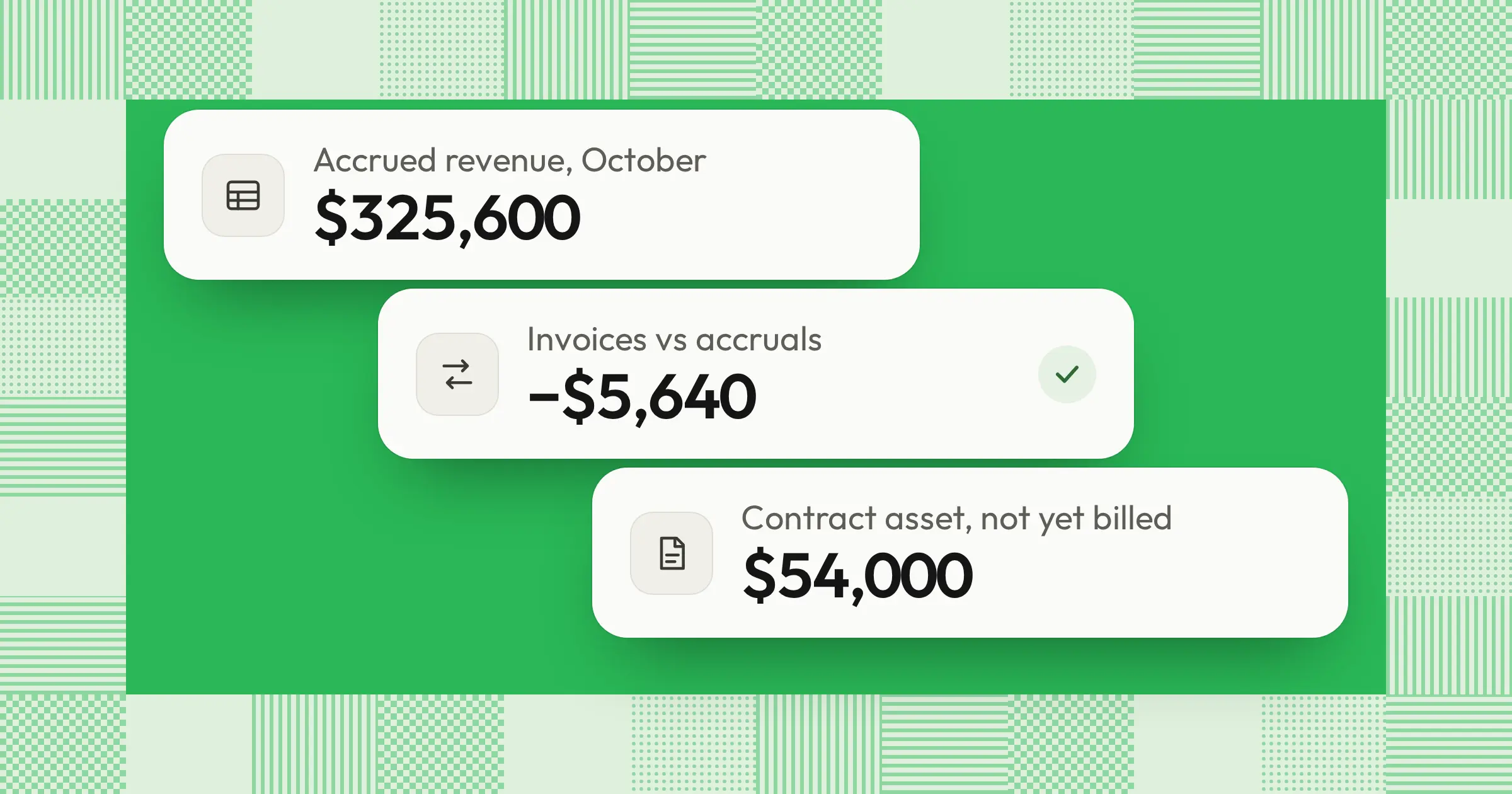
| Total | $325,600 |
The migration line is a contract asset because the customer owes nothing until go-live. The interest line is outside ASC 606, but it sits on the same schedule because it's earned and unbilled.
When the November invoices go out, the team compares each one with its accrual:
| Accrual | Accrued | Invoiced | Difference | Change for next month |
|---|---|---|---|---|
| Compute usage | $110,400 | $113,160 | $2,760 | Pull usage after the platform finalizes late events |
| Implementation | $130,200 | $121,800 | −$8,400 | Confirm write-offs with project managers before accruing |
| Data migration | $54,000 | Not billed | n/a | Go-live is set for December, so the balance stays |
| Interest | $31,000 | Not billed | n/a | The bank pays on December 31 |
The differences net to −$5,640 ($2,760 − $8,400), and they land in November's revenue. The implementation accrual was 6% too high (−$8,400 ÷ $130,200), so the basis changes, not just the number.
Prepared by Close Agent
- Implementation over-accruedInvoiced $121,800.00 against $130,200.00 accrued · 40 hours written offINV-7032−$8,400.00Needs review
- Compute usage differenceInvoiced $113,160.00 against $110,400.00 accrued · late eventsINV-7041$2,760.00Within range
- Contract asset not yet billableData migration · 60% complete, go-live set for DecemberSOW-2208$54,000.00Carried forward
Does accrued revenue affect cash flow?
Accrued revenue raises revenue and net income without bringing in cash, so it lowers operating cash flow relative to net income until you collect. Tracking the change explains why profit and cash don't move together.
On a cash flow statement prepared with the indirect method, an increase in accrued revenue is subtracted from net income. In the example, unbilled receivables, contract assets, and interest receivable rise from $268,000 at September 30 to $325,600 at October 31. That $57,600 increase ($325,600 − $268,000) reduces October's operating cash flow.
What are common mistakes teams make when measuring accrued revenue?
The most common mistakes are accruing revenue before it's earned, counting it twice, leaving balances that never clear, and classifying a conditional amount as a receivable. Each one misstates revenue in two periods.
- Over-accruingAccruing on a signed contract or a forecast instead of evidence of delivery, or accruing hours that will be written off
- Double countingLeaving an accrual in place when the invoice posts revenue, or accruing manually on top of a billing system that already recognized the amount
- Stale balancesUnbilled lines older than one billing cycle, which often mean a dispute, a missed invoice, or revenue that should be reversed
- Wrong classificationPresenting a conditional amount, such as a milestone awaiting acceptance, as a receivable instead of a contract asset
- No credit-loss review of contract assetsLeaving contract assets out of the allowance review, even though ASC 326-20 applies to them as well as to receivables
- Negative balancesA credit balance in accrued revenue after close, which often means an invoice and a reversal cleared the same amount
- No supportRound estimates with no usage file, timesheet, or progress calculation behind them
Two monthly checks catch these early. Each month, match every accrued line to the invoice that followed and explain the difference. Then review the age of every unbilled balance and clear anything with no billing date.
For where revenue accruals sit in the close, see Month-end close process. For each task with its owner and reviewer, see Month-end close checklist. If you're new to the close, start with What is month-end close?
How we approach it
Our Close Agent prepares revenue accruals as tasks on your close checklist. It builds each accrual from the source records, attaches the workpaper, and drafts the journal entry with its reversal for a named approver. Nothing posts until that person approves it. If you want your month-end accruals prepared before your team starts on them, explore our Close Agent.
Revenue
- Revenue accrual scheduleClose AgentIn reviewDWD 2
- Match prior-month accruals to invoicesClose AgentSigned offAWD 1
- Contract asset agingClose AgentIn progressAWD 2
- Interest income accrualClose AgentSigned offAWD 1
Share this article