Key takeaways
- Account reconciliation is the process of comparing a general ledger balance with independent support, such as a bank statement or subledger, and explaining every difference before the books close.
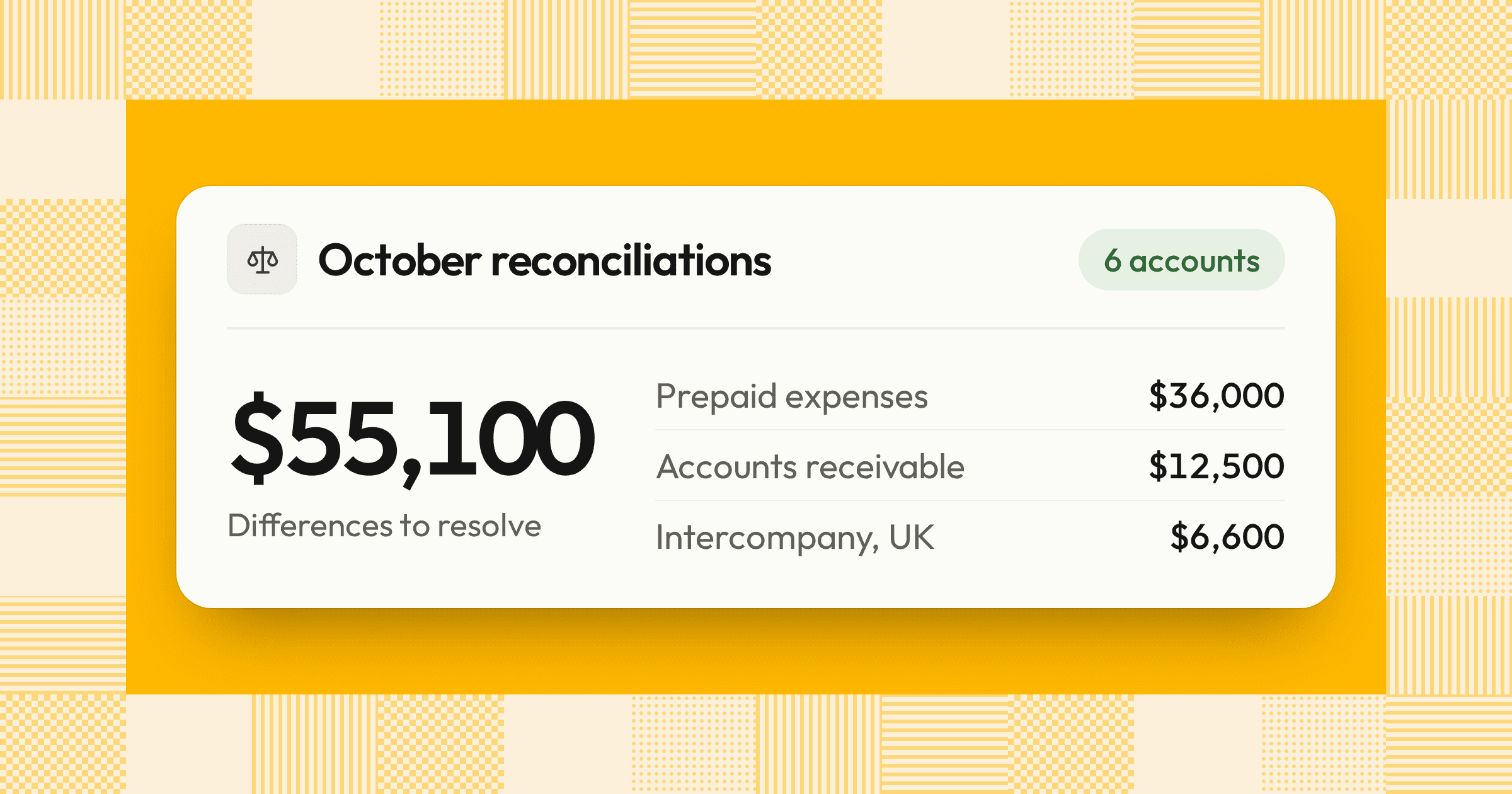
- In the worked example below, a software company with about $120 million in revenue reconciles six balance sheet accounts for October and finds three differences totaling $55,100 that need an entry or follow-up.
- In Ledge's 2025 survey of 100 finance professionals, cash reconciliation was the most time-consuming close activity, at 20–50 hours a month.
Account reconciliation is the process of comparing the balance of a general ledger account with independent support, such as a bank statement, subledger, or schedule, and explaining every difference. Getting account reconciliation right gives you balance sheet numbers you can defend, catches errors while they're still easy to fix, and keeps your team audit-ready. This guide covers the meaning, the types, the five-step process, one company's month of reconciliations, and how to clear old reconciling items.
What is account reconciliation?
Account reconciliation means proving that each balance in your general ledger is supported by a record outside it, and that every difference has a reason. It's how your team shows the balance sheet is right before you sign off the month.
- General ledger (GL) balanceThe account balance on your trial balance, such as cash or accounts receivable
- Supporting balanceThe independent figure you compare it with, such as a bank statement, an aging report, or an amortization schedule
- Reconciling itemA specific, documented reason the two balances differ, such as a deposit in transit
- Unexplained differenceWhat's left after every reconciling item, which should be zero before sign-off
Account reconciliation is the umbrella term. Bank reconciliation is one type, and balance sheet reconciliation is the monthly practice of reconciling every balance sheet account.
What are the types of account reconciliation?
The types of account reconciliation follow the support you compare against: a third-party statement, a subledger, or an internal schedule. Knowing which applies to each account tells your preparer where to find the evidence.
| Type | GL account | Compared with | Typical reconciling items |
|---|---|---|---|
| Bank | Cash | Bank statement | Deposits in transit, outstanding payments, bank fees |
| Card and payment processor | Clearing accounts | Processor or card statement | Settlement timing, fees, chargebacks |
| Accounts receivable | AR control account | AR aging (subledger) | Entries posted to the control account, unapplied cash |
| Accounts payable | AP control account | AP aging and vendor statements | Unrecorded bills, duplicate payments |
| Intercompany | Due to and due from | The other entity's balance | Timing, exchange rates, one-sided entries |
| Prepaid expenses | Prepaid assets | Amortization schedule | Unposted amortization, new invoices |
| Accrued liabilities | Accruals | Accrual schedule | Stale accruals, invoices already in AP |
| Fixed assets | Cost and accumulated depreciation | Fixed asset register | Unrecorded additions or disposals |
| Deferred revenue | Contract liabilities | Billing system schedule | Contract changes, credit notes |
A GL to subledger (GL and SL) reconciliation ties a control account, such as AR or AP, to the detail in its subledger. P&L accounts are reviewed through flux analysis, with revenue and expense activity reconciled to supporting records where needed.
How do you reconcile an account?
The account reconciliation process has five steps: pull the GL balance, get independent support, compare the two, investigate and resolve each difference, and document the review. Following the same steps for every account keeps the work consistent across preparers.
- Pull the GL balanceTake the period-end balance from the trial balance, for the right entity, currency, and period
- Get independent supportObtain the statement, subledger, or schedule as of the same date
- Compare and list differencesMatch transactions where volume is high, and list every item that appears on only one side
- Investigate and resolveClassify each item as timing, error, or missing entry, and propose a journal entry for anything that isn't timing
- Document and reviewAttach the support, record the preparer and the date, and have a different person review and sign off
The formula is the same for every account: GL balance + or − reconciling items = supporting balance. When the unexplained difference is zero and the reviewer agrees with every item, the account is reconciled.
You can support a balance in two ways. Documentation review ties it to statements, subledgers, or invoices, and analytics review compares it with an estimate built from past activity, such as a prepaid balance against its expected amortization.
Account reconciliation example: One company's October
Taking one month across several accounts shows what reconciliation finds in practice.
Example
A software company with about $120 million in annual revenue reconciles six balance sheet accounts at October 31, 2026. All amounts are illustrative.
| Account | GL balance | Supporting balance | Difference |
|---|---|---|---|
| Operating cash | $8,214,350 | $8,262,900 (bank) | −$48,550 |
| Accounts receivable | $14,806,200 | $14,793,700 (aging) | $12,500 |
| Prepaid expenses | $1,642,000 | $1,606,000 (schedule) | $36,000 |
| Accrued expenses | $2,318,000 | $2,318,000 (schedule) | $0 |
| Intercompany receivable, UK | $975,300 | $968,700 (UK ledger) | $6,600 |
| Deferred revenue | $9,480,000 | $9,480,000 (billing system) | $0 |
| Account | Explained by | Action |
|---|---|---|
| Operating cash | Deposit in transit $186,400, outstanding payments $234,950 | None, timing only |
| Accounts receivable | Invoice posted by journal to the control account | Entry |
| Prepaid expenses | October amortization not posted | Entry |
| Accrued expenses | None | None |
| Intercompany receivable, UK | Exchange rate difference | Follow-up |
| Deferred revenue | None | None |
The cash difference is fully explained by timing: $8,262,900 + $186,400 − $234,950 = $8,214,350, so no entry is needed. The three other differences total $55,100 ($12,500 + $36,000 + $6,600). Two need journal entries, and one needs an answer from the UK controller before sign-off.
The prepaid difference is a $432,000 annual software license amortized at $432,000 ÷ 12 = $36,000 a month. October's entry wasn't posted, so the fix is a debit to software expense and a credit to prepaid expenses for $36,000.
October software license amortization · $432,000 ÷ 12
- Dr 61500 · Software expense36,000.00
- Cr 14100 · Prepaid software36,000.00
Prepaid expenses reconciliation, October 2026
The accounts receivable reconciliation shows how a control-account difference is found and fixed:
| Accounts receivable, October 31, 2026 | Amount |
|---|---|
| GL balance, AR control account | $14,806,200 |
| AR aging total from the subledger | $14,793,700 |
| Difference | $12,500 |
| Reconciling item: training fees invoiced by manual journal JE-1047 | $12,500 |
| Unexplained difference | $0 |
The $12,500 of October training fees was recorded by a manual journal straight to the control account, so it's in the GL but not in the aging. The fix is to reverse JE-1047 and issue the invoice through the billing system, so the customer and the aging both show it.
Prepared by Close Agent
- GL balance12000 · Accounts receivable14,806,200.00
- AR aging totalSubledger14,793,700.00
- Difference12,500.00
- Reconciling item · 1 of 1Training fees invoiced by manual journalPosted straight to the control account, so in the GL but not in the agingJE-104712,500.00Needs review
- Unexplained difference0.00
ProposedReverse JE-1047 and issue the invoice through the billing system
Which accounts should you reconcile every month?
Reconcile every material balance sheet account each month, and set a lower frequency only for small, stable accounts with little activity. Writing the frequency and the reason into your close policy gives your reviewer and your auditors one rule to test.
| Risk | Example accounts | Frequency in an example policy |
|---|---|---|
| High | Cash, card and payment clearing, AR, AP, intercompany, payroll liabilities, accruals, deferred revenue, suspense | Every month, with an independent reviewer |
| Medium | Prepaid expenses, fixed assets, debt, leases | Every month while there's activity |
| Low | Stable deposits, equity accounts with no movement | Quarterly, with a monthly flux review |
A small balance isn't automatically low risk. A suspense or clearing account with a $0 balance can hide large offsetting entries, so reconcile it every month.
What should an account reconciliation template include?
An account reconciliation template, or workpaper, should let someone outside your team see the balance, the support, every reconciling item, and who reviewed it. Using one template for every account, whether in Excel or in close software, makes review faster and audit requests easier to answer.
- HeaderEntity, account number and name, period end, and currency
- BalancesThe GL balance from the trial balance and the supporting balance, each with its source report and run date
- Reconciling itemsDate, amount, description, cause, owner, and age for each item
- EntriesAny proposed or posted journal entry, with its reference
- SupportThe statement, aging, schedule, or invoices behind each number
- Sign-offPreparer and reviewer names and dates, with the reviewer different from the preparer
For accounts built from a schedule, such as prepaids, accruals, and fixed assets, add a roll-forward: opening balance + additions − reductions = closing balance. The roll-forward shows how the balance moved, and the reconciliation proves the closing balance is supported.
For where reconciliations sit in the close, see Month-end close process. For each reconciliation task with its owner and reviewer, see Month-end close checklist.
What causes reconciliation differences?
Reconciliation differences come from timing, missing or duplicate entries, postings to the wrong account or period, and data that didn't flow between systems. Checking these causes in order narrows the search quickly.
| What you see | What to check |
|---|---|
| A difference that clears next month | Timing items, such as deposits in transit and outstanding payments |
| The GL is higher or lower than the subledger | Manual journals posted to the control account |
| A recurring monthly amount | A schedule entry, such as amortization or depreciation, that wasn't posted |
| A difference in only one entity | Intercompany entries recorded on one side, or at different exchange rates |
| A difference after an integration change | Transactions that failed to import from the billing, payroll, or bank feed |
| The same item every month | A reconciling item carried forward without being resolved |
If you prepare reconciliations in a spreadsheet, the size of the difference helps too. A difference divisible by 9 often means transposed digits, and a difference equal to twice an amount often means it was posted to the wrong side.
How do you clear aged reconciling items?
Clear aged reconciling items by giving each one an original date, an owner, and a deadline, then resolving or writing it off with approval. Tracking age stops old items from rolling forward month after month.
A timing item should clear in the next period, so a deposit in transit still open after 30 days needs investigating as a possible error. A workable policy has three parts:
- Keep the original dateAge each item from the day it first appeared, not from the current reconciliation
- Escalate by ageFor example, flag items older than 60 days to the controller and require a decision on anything older than 90
- Write off with approvalResolve small unsupported items with a journal entry approved above a set threshold, and record the reason
Can account reconciliation be automated?
Yes, account reconciliation software can automate the work in stages, starting with transaction matching and moving to investigation and entries. Automating the matching first frees your team for the differences that need judgment.
The time is worth recovering. In Ledge's 2025 survey of 100 finance professionals, cash reconciliation was the most time-consuming close activity, and teams spent an average of 20–50 hours a month on it.
- MatchingRules match bank, card, and subledger transactions to the GL and leave only the exceptions
- InvestigationAgents pull the support for each exception, explain the difference, and draft the entry
- ReviewA named reviewer approves each reconciliation and entry, so control stays with your team
For the entries reconciliations produce, see Month-end journal entries: Examples and what to review. For the trial balance review that follows, see Post-closing trial balance: Examples, types, and when to prepare it. If you're new to the close, start with What is month-end close?
How we approach it
Our Close Agent reconciles accounts as tasks on your close checklist. It matches every statement line, ties every control account to source, and shows each difference with its amount, date, source, and reference. When data is missing, it stops and asks for it, and nothing posts until a named approver signs off. If you want your reconciliations prepared before your team starts on them, explore our Close Agent.
Reconciliations
- Bank reconciliation · 1010 Operating cashClose AgentSigned offAWD 1
- AR subledger to control accountClose AgentIn reviewDWD 2
- Deferred revenue to billing systemClose AgentSigned offAWD 2
- Prepaid expenses to scheduleClose AgentIn reviewDWD 2
- Intercompany receivable, UKClose AgentIn progressAWD 2
Share this article