BlogGuide
Month-end close for logistics and distribution: Freight accruals, in-transit revenue, and a day-by-day calendar
30 min read
Key takeaways
- Logistics and distribution closes run late because the work finishes before the paperwork: carriers bill weeks after delivery, loads are mid-trip at month end, and rebates, landed cost, and deductions settle after the period.
- Accrue freight load by load for delivered loads with no posted carrier bill, recognize revenue for loads in transit by days completed, and track accrual accuracy and stale accruals at every close.
- Most lost close days go to chasing documents, so a hard operational cut-off and a day-one accrual built from TMS and WMS data are the first fixes to make.
Month-end close for logistics companies and distributors is the standard close plus the work between operations and the ledger. That means freight accruals for loads with no carrier bill, revenue for loads in transit, goods in transit and landed cost, vendor rebates, and TMS and WMS tie-outs. This guide covers all five business models (asset-based carriers, freight brokers, 3PL warehouses, freight forwarders, and wholesale distributors). It walks through a freight accrual with checked numbers, the ASC 606 and ASC 705 treatments that are easy to get wrong, a day-by-day calendar with owners, and notes for NetSuite, Business Central, Dynamics 365, SAP S/4HANA, Oracle, and QuickBooks.
What is month-end close for logistics and distribution?
Month-end close for logistics and distribution is the process of recording every load, shipment, receipt, and warehouse service in the month it happened, then reconciling and locking the books. The difference from other industries is timing. Operations finish weeks before carrier bills, vendor credits, and customer deductions arrive, so the close runs on estimates you true up later.
- Freight accrualThe estimated cost of carrier services you've received but haven't been billed for, recorded as an expense or as inventory cost, with a matching liability
- Revenue in transitRevenue for loads picked up but not delivered by month end, recognized for the share of the trip completed
- Received not invoiced (RNI)Goods or services received before the vendor bill, held in an accrual or GR/IR clearing account until the bill posts
Everything else follows the usual order of cut-off, subledgers, accruals, reconciliations, review, and lock, set out step by step in the month-end close process. If you're new to the close itself, start with What is month-end close?
What makes month-end close harder for logistics and distribution companies?
Operations and invoices run on different clocks. Carriers bill weeks after delivery, some loads are mid-trip at midnight on the last day, and fuel surcharges and accessorials arrive late. TMS and WMS data must also tie to the ledger. Distributors add landed cost, received-not-invoiced goods, vendor rebates, and customer deductions, and multi-entity groups add intercompany freight and currency.
What you must close depends on your business model, and many companies run two or more models at once.
What each logistics and distribution model has to close
| Model | How it earns revenue | Close items that matter most | Where the detail lives |
|---|---|---|---|
| Asset-based carrier (trucking) | Moves freight on its own tractors and trailers | In-transit revenue, driver and owner-operator settlements, fuel cards, IFTA fuel tax, repairs and tolls, depreciation | TMS, fuel card files, and telematics data |
| Freight broker | Arranges carriers for shippers and keeps the spread | Carrier cost accruals for delivered loads, unbilled customer revenue, in-transit loads, gross or net presentation, carrier payables and quick-pay | TMS |
| 3PL warehouse | Charges for storage, handling, and value-added services | Unbilled storage and handling revenue, minimum-charge true-ups, labor and facility accruals, billable activity tie-outs | WMS and its billing module |
| Freight forwarder | Arranges multi-leg, often international moves by job | Cost accruals for each leg by job file, unbilled revenue, duties paid for clients, agent charges and currency | Forwarding system, such as CargoWise |
| Wholesale distributor | Buys, stores, and resells goods | Shipping cut-off, goods in transit, landed cost and RNI, vendor rebates, customer deductions, inventory valuation | ERP inventory module, often with a WMS |
Two patterns cut across all five. Every model carries an accrual built from operational data, and every model needs a hard cut-off so each load, receipt, and shipment lands in one month only.
How long should month-end close take for a logistics company?
No public benchmark breaks out close time for logistics or distribution companies. As planning targets, aim for 3–5 business days for a single-site distributor, 5–7 for multi-warehouse distributors and freight businesses with carrier accruals, and 7–10 for multi-country groups. Named logistics companies have reported closes ranging from three days to just under ten.
| Profile | Planning target (business days) | What usually sets the pace |
|---|---|---|
| Single-site distributor | 3–5 | Receiving and shipping cut-off, inventory valuation |
| Multi-warehouse distributor | 5–7 | Inventory tie-out by location, RNI and landed cost |
| Broker, carrier, or 3PL with carrier accruals | 5–7 | Delivered-but-unbilled loads, accessorials, warehouse billing |
| Multi-country group or forwarder | 7–10 | Intercompany charges, currency, job-level accruals |
These are planning targets, not measured medians. Two vendor case studies, read November 10, 2026, show the range in practice. BlackLine's case study on Daylight Transport, an LTL carrier processing 2,500 invoices a day, says the company went from a six-day soft close to closing in three days and publishing the book on the fifth. FloQast's case study on Outdoor Living Supply, a private equity-backed distributor on NetSuite, reports a close cut from up to four weeks to under 10 days. In that case, the goods-received-not-invoiced account had gone unreviewed for three to four years. For cross-industry benchmarks by company size, see How long should month-end close take?
In most logistics closes, the lost days go to chasing documents such as PODs, carrier bills, and client counts. Three changes take days out first: a hard operational cut-off at a set time, a day-one accrual built from TMS and WMS data instead of waiting for invoices, and a written threshold below which post-close differences go to the month the bill posts. If you're a distributor stuck at 12 days, look first at receiving and shipping cut-off, RNI and landed cost accruals, and inventory valuation that only ties out late in the close.
How do you accrue freight when carrier invoices haven't arrived?
Accrue freight for every load delivered by month end that has no posted carrier bill. Price each load from its rate confirmation or contract rate, then add the fuel surcharge, known accessorials, and an allowance for accessorials not yet reported. Post one entry tagged by load, reverse it on day one, and measure the variance as bills arrive.
A freight accrual, also called accrued freight or a carrier invoice accrual, records the cost of transportation you've received but haven't been billed for. Brokers book it as purchased transportation, and so do carriers for loads they hand to other carriers. Unbilled freight charges are carrier charges for completed moves that haven't been invoiced yet, and they're what the accrual estimates. The mechanics follow the general rules for accrued expenses. What's specific to freight is the population of loads and how you price them.
| Method | How it works | When to use it | Trade-off |
|---|---|---|---|
| Load-level rated cost | Price each delivered, unbilled load from its rate confirmation, contract, or TMS rated cost | The default for brokers, carriers, and shippers with a TMS | Needs clean load data; leaves the smallest true-ups |
| Historical ratio | Apply a trailing freight-to-revenue or cost-per-shipment ratio | When load-level rates are missing, or for small parcel spend | Faster to build; larger true-ups after the close |
| Open-shipment report | Price shipped orders with no matched bill at average cost | Distributors without a TMS | Average pricing hides lane and carrier mix |
Accrue on delivered loads, or on whatever event your carrier contract says completes the service. Loads still moving at month end go into the in-transit entries in the next section, so you don't accrue them twice.
Fuel surcharges and accessorials belong in the month the load moved, not the month the carrier bills them. Many carrier contracts key the fuel surcharge to the U.S. Energy Information Administration's weekly on-highway diesel price, which EIA publishes every Tuesday. EIA says it doesn't calculate or regulate surcharges, so price fuel from your contract table at the index week the contract names. Accrue accessorials dispatch has confirmed at contract rates, such as detention, lumper fees, layover, and truck ordered not used (TONU). Then add a statistical allowance for charges not yet reported, based on history by carrier and lane.
Example
A freight brokerage with a small asset fleet runs on NetSuite and is closing October 2026. Its policy is to accrue every load delivered by October 31 with no posted carrier bill, reverse on November 1, and send post-close differences under 2% of actual bills to November. All figures are illustrative.
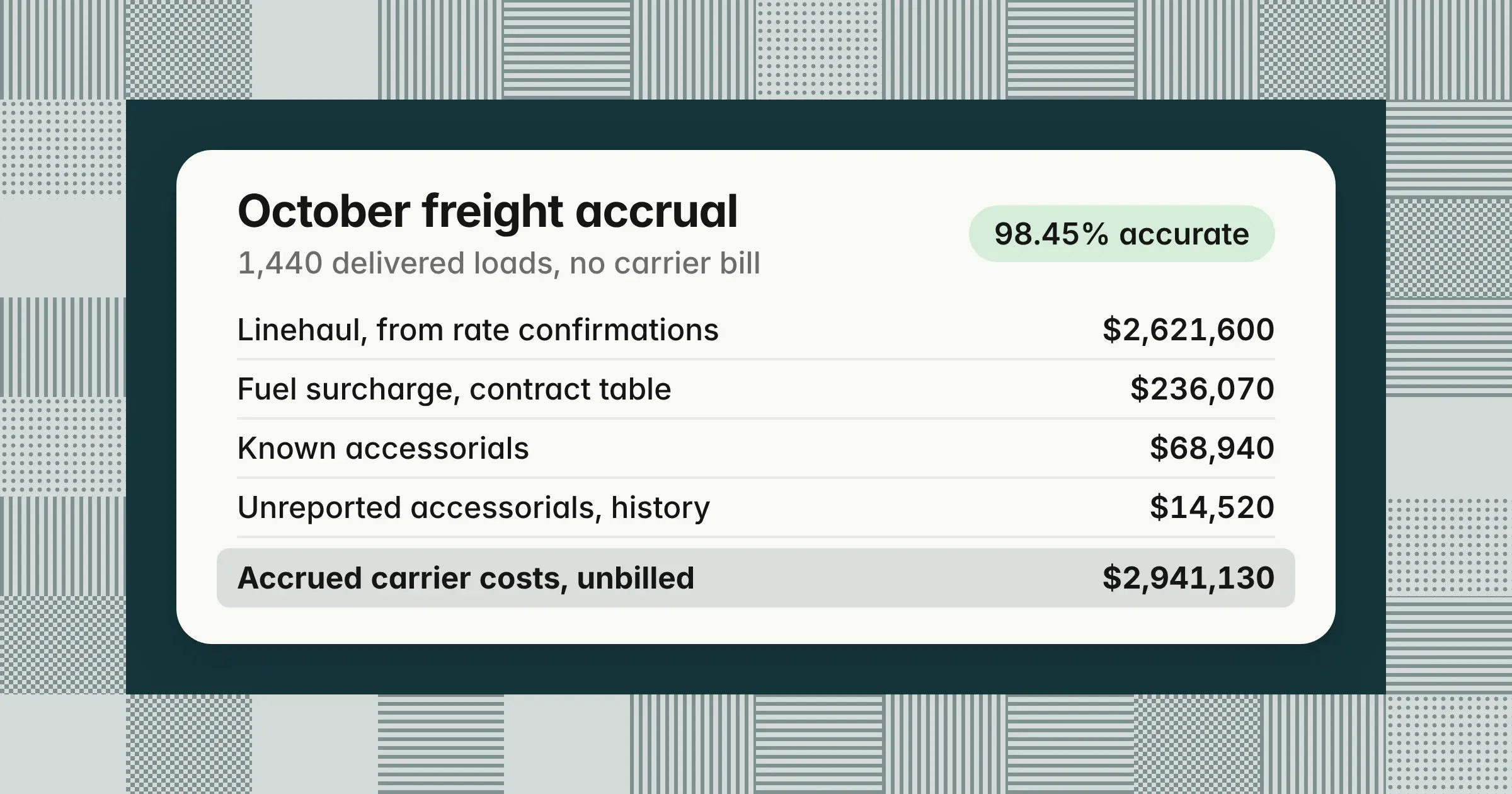
Step 1: Find the population. On November 3, close day 2, the TMS shows 6,420 loads delivered in October. Carrier bills are posted in AP for 4,980 of them, which leaves 1,440 delivered loads with no posted bill. Bills still waiting for approval in the AP inbox stay in the accrual until they post, so no load is counted twice.
Step 2: Price each load.
| Component | Basis | Amount ($) |
|---|---|---|
| Linehaul | Rate confirmation for each of the 1,440 loads (average $1,820.56) | 2,621,600 |
| Fuel surcharge | 610 loads bill fuel separately. The contract table, applied at each delivery week's EIA diesel price, works out to 21.5% of their $1,098,000 linehaul. The other 830 loads have all-in rates | 236,070 |
| Known accessorials | 212 events confirmed by dispatch, at contract rates | 68,940 |
| Unreported accessorials | 1,440 loads × 6.1% historical late-detention rate = 88 loads × $165 average | 14,520 |
| Total freight accrual | 2,941,130 |
Step 3: Post the entry. Date it October 31, set it to reverse on November 1, and carry load ID, carrier, customer, and entity on each line or in the support file.
| Account | Debit ($) | Credit ($) |
|---|---|---|
| Purchased transportation, linehaul | 2,621,600 | |
| Fuel surcharge expense | 236,070 | |
| Accessorial expense | 83,460 | |
| Accrued carrier costs, unbilled | 2,941,130 | |
| Total | 2,941,130 | 2,941,130 |
Reversing on day one lets AP post carrier bills as usual, with no one matching each bill to the accrual by hand. For when reversing entries make sense and when they don't, see adjusting entries.
Step 4: True up and measure accuracy. By December 15, carrier bills for those October loads total $2,987,410. October was under-accrued by $46,280, or 1.55% of actual bills. That's inside the 2% threshold, so you treat it as a change in estimate and don't reopen October. Each part of the difference lands in the month its bill posts: bills posted in November true up in November, and bills posted between December 1 and December 15 true up in December. Any October load still without a posted bill at November 30 goes back into the November accrual, because the policy accrues every delivered load with no posted bill. The reversals handle each step without a manual entry. It's a change in estimate, not an error correction, because October's accrual used the information available at the close. If bills come in below the accrual instead, the over-accrual lowers freight expense in the month the bills post: a negative true-up, not a negative accrual.
| Cause of the difference | Amount ($) |
|---|---|
| Accessorials above the estimate | 31,900 |
| Fuel surcharge billed at a different index week | 9,100 |
| Rate changes after tender | 5,280 |
| Total under-accrual | 46,280 |
Track accrual accuracy every month as 1 minus the absolute difference between actual and accrued, divided by actual. Here that's 1 − 46,280 ÷ 2,987,410, or 98.45%. Break it out by carrier and charge type, because a good total can hide one carrier whose bills always run well above the estimate. A 2% threshold is a review trigger your policy sets, not a materiality conclusion. If a large difference shows up before October's statements are issued, evaluate it under ASC 855 as possible evidence about the October liability.
Step 5: Age the stale accruals. At the same close, 37 July loads are still accrued at $58,900, more than 90 days after delivery with no carrier bill. Because the accrual rebuilds each month from delivered loads with no posted bill, old loads roll forward without anyone noticing. Review each one for a cancelled load, a duplicate, a carrier that never bills, or a bill posted to the wrong load. Release an accrual only with documented approval and a reason.
That quiet roll-forward is where accrual errors hide. CNN reported on December 11, 2024, that a single Macy's accounting employee had intentionally entered erroneous accrual figures to hide about $151 million of small-package delivery expense. The errors ran from the fourth quarter of 2021 to the third quarter of 2024. Macy's recognized $4.36 billion of delivery expense over that span and said the errors weren't material to its prior statements, but finding them delayed its quarterly earnings report by about two weeks. An aging report on accrued freight, reviewed by someone other than the preparer, is the control that catches this.
The accrued carrier costs account should carry a credit balance at month end. Under the reversal method, carrier bills post straight to freight expense and never touch this account. So a debit balance at month end points to a reversal posted twice, a manual debit, or a carrier bill coded to the accrual account by mistake. A missed reversal shows up the other way, as a credit balance larger than the open loads support. Each one needs a correction rather than a netting entry.
Keep a freight accrual register, in a spreadsheet or your close tool, with these columns: load ID, entity, customer, carrier, mode, lane, delivery date, POD date, rate confirmation linehaul, fuel surcharge basis and index week, fuel surcharge, known accessorials, statistical allowance, accrual total, AP status, invoice number, actual, variance, days open, and approver.
Where the cost lands depends on your model. For brokers and carriers, purchased transportation is cost of revenue. For distributors, outbound freight to customers goes to cost of goods sold or selling expense, depending on your accounting policy, applied consistently and disclosed. Inbound freight is part of inventory cost, covered in the landed cost section below.
How do you recognize revenue for loads still in transit at month end?
Under ASC 606, transportation is usually one performance obligation satisfied over time, because the shipper benefits as the load moves. At month end, recognize revenue for loads in transit by the share of the trip completed, usually measured in days or miles, and accrue the matching carrier cost. Large public carriers and brokers disclose this method in their annual reports.
Knight-Swift filed its 2025 annual report on Form 10-K on February 19, 2026. It says the performance obligation of providing transportation services "is satisfied over time." Management estimates revenue in transit at period end "based on the number of days completed of the dispatch," which is generally one to three days for its truckload, LTL, and logistics segments. C.H. Robinson's 2025 10-K says "a days-in-transit output method is used to measure the progress of our performance as of the reporting date," with the transit period based on the departure date and the delivery date. Baker Tilly's guidance for transportation companies (December 8, 2019) describes the same approach, based on transit time or distance.
Example
Back at the brokerage, 380 loads are in transit at October 31, with $851,200 of customer revenue and $722,500 of carrier cost. Weighted across the loads, 62% of the transit days are complete. The example applies one weighted rate for simplicity; in practice, you compute progress load by load in the TMS. All figures are illustrative.
| Account | Debit ($) | Credit ($) |
|---|---|---|
| Contract asset, revenue in transit | 527,744 | |
| Transportation revenue | 527,744 | |
| Purchased transportation | 447,950 | |
| Accrued carrier costs, in transit | 447,950 | |
| Total | 975,694 | 975,694 |
Both entries reverse on November 1, and November recognizes the rest as the loads deliver. The brokerage reports revenue gross here because it's the principal, which the next section explains. An agent would record only its net margin as revenue. An asset-based carrier recognizes in-transit revenue the same way, but its own costs work differently: driver pay and fuel are expensed as the miles are run, and tractor and trailer depreciation is a period cost, so neither needs a per-load in-transit accrual.
Delivered loads you haven't invoiced yet belong in a different account. Once a load is delivered, your right to payment is usually unconditional except for the passage of time, so unbilled freight revenue for delivered loads is an unbilled receivable. Revenue for loads still in transit is a contract asset until delivery. Keep the two in separate accounts so your aging and borrowing base reports stay clean. For the general entries, see accrued revenue.
So revenue can be recognized before delivery, as long as the service transfers over time and you can measure progress reliably. Some carriers with very short hauls recognize revenue at delivery instead, because the in-transit amount at any month end is small. That's a judgment to document in your revenue policy and revisit when volumes or haul lengths change, applied the same way every month.
Is freight broker revenue gross or net?
It depends on whether you control the transportation service before it transfers to the shipper, under the principal-versus-agent guidance in ASC 606-10-55-36 through 55-40. A broker that's primarily responsible for the move and sets the shipper's price is usually the principal and reports gross revenue. A broker that only arranges a carrier for a fee reports net.
The indicators of control in ASC 606-10-55-39 are:
- Primary responsibilityThe shipper looks to you to get the load delivered as promised, and the carrier's contract is with you
- Inventory riskYou carry risk before or after the service, for example by committing to capacity before you have a shipper for it
- Pricing discretionYou set the price the shipper pays, separately from what you pay the carrier
C.H. Robinson's 2025 10-K says most transactions in its transportation and sourcing businesses are recorded at the gross amount it charges customers, because it's primarily responsible for fulfilling the promise and has discretion in setting the price. The same filing records customs brokerage, managed solutions, and freight forwarding transactions at the net amount, and says that in Managed Solutions it often acts as the shipper's agent. The answer can differ by service line inside one company.
Example
A shipper pays $2,400 for a load, and the broker pays the carrier $2,040. The figures are illustrative.
| Line | Gross (principal) ($) | Net (agent) ($) |
|---|---|---|
| Revenue | 2,400 | 360 |
| Cost of revenue | 2,040 | 0 |
| Gross profit | 360 | 360 |
| Gross margin | 15.0% | 100.0% |
Profit is the same either way, but revenue and margin percentage change a lot. That's why freight income, gross profit, and broker margin figures should always say which basis they use. Freight income is revenue from moving freight: the full shipper billing for a principal, or the net fee for an agent. Sales teams often call total shipper billings "gross revenue," which is a different idea from gross presentation in the financial statements. At month end, the call decides whether carrier accruals sit in cost of revenue or reduce revenue. Make it once per service line, document it, and apply it consistently.
How do distributors handle in-transit inventory, shipping cut-off, and landed cost?
Record goods in transit to whichever party controls them under the contract. Incoterms and FOB terms set where delivery and risk pass, but legal title follows the purchase or sales contract, so read both. Then enforce one shipping and receiving cut-off time, and add inbound freight, duty, and brokerage to inventory cost as landed cost.
FOB shipping point usually means the buyer takes the goods once they leave the seller's dock, so the buyer records inventory in transit and a liability. FOB destination usually means the seller keeps them until delivery. Incoterms are narrower than many people assume: they set delivery, risk, and who pays which costs, and say nothing about title. Under EXW, risk passes at the seller's premises. Under FOB and CIF, it passes once the goods are on board the vessel at the port of shipment, and the two differ on who pays freight and insurance to the destination port.
Example
On October 30, a supplier ships $180,000 of goods to a distributor on terms that pass control at shipment, and they arrive November 4. The distributor records them in October. The figures are illustrative.
| Account | Debit ($) | Credit ($) |
|---|---|---|
| Inventory in transit | 180,000 | |
| Accrued purchases, in transit not invoiced | 180,000 | |
| Total | 180,000 | 180,000 |
On the sales side, revenue follows the transfer of control under ASC 606, which weighs shipping terms along with title, risk, and the customer's acceptance. FOB shipping point sales often transfer control at shipment, and FOB destination sales at delivery. If you ship after the customer already has control, ASC 606-10-25-18B lets you elect to treat shipping and handling as a fulfillment cost instead of a separate performance obligation. You then accrue the freight cost when you recognize the revenue.
Cut-off is where most distributor closes slip. These controls keep each shipment and receipt in one month:
- One operational cut-offA set time on the last day, such as 5 p.m. at each warehouse, communicated to operations two days ahead. The period still runs to midnight, so this time is a control, not the rule for which month a transaction belongs to
- Ship confirms tied to pickupOrders count as shipped in the month only when the carrier's pickup or bill of lading time is before midnight on the last day
- Staged orders stay in stockGoods packed but not picked up remain in inventory
- Late activity is logged and accruedUnless receiving and shipping physically stop at the cut-off, record every receipt and shipment through midnight on a post-cut-off log. Book each one to the month control passed, and accrue received-not-invoiced goods or recognize shipped revenue for anything your systems post to next month
- Interface holdBilling and WMS interfaces pause until someone checks the cut-off
- Cut-off testingSample shipments and receipts from the last two days of the month and the first two of the next, and trace each to the right period
Inbound freight, duty, customs brokerage, and similar costs to bring goods to their location are part of inventory cost under ASC 330, and under IAS 2 if you report under IFRS. So inbound freight accruals are capitalized, and outbound freight accruals aren't. When goods arrive before those bills, accrue the costs to a landed cost accrual account and allocate them to the items received. Freight-in is an asset while the goods are on hand and becomes cost of goods sold as they sell.
Example
A distributor receives 2,000 units at $25.00 each on October 28, a $50,000 receipt. Inbound freight of $3,000 and duty of $1,500 aren't billed yet. The figures are illustrative.
| Account | Debit ($) | Credit ($) |
|---|---|---|
| Inventory | 4,500 | |
| Landed cost accrual | 4,500 | |
| Total | 4,500 | 4,500 |
The landed cost is now $54,500, or $27.25 a unit. If 1,200 units sell by October 31, $2,700 of the freight and duty goes to cost of goods sold with them, and $1,800 stays in inventory with the 800 units on hand. When the bills arrive, a difference from the accrual goes to inventory for units still on hand and to cost of goods sold for units already sold.
How do you accrue vendor rebates and handle chargebacks and deductions?
Accrue vendor rebates as you make qualifying purchases, not when the vendor pays. Under ASC 705-20, a rebate you expect to earn reduces the cost of the inventory you bought, so split the accrual between inventory still on hand and cost of goods sold. Record customer deductions when the customer short-pays, and reserve for the ones you expect to lose.
When a rebate depends on cumulative purchases, ASC 705-20 has you recognize it systematically as you progress toward the target, if the amount is probable and reasonably estimable. If it isn't, recognize it as you reach each target. Not every vendor payment reduces inventory cost. Under ASC 705-20, payment for a distinct good or service you provide to the vendor is revenue, and a reimbursement of a specific cost you incur to sell the vendor's products, such as some co-op advertising, reduces that cost. Classify each program by its contract.
Example
A distributor's contract pays a 2% rebate on all calendar-year purchases once they pass $5 million. Purchases through October total $4.6 million, the forecast says the target will be met, and October purchases were $800,000. January to September were accrued the same way. Of October's purchases, 40% are still in inventory at month end. The figures are illustrative.
| Account | Debit ($) | Credit ($) |
|---|---|---|
| Vendor rebate receivable | 16,000 | |
| Inventory | 6,400 | |
| Cost of goods sold | 9,600 | |
| Total | 16,000 | 16,000 |
Many ERPs can't attach a rebate to item cost, so teams hold the inventory share in a contra-inventory account and release it to cost of goods sold as the stock turns. True up against vendor statements each quarter and whenever the forecast changes. If the forecast drops below the target, reverse what you've accrued so far.
In distribution, "chargeback" has two meanings, and neither is a credit card dispute. Rebates reward volume over a period, while chargebacks settle price on individual sales.
- Vendor chargebacksAlso called ship-and-debit or price support. You claim money back from a manufacturer when you sell to a contracted customer below your own cost. Accrue the claim when you make the sale, as a reduction of that sale's cost, and reconcile it to vendor credits
- Customer deductionsShort-payments a customer takes for pricing, shortages, damage, promotions, or late delivery. Record each one when the customer short-pays, code it to a reason, reserve for the share you expect to lose based on history, and clear valid ones against the original invoice
Deductions you can expect when you make the sale, such as promotional allowances and typical pricing concessions, are variable consideration under ASC 606, so estimate them and reduce revenue at the sale rather than waiting for the short-payment. Review the aged deduction balance at every close, so old items don't sit in receivables and overstate them.
How do you reconcile TMS and WMS data to the general ledger?
Pull every TMS load with its status at period end, match carrier bills to loads by PRO or bill of lading number, and accrue what's delivered but unbilled. Then tie TMS freight cost, the accrual, AP, and payments to the general ledger within a set tolerance. Work the exceptions: loads without bills, bills without loads, duplicates, and stale accruals.
Each system owns a different piece. The TMS runs loads, rates, and carrier settlements. The WMS runs receipts, inventory by location, picks, and warehouse billing. The ERP owns the general ledger, the subledgers, and the period lock. Some TMS and WMS products include accounting modules, but most mid-size companies keep the books in the ERP, so the close work sits in the gaps between systems.
Freight audit and payment tools check each carrier invoice against the rate and the load before you pay it. That AP control shrinks your true-ups, but it doesn't build the accrual, roll it forward, or reconcile it to the ledger.
Reconcile the accrued carrier costs account with a rollforward every month. If you reverse on day one, the beginning balance, less the reversal, plus the new month-end accrual, equals the ending balance. That ending balance must match the register total and the general ledger. If you don't reverse, replace the reversal with the bills posted against accrued loads.
Reconcile inventory in three layers:
- WMS quantities to the ERP inventory subledger, by SKU and location
- Subledger quantities and costs to the inventory valuation report
- The valuation report to the general ledger inventory accounts
Clear interface queues before you start. Most differences trace to unposted adjustments, unit-of-measure mismatches, receipts in the WMS that haven't reached the ERP, cost updates, and manual entries posted straight to inventory accounts. Block those manual entries or review each one. A 3PL holds client-owned inventory that isn't on its own balance sheet, so it reconciles billable activity instead: pallets stored, movements handled, and services completed. For formats and templates, see account reconciliation.
Month-end close checklist and day-by-day calendar for logistics and distribution
A logistics and distribution close runs the standard checklist around a day-one accrual cycle. Operations cuts off on the last day, accounting posts freight and revenue accruals on day one, subledgers and inventory tie out by day three, reconciliations and intercompany finish on day four, the controller signs off and locks the period on day five, and the reporting package goes out on day six.
Logistics accounting month-end process, by business day
| Day | Tasks | Owner |
|---|---|---|
| Days −2 to −1 | Send the cut-off notice with the exact time; chase open PODs, ship confirms, and client counts; confirm fuel card and toll files will arrive on time | Controller, operations manager |
| Day 0Last day of the month | Hard cut-off for shipments, receipts, and POD uploads; take TMS and WMS snapshots; run cycle counts | Operations and warehouse managers |
| Day 1 | Post day-one reversals; export delivered-unbilled and in-transit loads; post the freight accrual and unbilled revenue; import fuel card files; close AP cut-off | Freight or AP accountant, billing lead |
| Day 2 | Post in-transit revenue and cost; book accessorial allowances; accrue driver and owner-operator settlements; post RNI and landed cost; accrue 3PL storage and handling revenue; post forwarder job accruals | GL accountant, AP lead, billing lead |
| Day 3 | Run costing jobs; tie WMS to subledger to GL; accrue rebates and chargebacks; age and reserve deductions; accrue IFTA; reconcile factoring; send intercompany charges | Inventory accountant, AR lead |
| Day 4 | Reconcile accrued carrier costs, AR, AP, clearing, and GR/IR accounts; match intercompany balances; revalue currency; post eliminations; review flux and load, lane, and warehouse margins | Accounting manager |
| Day 5 | Review the full close, age stale accruals, sign off, and lock the period | Controller, CFO |
| Day 6 | Issue the reporting package | Controller, CFO |
For dates and cut-off times across 2026 and 2027, see the month-end close calendar. For the full general task list with owners and review steps, see the month-end close checklist. To get your own version as a template you can edit, build it with the free close checklist generator. Then add the items for your model below.
Trucking company month-end checklist
- Invoice every delivered load that has a POD, and accrue unbilled revenue for delivered loads still waiting on one
- Recognize revenue for loads in transit by days completed
- Reconcile fuel cards to trip records by truck and driver
- Accrue driver pay and owner-operator settlements for loads delivered but not yet settled, and reconcile escrow balances
- Accrue International Fuel Tax Agreement (IFTA) tax by jurisdiction from miles driven and fuel bought, ahead of the quarterly return
- Accrue repairs, tires, and tolls from open work orders and toll statements
- Update self-insured claims reserves where you retain the risk: auto liability, workers' compensation, cargo, physical damage, and employee medical, including claims incurred but not reported (IBNR). Use the claims register and your actuary's or insurer's estimates. This can be the largest accrual on the balance sheet: Knight-Swift reported $606.4 million of claims accruals at December 31, 2025, in its 2025 10-K
- Reconcile factoring: invoices sold, reserves held, fees, and recourse items
- Amortize prepaid expenses such as insurance, permits, and licenses
- Review revenue per truck, cost per mile, deadhead percentage, and operating ratio
The typical month-end entries for a trucking company are in-transit and unbilled revenue, purchased transportation accruals for brokered loads, and settlement accruals for drivers and owner-operators. Add fuel and IFTA accruals, repair and toll accruals, claims reserve accruals, depreciation on tractors and trailers, insurance and permit amortization, factoring fees, and the reversal of last month's accruals. For the debits and credits on each, see month-end journal entries.
Freight broker month-end checklist
- Accrue carrier costs for delivered loads with no posted bill, as in the worked example above
- Accrue unbilled customer revenue for delivered loads
- Recognize in-transit loads by days completed
- Reconcile carrier payables, quick-pay, and factoring clearing accounts
- Review load-level margin, and investigate negative and zero-margin loads before the lock, since they often point to a missing bill or a rate error
3PL warehouse month-end checklist
A 3PL recognizes storage and handling revenue over time as it performs the services. So accrue everything performed in the month, even when billing runs after the close, using WMS quantities and each client's rate card.
Example
A 3PL's October WMS data shows 4,200 pallets in storage at $12.00 a pallet for the month, 3,100 inbound pallets handled at $6.00, 12,500 outbound orders at $1.40, and 2,000 kitted units at $0.75. None is billed yet. The figures are illustrative.
| Account | Debit ($) | Credit ($) |
|---|---|---|
| Unbilled receivables | 88,000 | |
| Storage revenue | 50,400 | |
| Handling revenue (18,600 inbound + 17,500 outbound) | 36,100 | |
| Value-added services revenue | 1,500 | |
| Total | 88,000 | 88,000 |
Check each client against its minimum monthly charge and accrue the shortfall where the contract requires it. If you bill storage in advance, such as on an anniversary cycle, the part not yet earned is deferred revenue instead.
Freight forwarder month-end checklist
A forwarder closes by job file. For every shipment with a milestone before month end, accrue estimated costs for each leg not yet billed by carriers, agents, and customs brokers, and accrue customer revenue not yet invoiced. Duties and taxes paid on a client's behalf are usually pass-through receivables rather than revenue and cost, unless your contract makes you the principal for them. Compare estimated with actual cost per job as bills arrive to catch margin leakage, and close jobs that stay open past your policy limit.
Wholesale distributor month-end checklist
- Run shipping and receiving cut-off, with cut-off testing
- Record goods in transit by contract terms
- Accrue RNI and landed cost
- Run costing jobs and tie inventory valuation by location to the GL
- Accrue vendor rebates and chargebacks
- Age and reserve customer deductions
- Review gross margin by warehouse, category, and customer
Multi-entity and cross-border groups
Charge intercompany freight by shipment or job ID, and accrue intercompany costs when the service happened, even if the invoice is late. Revalue foreign-currency balances at month end and match both sides. Then eliminate intercompany revenue against expense, and receivables against payables, at consolidation. For the full process, see intercompany accounting.
Which ERP and close software do logistics and distribution companies use?
Most logistics companies run a specialist TMS, WMS, or forwarding system on top of an ERP such as NetSuite, Microsoft Dynamics 365 or Business Central, SAP S/4HANA, Oracle, or QuickBooks. The right month-end close software for logistics companies removes the manual work between those systems: accruals, matching, and reconciliations.
Common stacks by business model (examples, not a ranking)
| Model | Execution system | ERP |
|---|---|---|
| Freight broker | TMS such as McLeod, Turvo, MercuryGate, or Descartes | NetSuite, Business Central, Acumatica, or QuickBooks for smaller brokers |
| Asset-based carrier | TMS such as McLeod, Trimble TMW, or TruckMate, plus fuel card and telematics feeds | NetSuite, Dynamics 365, Oracle, or the TMS's own accounting module |
| 3PL warehouse | WMS such as Manhattan, Blue Yonder, Körber, or Extensiv | NetSuite, Dynamics 365, or SAP |
| Freight forwarder | Forwarding system such as CargoWise or Magaya | The forwarding system's accounting, or an ERP for group reporting |
| Wholesale distributor | ERP inventory module, often with a WMS such as Manhattan, SAP EWM, or Oracle WMS | NetSuite, Business Central, Dynamics 365, SAP S/4HANA, Oracle, Epicor, or Infor |
In SAP's case, SAP S/4HANA is the ERP, while SAP Transportation Management (TM) and SAP Extended Warehouse Management (EWM) are its transportation and warehouse applications.
Each ERP handles the logistics close a little differently. Confirm the features and settings below against your edition and release, because many of them depend on configuration.
| ERP | Freight and RNI accruals | Landed cost and goods in transit | Reversals and period lock |
|---|---|---|---|
| NetSuite | With Advanced Receiving, item receipts post the received value to an accrued purchases (received not billed) account until the bill posts; freight accruals from TMS data are usually a journal entry | Landed cost cost categories on item receipts, allocated by quantity, weight, or value; transfer orders hold stock in transit between locations | A Reversal Date on the journal entry, with Defer Entry to create the reversal on that date; the Period Close Checklist locks A/R, A/P, and payroll, then Lock All locks every transaction |
| Business Central | With expected cost posting on, receipts post to interim accounts until the invoice arrives; freight accruals go through a general journal | Item charges assigned to receipt lines; run Adjust Cost - Item Entries and Post Inventory Cost to G/L before you tie inventory | Recurring journals with reversing methods; Allow Posting From and To dates in General Ledger Setup and User Setup |
| Dynamics 365 Finance and Supply Chain Management | Product receipts post to Purchase expenditure, uninvoiced and an accrual account when Post product receipt in ledger and the item model group's accrual settings are on | The Landed cost module tracks voyages, estimated charges, and goods in transit | Reversing entry and reversing date fields on journal lines; the financial period close workspace and module-level period status |
| SAP S/4HANA | Goods receipts post to GR/IR clearing; planned delivery costs on purchase orders post freight to a freight clearing account; SAP TM freight settlement can create accruals | Delivery costs at goods receipt go to inventory or a price difference account, depending on the material's price control | Accrual documents set to reverse (FBS1 with F.81 in classic posting), or S/4HANA accrual management; posting periods opened and closed by account type |
| Oracle Fusion Cloud | Receipt Accounting accrues inventory receipts at receipt and expense receipts at receipt or at period end; uninvoiced balances are cleared by rule or by hand | Landed Cost Management estimates charges by shipment, allocates them to receipts, and adjusts receipt cost when the invoice arrives | AutoReverse criteria sets in General Ledger; periods closed by subledger, then the ledger |
| QuickBooks Online | No receipt-level freight accrual; record freight accruals as journal entries | No landed cost tool like QuickBooks Desktop Enterprise's; check your plan, or add freight-in to item cost by entry or through an inventory app | Reverse on a saved journal entry posts the reversal dated the first day of the next month; set a closing date with a password |
When you compare close software for a logistics company, test each option on one real month of your data, whatever category the vendor sits in. Checklist and reconciliation tools such as FloQast, BlackLine, and Numeric track tasks and reconciliations. These are the questions that separate tools for a logistics close:
- The accrual itselfDoes it build the freight accrual from delivered, unbilled loads with support by load, or only track a task called "freight accrual"?
- MatchingDoes it match bills posted during the month, so only the unbilled tail is left at close?
- RollforwardsDoes it handle in-transit revenue, RNI, rebates, and deductions as reconciliations with rollforwards?
- PostingDoes it post approved entries to your ERP with a named approver and an audit trail?
- FitDoes it support your ERP and where your data has to stay?
If you want a free starting point, use a disciplined checklist, like the generator above, plus a load-level accrual register. For close tools compared by the work they do, see best month-end close software.
Can AI automate freight accruals and the logistics close?
Yes, for the repeatable part. An AI agent can pull delivered loads, price them from rate data, add fuel and accessorial estimates, draft the accrual and its reversal, match bills as they arrive, and flag stale accruals. A controller still sets the accrual policy, reviews exceptions, and approves every entry before it posts to the ERP.
Some calls should stay with people: whether you're principal or agent for each service line, the true-up threshold, which accessorial history to trust, and whether to release a stale accrual. An agent can prepare the evidence for each one, but a person owns the decision.
If an agent posts to your ERP, hold it to the same controls as a person:
- Its own roleA separate integration role in the ERP, never a person's login
- A named approverSomeone other than the preparer approves the exact lines before they post
- One post per approvalA check that stops the same entry from posting twice
- Closed periods stay closedThe ERP rejects entries dated in a locked period
- Support on every lineEach line ties to its load, job, or receipt, so a reviewer can trace it
For what the evidence shows about AI and close accuracy, see Does AI make the month-end close more accurate?
How we approach it
Our Close Agent prepares the accruals, reversals, and reconciliations in this guide from your ERP data and the load or shipment data you provide. A controller approves every entry before it posts to NetSuite, Oracle, SAP S/4HANA, Microsoft Dynamics 365, Business Central, or QuickBooks. It also reads from Odoo, and it deploys in a dedicated AWS account we manage for you, in your own AWS account, or on-premises. Explore our Close Agent for the freight, revenue, and inventory work that repeats every close.
Share this article