BlogGuide
Oil and gas month-end close: Checklist, calendar, and worked examples for energy companies
30 min read
Key takeaways
- The oil and gas month-end close runs on estimates, because purchaser statements, operator JIBs, and field invoices usually arrive after the books close. Revenue, LOE, and partner costs are accrued from volumes, prices, and ownership decks, then trued up.
- The real dates are set by contracts and statutes: COPAS 2005 gives operators until the last day of the month to bill the prior month and partners 15 days from receipt to pay, and Texas oil tax is due the 25th of the next month and gas tax the 20th of the second month.
- JIB, revenue distribution, and division orders stay in your energy accounting system, while the close layer runs the checklist, reconciliations, review, and sign-off on top of the general ledger.
The oil and gas month-end close turns field volumes, ownership decks, and partner costs into closed books, usually before the purchaser statements and operator bills that confirm them have arrived. Running it on sound estimates lets you close on a fixed day each month while keeping revenue, royalty, and partner balances accurate. This guide covers what's different in an energy close, the dates that drive it, a checklist, worked revenue, JIB, and depletion examples, a 5-day calendar, and how to choose close software.
What is the oil and gas month-end close?
The oil and gas month-end close is the monthly process of recording production revenue, lease operating costs, partner billings, depletion, and taxes for a period, reconciling every account, and locking the books. It follows the same steps as any month-end close, with extra work driven by physical volumes and shared ownership.
- Working interest (WI) and net revenue interest (NRI)WI is your share of a well's costs. NRI is your share of its revenue after royalties. A 75% WI under a 12.5% royalty gives you a 65.625% NRI.
- Joint interest billing (JIB)The operator pays the well's bills and charges each non-operating partner its WI share every month.
- Prior period adjustment (PPA)The industry term for the true-up you book when a late purchaser statement or JIB differs from your estimate. It's usually a change in estimate booked in the current month, not a GAAP restatement.
Oil and gas accounting is the wider discipline of accounting for exploring, developing, producing, and selling oil and gas, including lease acquisition, reserves reporting, and tax. The month-end close is its monthly cycle.
What's different about the month-end close for an oil and gas company?
An oil and gas close starts from physical volumes rather than invoices. You estimate production and prices before purchaser statements arrive, split costs and revenue by working and royalty interest, bill partners through joint interest billing, and book depletion, ARO accretion, and severance taxes. Most of that data comes from operators, purchasers, and pipelines outside your team.
Here's how an upstream exploration and production (E&P) close compares:
| Area | Typical company | Upstream oil and gas company |
|---|---|---|
| Revenue source | Invoices you issue | Purchaser statements that often arrive one to three months after production |
| Revenue split | All revenue is yours | Shared across working, royalty, and overriding royalty owners by decimal |
| Costs | Your own vendor bills | Gross well costs billed to partners through JIB, or a share billed to you by an operator |
| Capital | Fixed asset additions | Drilling and completion costs tracked against an authorization for expenditure (AFE) |
| Depreciation | Straight-line by asset | Units-of-production depletion against reserves |
| Taxes | Sales and payroll taxes | Severance and ad valorem taxes by well and state |
| Market risk | Usually small | Commodity derivatives marked to market at each close |
| Data sources | ERP, bank, payroll | Field data, run tickets, pipeline statements, ownership decks, partner JIBs |
When do the real numbers arrive in an oil and gas close?
Most oil and gas numbers arrive after you close. Purchaser statements often come one to three months after production, operator JIBs up to a month later under COPAS 2005, and Texas production taxes are due the 25th of the next month for oil and the 20th of the second month for gas. That's why the close runs on accruals that later get trued up.
Terms differ by contract and state.
| Item | When the real number arrives | What you book at month end | Basis |
|---|---|---|---|
| Purchaser revenue statements and checks | Often 1–3 months after the production month | Revenue accrual from estimated volumes and prices | Hall, Kistler & Company, December 2018 |
| Operator JIB, if you're a non-operator | On or before the last day of the month after the cost month | Accrual of your estimated share | COPAS 2005 accounting procedure, Section I.2 |
| Partner payment on your JIB, if you operate | Within 15 days of receipt under COPAS 2005; 30 days under the COPAS 2022 Model Form | JIB receivable, aged from the statement date | COPAS 2005, Section I.3.B; COPAS 2022 Model Form; your JOA's Exhibit C governs |
| Field vendor invoices | Often after the close | LOE accrual from field tickets and run rates | Your vendor terms |
| Texas oil production tax (4.6%) | Due the 25th of the month after production; paid by the first purchaser | Severance tax, withheld from your receivable | Texas Comptroller, page modified January 29, 2025 |
| Texas gas production tax (7.5%) | Due the 20th of the second month after production | Severance tax accrual | Texas Comptroller, page modified March 9, 2026 |
| Ad valorem (property) tax | Annual bill | One-twelfth of the annual estimate each month | County appraisal and tax office |
| Reserve report | At least annually; some companies update more often | Depletion at the current rate until reserves change | Your reserve engineers |
| Full cost ceiling test | Each quarterly reporting date | Nothing monthly; quarterly test and any write-down | 17 CFR 210.4-10; SEC filer practice |
| Month-end forward curves | Last trading day of the month | Derivative mark-to-market | Your counterparties and price source |
The 1984 and 2005 forms also presume bills are true and correct after 24 months, which limits how far back partner audit exceptions can reach. Exhibit C of your joint operating agreement (JOA), the accounting procedure attached to it, governs which version and which terms apply.
How long does an oil and gas month-end close take?
There's no published close benchmark specific to oil and gas. In its August 17, 2026 upstream close checklist, Quorum Software says most finance teams target five to ten business days, a vendor statement with no survey behind it. By that yardstick a 12-day close is slow, and estimating instead of waiting for statements is the main lever for shortening it.
Across industries, Vena's survey of more than 600 US finance professionals, published October 23, 2026, found an average close of 6.2 business days: 4.7 for single-entity teams and 8.3 for teams closing more than 10 entities. If you close many joint venture or project entities, compare yourself with the multi-entity figure.
Data you don't control, stale division of interest (DOI) decks, and manual system handoffs push an upstream close toward the long end, as the calendar section below shows.
For cross-industry benchmarks by company size, see how long the month-end close should take, and compare your own close with the close benchmark checker.
Oil and gas month-end close checklist
An upstream checklist adds eight blocks to the normal close: production volume cutoff, revenue accrual and true-up, royalty and owner payables, joint interest billing, LOE accruals, AFE and capital review, DD&A with ARO accretion, and severance and ad valorem taxes. Each task needs an owner, a source document, a due day, and a separate reviewer.
The due days below match a 5-business-day close. BD1 is the first business day after month end.
Production volume cutoff and load. Owner: Production accountant. Reviewer: Revenue manager. Due: BD1.
Source document
Run tickets, meter data, well tests
GL accounts
None (volume data)
LOE accrual by well. Owner: Cost accountant. Reviewer: Accounting manager. Due: BD1–BD2.
Source document
Field tickets, prior-month run rates
GL accounts
LOE, accrued liabilities, JIB receivable
Volume reconciliation to purchaser and pipeline statements. Owner: Revenue accountant. Reviewer: Revenue manager. Due: BD2.
Source document
Purchaser and pipeline statements
GL accounts
Accrued oil and gas receivable
Prior period adjustments for statements received. Owner: Revenue accountant. Reviewer: Revenue manager. Due: BD2.
Source document
Purchaser check stubs
GL accounts
Oil and gas revenue, receivable, distribution payable
Revenue accrual for open production months. Owner: Revenue accountant. Reviewer: Controller. Due: BD3.
Source document
Volume estimates, price deck, DOI deck
GL accounts
Accrued receivable, revenue, distribution payable
Severance and ad valorem accruals. Owner: Tax accountant. Reviewer: Accounting manager. Due: BD3.
Source document
Revenue accrual, annual estimate
GL accounts
Tax expense, taxes payable, distribution payable
JIB allocation and COPAS overhead. Owner: JIB accountant. Reviewer: Accounting manager. Due: BD3–BD4.
Source document
Coded invoices, ownership decks, JOA
GL accounts
JIB receivable, JIB clearing, overhead
Non-operated JIB accruals. Owner: JIB accountant. Reviewer: Accounting manager. Due: BD4.
Source document
Prior operator JIBs, AFEs
GL accounts
LOE or capital, accrued JIB payable
AFE capital accrual and WIP review. Owner: Capital accountant. Reviewer: Controller. Due: BD4.
Source document
AFEs, drilling and completion reports
GL accounts
Wells in progress, accrued capital
Revenue distribution payable and suspense reconciliation. Owner: Revenue accountant. Reviewer: Revenue manager. Due: BD4.
Source document
Distribution run, suspense report
GL accounts
Distribution payable, suspense
Derivative settlements and mark-to-market. Owner: Treasury or financial reporting. Reviewer: Controller. Due: BD2, BD3.
Source document
Counterparty statements, forward curves
GL accounts
Derivative assets and liabilities, gains and losses
Depletion and ARO accretion. Owner: Fixed asset accountant. Reviewer: Controller. Due: BD4.
Source document
Final volumes, reserve report, ARO schedule
GL accounts
DD&A, accumulated DD&A, ARO
Gas imbalance schedule. Owner: Revenue accountant. Reviewer: Revenue manager. Due: BD4.
Source document
Pipeline and operator allocation statements
GL accounts
Gas imbalance asset or liability
Balance sheet reconciliations and flux review. Owner: Staff accountants. Reviewer: Accounting manager. Due: BD5.
Source document
Subledgers, bank, statements
GL accounts
All balance sheet accounts
Sign-off and period lock. Owner: Controller. Reviewer: CFO. Due: BD5.
Source document
Reviewed reconciliations and entries
GL accounts
None
If you want an Excel version, build it with these columns: task, workstream, owner, reviewer, source document, due day, GL accounts, and status, grouped by the workstreams above. The general month-end close checklist covers the cash, payables, payroll, and reporting tasks every company shares. The free month-end close checklist generator builds a starting file you can add these energy rows to.
How do you accrue oil and gas revenue when purchaser statements arrive 60 days late?
Book revenue in the production month from estimated volumes times an estimated realized price, usually the index average less differentials and deducts, times your net revenue interest. Credit royalty and partner payables for their shares. When the statement arrives about 60 days later, book the difference as a prior period adjustment in the current month.
A revenue accrual records revenue you've earned before a purchaser statement or check confirms it. The general mechanics are in the guide to accrued revenue. In oil and gas, the estimate has three inputs:
- VolumesUse run tickets, gas meter data, and well tests, and adjust for shut-ins and downtime
- PriceUse the month's index average, such as WTI for oil or Henry Hub for gas, less location and quality differentials and gathering, processing, and transportation deducts
- OwnershipApply the current DOI deck, so your share, partner shares, and royalty shares add up to 100%
Before you finalize the accrual, reconcile volumes. Tie field production to sold volumes on purchaser and pipeline statements, then to revenue by well and product. Investigate gaps above your review threshold, such as allocation errors, missing statements, or shut-in wells. Treat materiality as a trigger for review rather than a bright line, because a small recurring gap can point to a measurement or allocation problem. Volumes drive revenue, severance tax, and depletion, so an error here flows into all three.
Example
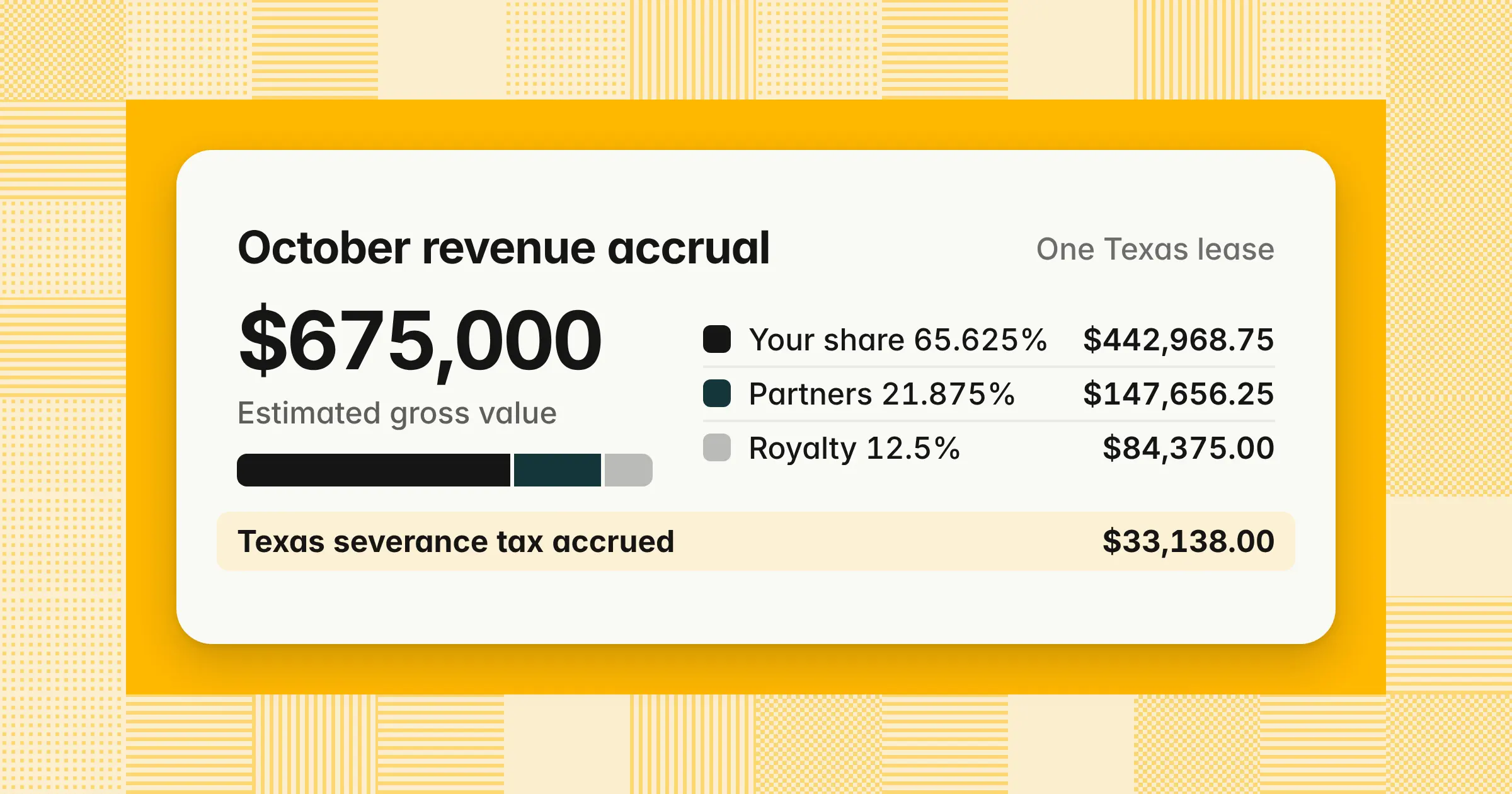
Example A (illustrative): October revenue accrual on a Texas lease you operate and sell for all owners. You hold a 75% working interest under a 12.5% royalty, so your NRI is 0.75 × 0.875 = 65.625%. Partners hold 0.25 × 0.875 = 21.875%, and royalty owners hold 12.5%, for 100% in total.
| October production (8/8ths) | Volume | Estimated realized price | Gross value |
|---|---|---|---|
| Oil | 9,000 bbl | $70.00 index average − $3.00 differential = $67.00 per bbl | $603,000.00 |
| Gas | 30,000 Mcf | $3.00 index − $0.60 deducts = $2.40 per Mcf | $72,000.00 |
| Total | $675,000.00 |
The $675,000.00 splits into $442,968.75 for you (65.625%), $147,656.25 for partners (21.875%), and $84,375.00 for royalty owners (12.5%). Partner and royalty shares together are $232,031.25.
Texas severance tax on the same volumes is 4.6% × $603,000.00 = $27,738.00 for oil and 7.5% × $72,000.00 = $5,400.00 for gas, or $33,138.00 in total. Your 65.625% share is $21,746.81, and the partners' and royalty owners' share of $11,391.19 is withheld from their distributions.
| October 31 entries | Debit | Credit |
|---|---|---|
| Accrued oil and gas receivable | $675,000.00 | |
| Oil and gas revenue | $442,968.75 | |
| Revenue distribution payable (partners and royalty owners) | $232,031.25 | |
| Severance tax expense | $21,746.81 | |
| Revenue distribution payable (owners' tax withheld) | $11,391.19 | |
| Accrued oil and gas receivable (oil tax withheld by the first purchaser) | $27,738.00 | |
| Severance tax payable (gas) | $5,400.00 | |
| Total | $708,138.00 | $708,138.00 |
In Texas, the first purchaser pays the oil production tax and deducts it from your proceeds, so the $27,738.00 of oil tax reduces the receivable. The gas tax is primarily paid by the producer unless a contract shifts it to the purchaser, so the $5,400.00 goes to severance tax payable. The purchaser's October oil tax is due November 25, and your October gas report is due December 20, or the next business day when the 20th falls on a weekend (December 21 in 2026). Other states set different rates, due dates, and filing rules.
With a 60-day lag, here's where each open month stands at the October close:
| Production month | Status at the October close | What you do |
|---|---|---|
| August | Statement received | True up the August estimate to the statement |
| September | Still an estimate | Keep the September accrual, updated for known changes |
| October | New estimate | Book the accrual above |
Two of the three open production months are estimates at every close, so the close is only as good as your price deck and volume cutoff. For the August true-up, say you accrued $430,000.00 of net revenue and the statement shows $421,500.00. Record the $8,500.00 shortfall as a prior period adjustment in October revenue, and don't reopen August. Assuming the shortfall is shared by decimal, the gross shortfall is $8,500.00 ÷ 65.625% = $12,952.38, and the other owners' 34.375% share is $4,452.38, so the entry is:
| October entry: August true-up | Debit | Credit |
|---|---|---|
| Oil and gas revenue, prior period adjustment | $8,500.00 | |
| Revenue distribution payable (owners' share of the shortfall) | $4,452.38 | |
| Accrued oil and gas receivable | $12,952.38 | |
| Total | $12,952.38 | $12,952.38 |
Severance tax on the shortfall trues up the same way. Booking the difference in the current month is correct when it's a change in estimate under ASC 250, as purchaser true-ups typically are. A true error in a closed period, such as a wrong decimal applied for months, follows your error-correction policy under ASC 250 instead.
Under ASC 606, you recognize oil and gas revenue when control passes to the purchaser, typically at the agreed delivery point in the production month. Whether gathering, processing, and transportation deducts reduce revenue or sit in expense depends on where control transfers and your principal-versus-agent analysis. Recognize only your NRI share as revenue when you sell for other owners.
There's no published benchmark for the typical gap between estimated and actual revenue. Track it yourself by comparing each month's accrual by well and purchaser with the statement when it arrives. If the variance keeps running in one direction, fix the price differential or volume estimate instead of accepting recurring prior period adjustments.
How does joint interest billing fit into the close?
Joint interest billing is how the operator charges each non-operating partner its working-interest share of costs on a well. In the close it runs after LOE and capital are coded to wells and AFEs: apply the ownership deck, add COPAS overhead, move partners' shares to receivables, then issue JIB statements after the books close.
Under the COPAS 2005 accounting procedure, the operator bills non-operators on or before the last day of the month for the preceding month. Each party pays within 15 days of receipt, and late balances bear interest at Wall Street Journal prime plus 3% a year, compounded monthly, or the maximum lawful rate if lower. The COPAS 2022 Model Form moves to a 30-day payment period. Whichever version your signed JOA attaches as Exhibit C governs.
Your close looks different depending on which side of the JIB you're on:
| Close step | Operator | Non-operator |
|---|---|---|
| Vendor costs | Records gross invoices and field tickets for the well | Records its share from the operator's JIB |
| Partner shares | Moves partners' WI shares to a JIB receivable | Accrues its share as a payable to the operator |
| Month-end gap | Accrues gross for work done but not invoiced | Accrues an estimate, because the JIB arrives about a month later |
| Overhead | Charges COPAS overhead to partners | Pays COPAS overhead in the JIB |
| Revenue | Often sells for all owners and pays out shares | Accrues its share by well until checks arrive |
The JIB cutoff and the close cutoff are different dates. The JIB cutoff is the last day costs can be coded into this month's JIB run, and costs coded after it go on the next JIB. The close still accrues those late costs in the right month.
Example
Example B (illustrative): the October JIB cycle on COPAS 2005 dates. An operated well incurs $200,000.00 of gross LOE in October. You hold 75% WI, and one partner holds 25%.
| Operator, October 31 | Debit | Credit |
|---|---|---|
| Lease operating expense (75%) | $150,000.00 | |
| JIB receivable, partner (25%) | $50,000.00 | |
| Accounts payable or accrued LOE | $200,000.00 | |
| Total | $200,000.00 | $200,000.00 |
The October JIB statement goes out on or before November 30. If the partner receives it on November 30, payment is due within 15 days, by December 15.
| Non-operator (the 25% partner), October 31 | Debit | Credit |
|---|---|---|
| Lease operating expense | $50,000.00 | |
| Accrued JIB payable | $50,000.00 | |
| Total | $50,000.00 | $50,000.00 |
The partner can't wait for a statement that arrives in late November, so it accrues $50,000.00 from prior JIBs, AFEs, and known activity, then trues up when the JIB arrives. The operator builds its JIB from the closed month, so JIB timing never shortens the operator's close, but it does set the non-operator's estimate cycle.
If you're a non-operated working interest owner, apply this to every operator and purchaser: accrue expected JIBs and revenue by well, keep a received and not-received list, and true up in the current month when JIBs and checks arrive.
A JIB statement typically shows the property and well, the AFE number, the cost category and account, the gross amount, the partner's decimal interest, the partner's net share, COPAS overhead, prior balance, payments received, and the amount due.
To set up JIB in a mid-size E&P, start with master data: JOAs, ownership decks, COPAS overhead rates, and AFE numbers. Code every invoice to well, AFE, and account. Reconcile the JIB clearing account to zero each month, and review partner receivable aging before statements go out.
How do you accrue LOE and AFE capital at month end?
Accrue LOE from field tickets, prior-month run rates per well, and known activity like workovers, then reverse it on day one of the next month. If you operate, accrue the gross amount and move partners' shares to a JIB receivable. If you don't, accrue your net share of the expected operator JIB. True up when invoices arrive.
Lease operating expense is the operating cost, or opex, of an oil and gas well. It covers lifting costs such as pumpers, chemicals, saltwater disposal, electricity, compression, and repairs that keep a well producing without adding reserves. Example B shows both the operator's gross accrual and the non-operator's net accrual. The general method for unbilled costs is in the guide to accrued expenses.
Capital follows a different path. Code drilling, completion, and major workover costs to the AFE that approved them, not to LOE. Each month:
- Accrue incurred costsUse daily drilling and completion reports to accrue work done but not invoiced
- Compare to budgetTrack spend against each AFE and flag projects running over
- Move completed wellsTransfer finished wells from wells in progress into producing properties
- Flag suspended projectsSend suspended or abandoned projects for capitalization or impairment review
Intangible drilling costs (IDC), such as labor, fuel, drilling mud, and site preparation, are capitalized for book purposes under full cost. Under successful efforts, IDC on development wells is capitalized, while costs of exploratory wells that find no proved reserves are expensed. For federal income tax, many producers can elect to deduct IDC when incurred, subject to limits. At month end, code IDC to the AFE and accrue drilling invoices not yet received.
How do you book depletion, ARO accretion, and the ceiling test each month?
Monthly units-of-production depletion equals the depletable cost base divided by beginning-of-month reserves, times the month's production. Book it after final volumes are in. Accrete each ARO layer at its credit-adjusted risk-free rate. If you use full cost, run the SEC ceiling test at each quarterly reporting date, not monthly.
Depletion is the oil and gas version of depreciation: it spreads capitalized well costs over the reserves they produce.
Example
Example C (illustrative): October units-of-production depletion.
| Step | Calculation | Result |
|---|---|---|
| Depletable cost base | $10,000,000 net book value + $500,000 October additions (no future development or abandonment costs, no exclusions) | $10,500,000 |
| Beginning-of-month reserves | 1,900,000 BOE at month end + 100,000 BOE produced | 2,000,000 BOE |
| Depletion rate | $10,500,000 ÷ 2,000,000 BOE | $5.25 per BOE |
| October depletion | $5.25 × 100,000 BOE | $525,000 |
The entry debits DD&A expense $525,000 and credits accumulated DD&A $525,000. Under successful efforts, development costs deplete over proved developed reserves and leasehold costs over total proved reserves. Under full cost, the whole pool depletes over total proved reserves, and SEC Rule 4-10(c)(3) sets the base: capitalized costs net of accumulated amortization, plus estimated future costs to develop proved reserves and estimated dismantlement and abandonment costs net of salvage. You may exclude the cost of unproved properties and major development projects until proved reserves are assigned. Don't count abandonment costs twice if they're already capitalized as ARO assets. Example C assumes future development and abandonment costs are zero and nothing is excluded. The rate holds between reserve reports unless something significant changes.
Full cost accounting capitalizes every cost of finding reserves, including dry holes, into one pool per country. Successful efforts expenses exploration costs that don't lead to proved reserves, such as geological and geophysical work and exploratory dry holes. The choice changes several close tasks:
| Close task | Successful efforts | Full cost |
|---|---|---|
| Exploration costs | Geological and geophysical costs and exploratory dry holes are expensed | Capitalized into the cost pool |
| Depletion unit | By field or reservoir | One pool per country |
| Impairment | Tested when triggering events occur | SEC ceiling test at each quarterly reporting date |
| Write-down reversal | Not reversed | Not reinstated for later ceiling increases |
| Property sales | Gain or loss recognized | Usually no gain or loss unless the sale would significantly change the relationship between capitalized costs and proved reserves |
The full cost ceiling, set in 17 CFR 210.4-10, is the present value of future net revenues from proved reserves discounted at 10%, plus unproved costs, less tax effects. Reserve prices are the unweighted average of the first-day-of-the-month price for each of the prior 12 months. Capitalized costs above the ceiling are charged to expense in that period.
Each month, accrete each asset retirement obligation (ARO) layer by its beginning liability times the credit-adjusted risk-free rate used when that layer was recorded, and classify the accretion as an operating expense, not interest. Add a new layer at the current rate for each well drilled in the month, depreciate the capitalized retirement cost, and charge plugging spend against the liability. For example, an illustrative $8,000,000 liability at a 6% annual rate accretes $8,000,000 × 6% ÷ 12 = $40,000 a month.
How do severance, ad valorem, and royalty accruals work at month end?
Accrue severance tax in the production month on the taxable value in your revenue accrual. In Texas, that's 4.6% of market value for oil, due the 25th of the next month, and 7.5% for gas, due the 20th of the second month. Accrue ad valorem tax monthly from the annual estimate, then true up to the bill. Other states differ.
Severance tax rides on the revenue accrual, as Example A shows. Ad valorem tax is an annual property tax on producing properties, so you spread the estimate evenly. For example, an illustrative $240,000 annual estimate means a $20,000 accrual each month, trued up when the bill arrives.
Royalties and owner revenue follow the sale. When you sell production for all owners, accrue the full sales value, credit your share to revenue, and credit royalty, overriding royalty, and partner shares to revenue distribution payables. Then:
- Withhold taxes by ownerDeduct each owner's share of severance tax from the distribution payable
- Reconcile payablesTie the distribution payable to the last distribution run plus new accruals
- Age suspenseReview owner suspense balances held for title issues, missing addresses, or minimum payment thresholds, and follow your state's unclaimed property rules
- Pay from actualsPay owners from the distribution run built on actual statements, not from estimates
Payment deadlines set when the distribution run has to land. In Texas, the first royalty payment is due 120 days after the end of the month of first sale, then, unless your lease or another written agreement sets a different schedule, 60 days after the end of the month of sale for oil and 90 days for gas. Royalties on federal leases are due at the end of the month following the month the oil and gas is produced and sold. Put both on your close calendar next to the purchaser statement dates.
How do you handle hedges and gas imbalances at month end?
Remeasure every open swap, collar, and basis swap at fair value using month-end forward curves, and record settlements for contracts that expired in the month. Many E&Ps don't designate derivatives for hedge accounting, so the full mark-to-market change hits earnings every close. Reconcile positions to counterparty statements before posting.
Diamondback Energy's 2020 Form 10-K, for example, says the company does not designate its derivatives for hedge accounting. If your company applies cash flow hedge accounting under ASC 815, changes in the hedge's fair value generally go through other comprehensive income until the hedged sale affects earnings. That also adds hedge documentation work each period.
A gas imbalance happens when you sell more or less gas than your ownership share of production, which leaves you overlifted or underlifted. At month end, reconcile pipeline and operator allocation statements to your entitlement and update the imbalance schedule by well. Under ASC 606, revenue generally follows actual sales, and you record a liability for overproduced positions you expect to settle in gas or cash, as your policy defines.
What journal entries does an oil and gas company post at month end?
Typical oil and gas month-end entries are the revenue accrual and prior-period true-up, royalty and partner payables, severance and ad valorem accruals, the LOE accrual and its reversal, AFE capital accruals, JIB receivables and COPAS overhead, depletion, ARO accretion, derivative mark-to-market and settlements, gas imbalance adjustments, and intercompany entries.
| Entry | Debit | Credit | Timing |
|---|---|---|---|
| Revenue accrual | Accrued oil and gas receivable | Oil and gas revenue; revenue distribution payable | Each open production month |
| Prior period adjustment (actual below estimate) | Oil and gas revenue; revenue distribution payable | Accrued oil and gas receivable | When the statement arrives |
| Severance tax accrual | Severance tax expense; revenue distribution payable (owners' share) | Severance tax payable, or the receivable where the purchaser withholds | With the revenue accrual |
| Ad valorem accrual | Ad valorem tax expense | Accrued property taxes | Monthly, one-twelfth of the estimate |
| LOE accrual, operator | Lease operating expense; JIB receivable (partners' share) | Accrued liabilities | Month end, reversing |
| LOE accrual, non-operator | Lease operating expense | Accrued JIB payable | Month end, trued up to the JIB |
| AFE capital accrual | Wells and equipment in progress | Accrued capital expenditures | Month end, reversing |
| COPAS overhead, operator | JIB receivable (partners' share) | Overhead recovery, per your policy | With the JIB run |
| Partner payment received | Cash | JIB receivable | Within the COPAS payment period |
| Depletion | DD&A expense | Accumulated DD&A | After final volumes |
| ARO accretion | Accretion expense | Asset retirement obligation | Monthly |
| New ARO layer | Asset retirement cost (oil and gas properties) | Asset retirement obligation | Month a well is drilled |
| Derivative mark-to-market (gain) | Derivative asset | Unrealized gain on derivatives | Month end, reversed for losses |
| Derivative settlement (received) | Cash | Derivative asset, with any difference to gain on derivatives | Month the contract settles |
| Gas imbalance, overproduced | Oil and gas revenue | Gas imbalance liability | Per your imbalance policy |
| Full cost ceiling write-down | Impairment expense | Accumulated DD&A | Quarterly, if the pool exceeds the ceiling |
| Intercompany charges between operating entities | Intercompany receivable (billing entity); expense (receiving entity) | Cost recovery (billing entity); intercompany payable (receiving entity) | Month end, matched by both entities |
For how each entry type is prepared and reviewed, see the guide to month-end journal entries. Companies with an operating entity that bills affiliated partnerships also need matched balances on both sides, covered in the guide to intercompany accounting.
Day-by-day oil and gas close calendar
A 5-business-day oil and gas close runs four workstreams in parallel. Lock volumes and accrue LOE on days 1–2, accrue revenue, royalties, and severance and mark hedges to market on day 3, and finish JIB and AFE review, DD&A, and ARO on day 4. Review, sign off, and lock on day 5, and send the management pack on day 6.
This illustrative calendar shows the order and the handoffs:
| Day | Revenue and production | Costs, JIB, and capital | Hedges, DD&A, and ARO | Reconciliations and review |
|---|---|---|---|---|
| Day 0Last day of the month | Send the production cutoff notice; freeze DOI changes for the month | Close field ticket intake for the month | Capture month-end forward curves and open positions | Reconcile bank accounts to date |
| BD1 | Load run tickets, meter data, and well tests | Post payables; accrue LOE by well | Confirm open positions with counterparties | Cash and payroll reconciliations |
| BD2 | Reconcile volumes to purchaser and pipeline statements; book prior period adjustments | Accrue late LOE; code capital to AFEs | Book settlements for contracts that expired | Payables and accrued liabilities reconciliations |
| BD3 | Accrue open months; royalty and partner payables; severance and ad valorem | Start the JIB run: ownership decks and COPAS overhead | Mark derivatives to market | Intercompany matching |
| BD4 | Reconcile distribution payables and suspense; update the gas imbalance schedule | Finish JIB; clear JIB clearing to zero; accrue non-operated JIBs; review AFEs and WIP | Depletion on final volumes; ARO accretion | Partner receivable aging; fixed asset roll-forward |
| BD5 | Quarter end only: ceiling test or impairment review | Reviewer approval of reconciliations and entries; flux review; controller sign-off and period lock | ||
| BD6 | Management reporting pack to the CFO | |||
| After close | Owner distribution run; confirm purchasers' oil tax by the 25th; file gas tax by the 20th of the second month | Issue JIB statements by the last day of the month |
Two dependencies set the order. Depletion needs final volumes, so it can't start before the volume reconciliation is done, and mark-to-market needs month-end curves. For general calendar templates, see the month-end close calendar, and for the step-by-step order every close shares, see the month-end close process.
Late oil and gas closes tend to trace to four bottlenecks:
- Late production dataVolumes arrive after cutoff, so revenue, taxes, and depletion all wait
- Stale ownership decksA DOI change posted late forces revenue and JIB reruns
- Missing statementsThe team waits for an operator or purchaser statement instead of estimating it
- Manual handoffsReconciling the energy accounting system to spreadsheets and the general ledger by hand
Fix cutoff discipline first, then estimate anything missing by the cutoff day and true it up later. Lock the period at sign-off, as the guide to locking an accounting period explains, so true-ups land in the open month.
What KPIs should an oil and gas close team track?
Track days to close, revenue accrual variance against actual statements, the number and dollar value of prior period adjustments, unreconciled items older than 90 days, owner suspense balances, JIB receivable aging, and the share of accounts reconciled and reviewed by the deadline. Review them monthly so estimate quality improves along with speed.
Calculate revenue accrual variance, the energy-specific measure, as the actual statement amount minus the accrual, by purchaser and month. For formulas, targets, and a free scorecard for the general close KPIs, see month-end close KPIs.
How is the close different for midstream, utilities, and renewable energy?
Midstream companies close on throughput and fees, utilities on metered usage and regulated rates, and renewable energy companies on metered megawatt-hours, PPAs, and renewable energy certificates. None of them books upstream depletion or JIB, but all three run on volume data that arrives after month end.
| Close area | Midstream (gathering, processing, pipelines) | Utilities (electric and gas) | Renewable energy (solar and wind) |
|---|---|---|---|
| Revenue driver | Volumes gathered, processed, and transported; fees and product sales | Metered customer usage under approved rates | Metered MWh sold under PPAs or into the market |
| Main month-end accrual | Fee revenue and product sales from plant statements | Unbilled revenue for usage since the last meter read | Unbilled PPA revenue from meter data |
| Reconciliation focus | Meter allocations, shipper imbalances, fuel, and lost and unaccounted-for gas | Billing to cash, fuel and purchased power costs | Generation data against offtaker invoices; RECs generated against RECs issued by the registry |
| Regulatory or contract items | Tariffs and contract minimums | Regulatory assets and liabilities, cost recovery clauses | Virtual PPAs that may be derivatives under ASC 815 |
| Asset accounting | Depreciation of pipelines and plants | Depreciation and rate base tracking | Straight-line depreciation of plant; decommissioning ARO |
| Partners | Joint ventures on some systems | Usually none in the close | Tax equity investors, often allocated using hypothetical liquidation at book value (HLBV) |
For utilities, close software has to handle high-volume reconciliation, fixed asset roll-forwards, and SOX-ready review rather than JIB or depletion. In renewable project finance, "financial close" also means the date a project's financing is signed. This guide covers the monthly accounting close, which picks up the new project entity, its debt, and its tax equity accounts once financing closes. In the monthly close for a renewable energy company, record REC revenue or inventory under your policy, since accounting for certificates varies by company. For midstream, apply the same estimate-then-true-up approach to meter allocations.
What accounting systems do oil and gas companies use to run the close?
Upstream operators typically run a dedicated oil and gas accounting system such as Quorum (including the former OGsys), Enertia, IFS BOLO (formerly P2 BOLO), W Energy, or PakEnergy for revenue distribution, JIB, and division orders. Larger or diversified companies often use SAP or Oracle with industry add-ons. The close itself spans these systems, spreadsheets, banks, and field data.
The two layers do different work:
| Layer | What it does | Examples of systems teams run |
|---|---|---|
| Energy accounting system | Production accounting, revenue distribution, division orders, JIB, AFEs, owner payments | Quorum, Enertia, IFS BOLO, W Energy, PakEnergy, or SAP and Oracle with joint venture and industry modules |
| General ledger and ERP | Corporate entities, consolidation, payables, reporting | The energy system's own ledger, or NetSuite, SAP S/4HANA, Oracle, Microsoft Dynamics 365, Business Central, or QuickBooks |
| Close layer | Checklist, reconciliations, accruals, journal entry review, sign-off, audit evidence | Close software or spreadsheets on top of the ledger |
Production data usually flows from field capture or SCADA into a production accounting module, which allocates volumes to wells and feeds revenue accounting and the general ledger. The weak points are manual uploads and spreadsheet handoffs, which is why the volume reconciliation sits early in the calendar.
Mid-size operators often choose a dedicated oil and gas accounting system, because general ERPs need add-ons for JIB, revenue distribution, and division orders. Diversified companies with corporate entities often keep SAP, Oracle, or NetSuite at the top and feed it from the energy system. If you run NetSuite or QuickBooks Online for a small operator, keep the JIB and revenue math in a dedicated tool or add-on and post summarized entries to the ledger.
If you run SAP S/4HANA, Joint Venture Accounting does the partner split at period-end. The cutback allocates operated costs to partners by their equity share, equity adjustments rebalance costs when ownership changes, cash calls are reclassified against the costs they funded, and overhead is calculated. Run those steps before you reconcile the JIB receivables.
JIB is calculated inside these oil and gas accounting systems or their ERP add-ons. General close tools don't calculate JIB. They reconcile the JIB clearing and partner receivable accounts and track the JIB task inside the checklist.
Which month-end close software works for energy and oil and gas companies?
Pick a close layer that works on top of your energy accounting system and ERP rather than a second oil and gas ERP. The close tool should run the checklist, reconcile every account, prepare entries with workpapers, and require reviewer approval before anything posts.
If you run Quorum or Enertia, keep the industry math there and use their own close features. You can also add a close platform above them for task tracking, balance sheet reconciliations, journal entry review, and audit evidence.
This section covers close software for energy and utility companies. Software for accruing your own company's utility bills is a different category.
Among general close vendors, BlackLine and Trintech publish dedicated energy pages, and FloQast publishes one energy case study. Numeric, HighRadius, and Ledge had no energy pages when we checked on November 10, 2026. The results below are what each vendor reports.
| Vendor | Energy coverage | Results the vendor reports |
|---|---|---|
| BlackLine | Energy and natural resources page | sPower, a renewable energy producer, closes 66% faster each month; Hydro automated 90% of its global finance tasks |
| Trintech (Cadency) | Power and utilities page | Auto-match above 99%, a 75% shorter close, and 62% fewer write-offs; customers include Atmos Energy and Engie |
| FloQast | One energy case study | Aspect Energy cut its U.S. monthly close to 10 days, from 12 to 15, and its international quarterly close to under 30 days, from more than 45 |
| Numeric, HighRadius, Ledge | No energy page found | None published |
Ask each vendor to show a working connection to your energy system in the demo. BlackLine says it integrates with any ERP, but none of these vendors' energy pages names Enertia, Quorum, or IFS BOLO as a standard connector. Plan for a file or database extract from those systems. If your general ledger is NetSuite, SAP S/4HANA, or Oracle, a close tool with a native connector reads the ledger directly.
Use these requirements to compare month-end close software for energy companies:
| Requirement | Why it matters in an energy close | What to ask in a demo |
|---|---|---|
| Reads the ledger and energy subledgers | Revenue, JIB, and distribution balances live in the energy system | Which systems does it read from, and how often? |
| Reconciles every account in full | Purchaser receivables, JIB clearing, and suspense hide small breaks | Does it check every line or sample? |
| Prepares accruals with workpapers | Revenue, LOE, and non-operated JIB accruals are estimates | Can it show the inputs behind each accrual? |
| Separate preparer and reviewer | Auditors, and SOX for public companies, expect segregation of duties | Can one person prepare and approve the same entry? |
| Approval before posting | Estimates should never post unreviewed | What exactly does the approver see before approving? |
| Audit trail | Auditors test accruals, PPAs, and partner balances | Does every entry record who prepared it, who approved it, when, and the source documents? |
| Period lock | True-ups belong in the open month | Can anyone post into a closed period? |
| Where it runs | Producers and utilities often keep production and partner data inside their own network | Can it run in your own cloud or on-premises, and does any data leave your environment? |
For audit trail, check that every entry links to its source documents, such as purchaser statements, JIBs, and field tickets, and that the system keeps an append-only activity log your auditors can read. Account-level methods are in the guide to account reconciliation, and variance review is in the guide to flux analysis.
AI can automate much of the energy close today. AI agents can reconcile accounts line by line, prepare accruals and journal entries with workpapers, match purchaser statements, and flag variances. Accountants still own reserve inputs, impairment and ceiling-test judgments, ownership disputes, and policy calls, and a named reviewer should approve every entry before it posts. The guide to AI in the month-end close covers how to test whether it's working. To move work out of the close window, see the guide to a faster month-end close. To compare tools by the work they do, see the best month-end close software.
How we approach it
JIB, revenue distribution, and production accounting stay in your energy accounting system. Our Close Agent works on top of your ERP, reading from and posting approved entries to NetSuite, Oracle, SAP S/4HANA, Microsoft Dynamics 365, Business Central, and QuickBooks, and reading from Odoo. It runs the close checklist, reconciliations, and accruals, and nothing posts until a named approver signs off on the exact lines. It deploys in a dedicated AWS account we manage for you, in your own AWS account, or on-premises, so production and partner data can stay inside your network. To see how it fits your close, explore our Close Agent.
Share this article