BlogGuide
Healthcare month-end close: Hospital checklist, worked entries, and which software fits
30 min read
Key takeaways
- A healthcare close runs on revenue estimates. Under ASC 606, hospitals book net patient service revenue after contractual allowances and implicit price concessions, accrue Medicare and Medicaid settlements as they go, and keep charity care out of revenue entirely.
- No published benchmark measures how long a healthcare close takes. Across industries, half the teams in Ledge's 2025 survey close within five business days, and the hospital-only work on this page can push providers past that.
- Close software runs the checklist, reconciliations, and review on top of your ERP, but the allowance model, cost report, and 340B math stay with your revenue and reimbursement teams. Any vendor that handles patient-level data needs a business associate agreement.
The healthcare month-end close is how a provider's finance team turns a month of patient charges, payer remittances, payroll, and supply costs into reviewed, locked books. Running it on sound estimates gives your CFO and board revenue numbers they can rely on, with fewer surprises when payers and Medicare settle.
What is the month-end close in healthcare?
The month-end close in healthcare is the work a provider's finance team does after each month ends to record, reconcile, and review the books before they lock. It follows the same steps as any month-end close, then adds patient revenue estimates, payer settlements, charity care, 340B drug pricing, and physician pay accruals.
- Net patient service revenue (NPSR)The amount you expect to collect for care you delivered in the month, after price concessions
- Explicit price concessionA known discount off gross charges, such as a negotiated payer rate or an uninsured discount, usually booked as a contractual allowance
- Implicit price concessionThe part of a patient's balance you expect not to collect, estimated when you provide the care rather than written off later as bad debt
This guide covers providers: hospitals and health systems, physician groups and clinics, and other providers such as home health, hospice, ambulatory surgery centers, and community health centers. Payers and health plans close on claims reserves and statutory reporting, and pharma and life sciences companies close on inventory, R&D, and gross-to-net rebates, so both are out of scope here.
Healthcare accounting is the wider practice of applying GAAP to providers, mainly ASC 954 for health care entities and ASC 606 for patient revenue. Government-owned hospitals report under GASB standards instead. A healthcare accountant, sometimes called a medical accountant, works across revenue accounting, reimbursement, and the general ledger, and the month-end close is the cycle where that work comes together.
In medical billing, "month-end close" often means something narrower: closing the period in the practice management or patient accounting system so charges and payments stop changing. That billing close is an input to the accounting close, which starts when finance ties those subledger totals to the general ledger.
How is a hospital close different from a normal company's close?
A hospital close is different because revenue is an estimate. Gross charges rarely match what payers and patients pay, so finance books revenue at the expected amount, accrues Medicare and Medicaid settlements, keeps charity care out of revenue, and ties the patient accounting subledger in Epic, Oracle Health, or Meditech to the general ledger.
The revenue cycle, which runs from registration and charge capture through claims, payment posting, and denials, feeds every revenue line in the close. Here's how a hospital or health system compares with a typical company:
| Area | Typical company | Hospital or health system |
|---|---|---|
| Revenue source | Invoices at agreed prices | Gross charges from the chargemaster, paid at payer-specific rates |
| Revenue measurement | The invoice amount | The expected amount after explicit and implicit price concessions |
| Receivables | One customer aging | Patient A/R by payer, patient class, and aging bucket, held in the EHR's patient accounting subledger |
| Government settlements | None | Medicare and Medicaid cost report settlements, accrued as variable consideration |
| Free services | Rare | Charity care, excluded from revenue and disclosed at cost |
| Labor | Salaries, commissions, and bonuses | Overtime, shift differentials, on-call pay, agency staff, and productivity-based physician pay |
| Inventory | Goods for sale | Medical supplies, implants, and pharmacy drugs, some bought at 340B prices |
| Entities | Often one or a few | Hospitals, physician groups, foundations, and joint ventures, often inside an obligated group for bond reporting |
| Data sources | ERP, bank, and payroll | EHR and patient accounting, payer remittances, cost report models, payroll, and supply chain systems |
How long does a hospital month-end close take?
No published benchmark measures how long the month-end close takes at hospitals or health systems. A figure of 8.1 days circulates in AI answers and vendor blogs, but its source doesn't say which survey produced it. The best dated data is cross-industry: half the teams in Ledge's 2025 survey close within five business days.
Ledge surveyed 100 finance professionals at companies with 51 to more than 10,000 employees, including healthcare respondents, and updated the results on August 8, 2026. The report doesn't break out healthcare, so treat it as the cross-industry range your hospital sits in.
| Business days to close | Share of respondents |
|---|---|
| 1–3 | 18% |
| 4–5 | 32% |
| 6–7 | 23% |
| More than 7 | 27% |
Several hospital-only steps can push providers toward the slower end of that range:
- The allowance model waits on remittancesRevenue accounting can't finalize price concessions until month-end payment and denial data is posted
- Settlement estimates need the reimbursement teamCost report models get updated by a small group that's also filing and appealing prior years
- Interfaces breakCharges or payments that fail between the EHR and the ERP leave the subledger and the general ledger out of balance
- Entities multiplyA system with hospitals, physician groups, a foundation, and an obligated group has more intercompany and consolidation work
Set your target from your own baseline and complexity. A single hospital on one ERP can reasonably aim for the cross-industry middle of four to five business days. A multi-state system with many entities and bond reporting often needs longer. Measure from period end to the final consolidated package, and track it every month. For cross-industry benchmarks by company size, see how long the month-end close should take, and for ways to move work out of the close window, see the guide to a faster month-end close.
What's on a hospital month-end close checklist?
A hospital month-end close checklist runs four tracks in parallel: revenue cycle, general accounting, reimbursement, and reporting. Each line needs an owner, a reviewer, a due day, and a source system, for example the contractual allowance model prepared by revenue accounting on business day 2 and reviewed by the controller on day 3.
The illustrative schedule below fits an 8-business-day close for a hospital or small system. BD1 is the first business day after month end.
| Task | Owner | Reviewer | Due day | Source system |
|---|---|---|---|---|
| Send the charge cutoff notice to clinical departments | Revenue integrity manager | Patient financial services (PFS) director | Day 0 (last day of the month) | EHR and charge capture |
| Close the patient accounting period and run the GL interface | Revenue accountant | Revenue accounting manager | BD1 | EHR patient accounting, interface engine, ERP |
| Reconcile bank, lockbox, and card settlement accounts; clear unapplied cash | Treasury accountant | Accounting manager | BD1 | Bank portals, ERP |
| Accrue payroll, overtime, shift differentials, on-call pay, and PTO | Payroll accountant | Accounting manager | BD1 | Payroll and timekeeping |
| Tie patient A/R in the subledger to the GL control account by facility | Revenue accountant | Revenue accounting manager | BD2 | EHR reports, ERP |
| Value DNFB and in-house accounts | Revenue accountant | Revenue accounting manager | BD2 | EHR DNFB and census reports |
| Run the contractual allowance and implicit price concession model | Revenue accounting manager | Controller | BD2, reviewed BD3 | Spreadsheet or decision support tool |
| Accrue supplies, implants, pharmacy, and agency staffing; cut off AP | AP and supply chain accountants | Accounting manager | BD2 | ERP, supply chain system |
| Review reserves with PFS, revenue integrity, and managed care contracting | Revenue accounting manager | Controller | BD3 | Allowance model, denial reports |
| Update Medicare and Medicaid settlement estimates | Reimbursement manager | Controller | BD3 | Cost report model |
| Post charity care write-offs; reconcile 340B purchases and contract pharmacy statements | Revenue accountant; pharmacy accountant | Revenue accounting manager | BD3 | EHR, wholesaler and third-party administrator files |
| Accrue physician pay and bonuses from work RVUs | Physician compensation analyst | Accounting manager | BD3 | EHR productivity reports, comp plans |
| Book IBNR for capitated or at-risk contracts | Managed care accountant or actuary | Controller | BD4 | Claims lag data |
| If self-insured: update malpractice and general liability reserves for case reserves, IBNR, the latest actuarial estimate, and reinsurance recoverables | Risk or insurance accountant | Controller | BD4 | Claims system, actuarial report, reinsurance contracts |
| Depreciate medical equipment and roll forward fixed assets | Fixed asset accountant | Accounting manager | BD4 | Fixed asset register |
| Release donor restrictions met in the month (nonprofits) | Foundation accountant | Controller | BD4 | Gift agreements, foundation ledger |
| Match intercompany and consolidate hospitals, groups, and the foundation | Corporate accounting manager | Controller | BD5 | ERP consolidation |
| Reconcile balance sheet accounts and run flux review | Staff accountants | Accounting manager | BD5–BD6 | ERP, reconciliation workpapers |
| Test bond covenants such as days cash on hand and debt service coverage | Treasury manager | CFO | BD6 | Consolidated statements |
| Prepare statements and the board package with revenue cycle KPIs | Financial reporting manager | CFO | BD7 | ERP, reporting tools |
| Sign off and lock the period | Controller | CFO | BD8 | ERP |
The professional liability row applies when you self-insure malpractice and general liability, directly or through a captive. Book known claims as case reserves, add IBNR for incidents not yet reported, update both when the actuary's report arrives, and record expected reinsurance recoveries as a receivable rather than netting them against the liability. The balances can be large: HCA Healthcare's 2025 Form 10-K reports $1.997 billion of professional liability reserves at December 31, 2025, net of $47 million receivable under reinsurance, including $873 million for IBNR.
A hospital accountant's day-to-day work maps onto these rows. Revenue accountants own patient A/R and the allowance model, reimbursement staff own the cost report and settlements, general accountants own accruals and reconciliations, and the controller reviews the estimates that move the income statement most. The BD3 reserve review matters because finance can't close revenue alone. PFS knows which denials are piling up, and contracting knows which payer rates changed, so schedule the meeting before the controller's review, not after.
If you want an Excel or Google Sheets version, build it with these columns: task, track, owner, reviewer, due day, source system, GL accounts, and status. The general month-end close checklist covers the cash, payables, and reporting tasks every company shares, and the free month-end close checklist generator builds a starting file you can add these healthcare rows to. For day-by-day calendar templates, see the month-end close calendar, and for the variance step, see the guide to flux analysis.
How do hospitals book net patient service revenue at month-end?
Hospitals record net patient service revenue at the amount they expect to collect. Under ASC 606, gross charges are reduced by explicit price concessions, the contractual allowances agreed with payers, and by implicit price concessions, the patient balances they expect not to collect. Both are estimated by portfolio, such as payer and aging bucket, then trued up monthly.
The two concessions differ in what drives them:
| Aspect | Explicit price concession | Implicit price concession |
|---|---|---|
| What it is | A known discount off charges | The share of a balance you expect not to collect |
| Applies to | Payer contract rates, Medicare and Medicaid fee schedules, uninsured discounts | Self-pay balances and the patient's share after insurance, such as deductibles and copays |
| Estimated from | Contract terms and historical payment-to-charge ratios by payer | Historical collection rates by portfolio and aging bucket |
| Where it lands | Contra-revenue, usually called contractual allowances | Contra-revenue, inside the transaction price |
Under ASC 606, a later shortfall in collections is generally treated as an implicit price concession, according to PwC's Viewpoint health care guide, checked November 10, 2026. Bad debt generally applies only when a specific credit event occurs, such as a patient's bankruptcy or job loss after you assessed their ability to pay. That's why the older practice of booking a "bad debt reserve" against most patient balances no longer fits.
Most hospitals use the portfolio approach. You group accounts with similar characteristics, such as payer, patient class (inpatient or outpatient), and aging bucket, then apply each group's historical results. The look-back data you need is a set of fully resolved accounts by portfolio, showing charges, payments, and adjustments, with outliers removed. Refresh it monthly so recent payer behavior and denial trends show up in the rates.
Example
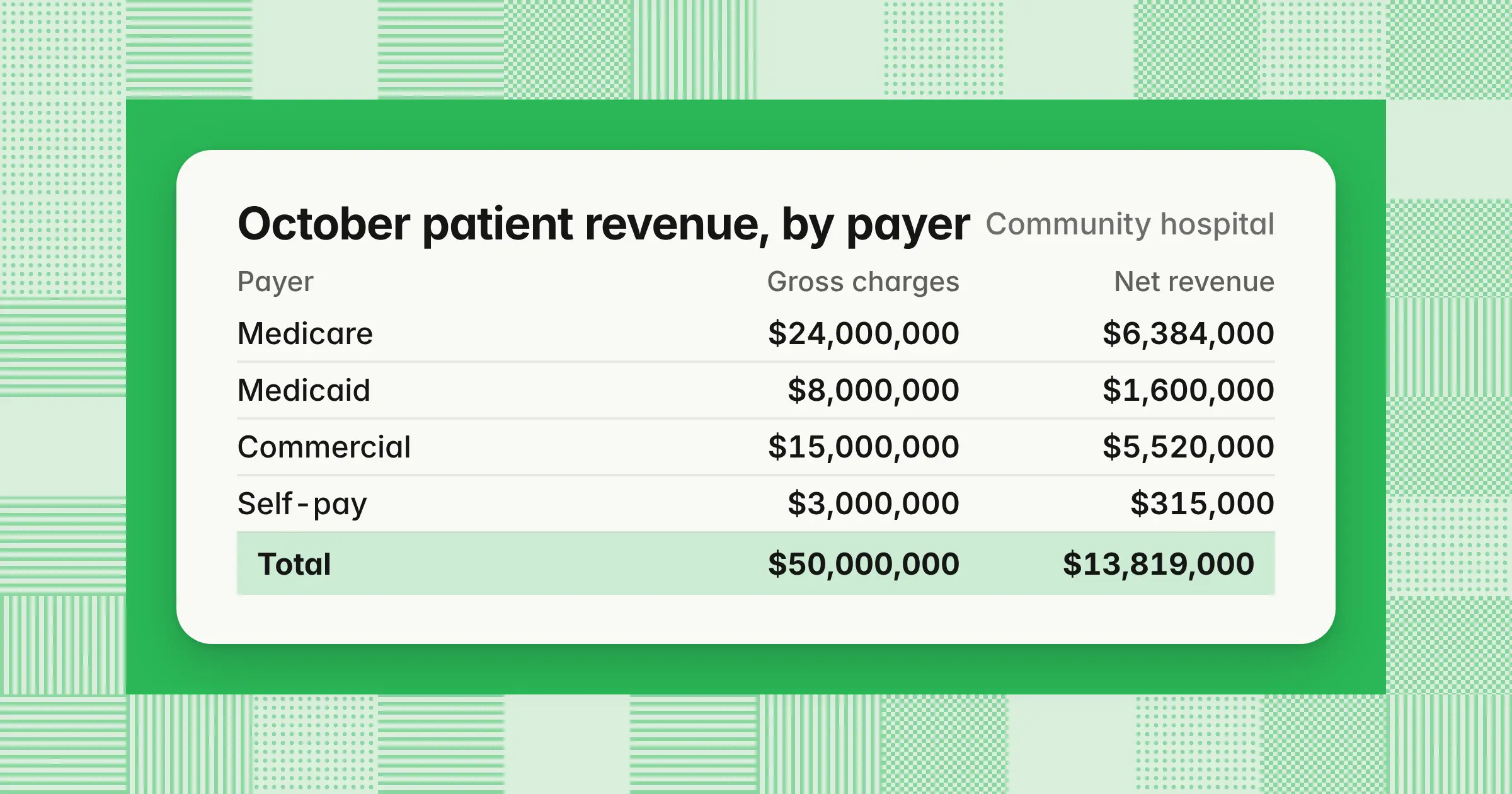
October net patient service revenue at a community hospital. The patient accounting interface posts $50,000,000 of October gross charges to patient A/R and gross patient revenue. Charity care approved under the financial assistance policy is already excluded. At month end, revenue accounting applies portfolio rates:
| Portfolio | Gross charges | Explicit price concessions | Expected after explicit |
|---|---|---|---|
| Medicare | $24,000,000 | $17,280,000 (72%) | $6,720,000 |
| Medicaid | $8,000,000 | $6,400,000 (80%) | $1,600,000 |
| Commercial | $15,000,000 | $9,000,000 (60%) | $6,000,000 |
| Self-pay | $3,000,000 | $900,000 (30% uninsured discount) | $2,100,000 |
| Total | $50,000,000 | $33,580,000 | $16,420,000 |
| Portfolio | Patient share | Expected collection on patient share | Implicit price concessions | Net patient service revenue |
|---|---|---|---|---|
| Medicare | $672,000 (10%) | 50% | $336,000 | $6,384,000 |
| Medicaid | None | n/a | $0 | $1,600,000 |
| Commercial | $1,200,000 (20%) | 60% | $480,000 | $5,520,000 |
| Self-pay | $2,100,000 (100%) | 15% | $1,785,000 | $315,000 |
| Total | $2,601,000 | $13,819,000 |
Net patient service revenue is $50,000,000 − $33,580,000 − $2,601,000 = $13,819,000, or about 27.6% of gross charges.
| October 31 entry | Debit | Credit |
|---|---|---|
| Contractual allowances (explicit price concessions, contra-revenue) | $33,580,000 | |
| Implicit price concessions (contra-revenue) | $2,601,000 | |
| Allowance for contractual adjustments (contra-A/R) | $33,580,000 | |
| Allowance for implicit price concessions (contra-A/R) | $2,601,000 | |
| Total | $36,181,000 | $36,181,000 |
This example books the allowance on one month's charges to keep the math visible. In practice, many hospitals revalue the allowance on all open patient A/R each month, while payments and contractual adjustments posted from remittances draw it down as accounts resolve. Account names vary, and many hospitals present one net figure on the income statement.
The monthly true-up. Say September's commercial outpatient portfolio had $6,000,000 of charges booked at a 40% expected payment rate. By October 31, remittances show the portfolio will pay 41%. The extra 1% is $60,000 of revenue:
| October 31 entry: September commercial true-up | Debit | Credit |
|---|---|---|
| Allowance for contractual adjustments | $60,000 | |
| Contractual allowances (increases net revenue) | $60,000 | |
| Total | $60,000 | $60,000 |
Book it in October as a change in estimate under ASC 250, which is typically right here because it reflects new payment information, not an error. Don't reopen September, and don't call it a bad debt recovery. If one portfolio keeps truing up in the same direction, fix its rate instead of accepting the same adjustment every month. For how adjustments like this fit with the rest of the close, see the guide to adjusting entries.
Treat Medicaid-pending accounts, uninsured patients whose Medicaid applications are still open, as their own portfolio. Estimate them from your history of approvals and the payment you'd expect if approved, then move accounts to the Medicaid or self-pay portfolio as decisions arrive. Applying self-pay rates to the whole group usually understates revenue, and applying Medicaid rates usually overstates it.
How do you accrue in-house and DNFB revenue at month-end?
You book revenue for care already delivered, even when the patient is still admitted or the account isn't final-billed. For discharged-not-final-billed (DNFB) accounts, make sure posted charges carry the same price concessions as billed accounts. For inpatients paid per case, accrue the earned share of the expected payment for the stay.
Start with how your interface works. If it posts charges to the ledger as they're entered, in-house and DNFB charges are already in gross revenue and A/R, so the close work is valuing them correctly. If it posts only at final billing, you need to accrue them, as the guide to accrued revenue explains for unbilled revenue generally.
Example
A Medicare inpatient still in house on October 31. The patient was admitted October 28, and the expected DRG payment is $15,000 for an expected 5-day stay. By October 31, 4 days have passed, so the earned share is 4 ÷ 5 = 80%, or $12,000. Charges posted through October 31 are $40,000, so the price concession needed on this account is $40,000 − $12,000 = $28,000. One common method spreads the expected case payment over the expected length of stay. Use the method your policy documents, and apply it the same way every month.
HFMA's 2023 MAP Keys measure the DNFB backlog as Days in DNFB: gross dollars in discharged-not-final-billed A/R at month end, divided by average daily gross patient service revenue for the month. In-house accounts, late charge bills, and rebills are excluded. The KPI table below works the October example.
A growing DNFB backlog usually traces to coding delays, documentation holds that wait on physicians, or late charges from departments. It affects the close in two ways. Valuation gets harder, because unbilled accounts don't have a claim or remittance yet. Cash also arrives later, which shows up in net days in A/R. Track DNFB days by cause each month, and age the oldest accounts so revenue integrity can clear them before the next cutoff.
How do you accrue Medicare and Medicaid cost report settlements?
Hospitals typically accrue cost report settlements monthly as variable consideration under ASC 606. The reimbursement team estimates what Medicare or Medicaid will pay or recover for the year, and finance books the change, debiting an estimated settlement receivable and crediting net patient service revenue, or the reverse for a payable.
PwC's Viewpoint health care guide treats cost report adjustments, recovery audits, recoupments, and risk-sharing bonuses or penalties as variable consideration. You estimate each with the expected value or most likely amount method, update it every period, and apply the constraint so you don't book revenue that's likely to reverse.
Example
An October update to the 2026 Medicare settlement. Each month, the reimbursement team reruns a year-to-date cost report model on actual volumes, costs, and interim payments. Through September, the model supported a $1,350,000 Medicare settlement receivable for 2026, and that's the balance booked. Run on actual statistics through October, the model estimates a year-to-date settlement of $1,750,000, so October's entry is $1,750,000 − $1,350,000 = $400,000. Spreading a full-year estimate evenly, one-twelfth a month, works only if the settlement is earned evenly through the year. Seasonal volume or a mid-year rate change breaks that assumption, so use the year-to-date model.
| October 31 entries | Debit | Credit |
|---|---|---|
| Estimated third-party settlements receivable, Medicare 2026 | $400,000 | |
| Net patient service revenue, third-party settlements | $400,000 | |
| Net patient service revenue, prior-year settlement adjustments | $250,000 | |
| Estimated third-party settlements receivable, Medicare 2024 | $250,000 | |
| Total | $650,000 | $650,000 |
The second pair records a $250,000 shortfall when the final settlement for the 2024 cost report comes in below the amount accrued. Keep prior-year changes in their own account, because many providers disclose them separately and auditors test them every year.
A Medicare cost report generally must be received by the contractor 5 months after the facility's fiscal year end, according to Noridian, a Medicare administrative contractor. For a December year end, that's the end of May. Put that month on your close calendar, because the reimbursement team will have less time for monthly estimates. Medicaid programs add their own items, such as supplemental and disproportionate share payments and provider taxes, and each state sets its own rules and timing.
One older item may still sit on your balance sheet. Provider Relief Fund payments ended June 5, 2023, according to LeadingAge, and the final standard reporting period, Reporting Period 7, closed September 30, 2024. HRSA says Reporting Periods 1 through 7 have concluded. If you still carry unspent funds, keep the repayment liability on your reconciliation list until it's cleared. For how each entry type is prepared and reviewed, see the guide to month-end journal entries.
How do charity care and 340B affect the close?
Under GAAP, charity care never counts as revenue. Care given under your financial assistance policy is written off from gross charges and disclosed at cost, never booked as an allowance or bad debt. 340B lowers drug cost under the upfront discount model, and for drugs in HRSA's revised rebate pilot, scheduled to start January 1, 2027, you'll accrue a rebate receivable instead.
PwC's Viewpoint health care guide states that charity care doesn't qualify for recognition as revenue or as a receivable. Providers disclose their charity care policy and the level of care provided, measured at cost, and may use a cost-to-charge ratio to estimate it. Nonprofit hospitals also report charity care on IRS Form 990 Schedule H.
Example
In October, the hospital approves $400,000 of gross charges as charity care. With a cost-to-charge ratio of 0.30, the cost of that care is $400,000 × 0.30 = $120,000. The $400,000 comes out of gross charges and patient A/R, so it never reaches revenue. The $120,000 goes into your charity care disclosure. If a patient qualifies after you billed them, reverse the charges out of revenue and A/R as charity care. Don't move the balance to bad debt or an implicit price concession.
The 340B Drug Pricing Program lets eligible hospitals and clinics buy outpatient drugs at discounted ceiling prices. Under today's upfront discount model, the savings show up as lower drug cost, so the close work is reconciliation:
- Inventory and costTie 340B purchases, wholesaler invoices, and split-billing files to pharmacy inventory and drug expense
- Contract pharmaciesReconcile third-party administrator statements, which often arrive after the close, and accrue the month's contract pharmacy revenue and fees from your own dispense data
- EligibilityMake sure ineligible dispenses don't land in 340B accounts, because they create repayment exposure
The rebate model changes the entry for some drugs. In February 2026, the federal district court in Maine vacated HRSA's original rebate pilot after a challenge by the American Hospital Association and hospitals. On July 31, 2026, HHS announced a revised pilot, with approved rebate models scheduled to take effect January 1, 2027, according to the AHA. The AHA and a group of hospitals sued on October 9, 2026 to block the revised pilot as well, so the start date could still change. The revised pilot covers only drugs on the Medicare Drug Price Negotiation selected drug lists for 2026 and 2027. For those drugs, you pay the higher price up front and claim a rebate afterward.
Example
January 2027. You buy $500,000 of pilot drugs at the full price and dispense them to eligible patients, and you estimate a $180,000 rebate, the difference between what you paid and the 340B ceiling price.
| January 31 entry | Debit | Credit |
|---|---|---|
| 340B rebate receivable | $180,000 | |
| Pharmacy drug expense | $180,000 | |
| Total | $180,000 | $180,000 |
Clear the receivable when the manufacturer pays, and age anything unpaid past the expected timeline. Check HRSA's final guidance and each manufacturer's approved model before you set up the accounts, because rebate terms differ by manufacturer.
How do physician groups accrue wRVU compensation and IBNR?
Physician groups accrue earned but unpaid pay every month: work RVUs produced times the conversion factor in each contract, less what payroll already paid, plus a share of quality bonuses earned to date. Groups on capitated or at-risk contracts also book an IBNR liability for care already delivered whose claims haven't arrived yet.
A work relative value unit (wRVU) measures the physician work in each service. Many compensation plans pay a dollar amount per wRVU. Kaufman Hall's Physician Flash Report tracks the related metric, provider compensation per wRVU: total provider compensation paid for the period divided by provider work RVUs.
Example
October pay accrual for one physician. The physician produced 600 wRVUs in October, and the contract pays $55 per wRVU, so October pay earned is 600 × $55 = $33,000. Payroll paid a $25,000 base draw, so $8,000 is unpaid. The contract also has a $24,000 annual quality bonus, and the group expects 75% of the targets to be met, so it accrues $24,000 × 75% ÷ 12 = $1,500 a month.
| October 31 entry | Debit | Credit |
|---|---|---|
| Physician compensation expense (productivity $8,000 + quality bonus $1,500) | $9,500 | |
| Accrued physician compensation | $9,500 | |
| Total | $9,500 | $9,500 |
Accrue payroll taxes and benefits on the same amount. October's wRVUs often aren't final at the close, because charts are still being coded, so estimate the uncoded volume from scheduled visits or charges and true up the next month. The general method for unbilled costs is in the guide to accrued expenses.
IBNR (incurred but not reported) applies when your group takes financial risk for a patient population. The American Hospital Association's 2013 guide to value-based contracting notes that under fixed or capitated payments, providers record an IBNR liability for services already provided whose claims haven't been received.
Example
IBNR for October service under a capitated contract. Claims paid to date for October service total $420,000. Your claims lag history shows that claims paid within the service month are typically 35% of the final total, the completion factor. Estimated ultimate claims are $420,000 ÷ 0.35 = $1,200,000, so IBNR is $1,200,000 − $420,000 = $780,000. The entry debits medical claims expense $780,000 and credits the IBNR liability $780,000.
Many groups have an actuary review the lag triangles and completion factors at least quarterly. Shared savings and shared loss arrangements are variable consideration, too. Accrue them only to the extent you don't expect a significant reversal once the payer reconciles the year.
How is the close different for nonprofit hospitals, for-profit systems, and physician groups?
Nonprofit and for-profit providers follow the same revenue rules, ASC 954 and ASC 606. Nonprofit hospitals add ASC 958 net asset classes, monthly releases from donor restrictions, bond covenant tests such as days cash on hand, and Form 990 Schedule H reporting. For-profit systems add income tax provisions. Physician groups center on pay accruals and owner distributions.
| Close area | Nonprofit hospital or system | For-profit health system | Physician group or clinic |
|---|---|---|---|
| Revenue rules | ASC 954 and ASC 606 | ASC 954 and ASC 606 | ASC 954 and ASC 606 for GAAP statements; many use cash or modified cash for tax |
| Equity | Net assets with and without donor restrictions | Shareholders' equity | Owners' equity and distributions |
| Monthly extras | Releases from restriction, endowment returns, foundation activity | Income tax provision, management fees between entities | wRVU pay accruals, draws, and distributions |
| Debt reporting | Obligated group covenant tests | Credit agreement covenants | Bank covenants, if any |
| Annual filings that shape the close | Form 990 and Schedule H | Corporate tax return | Partnership or S corporation return |
Example
Releasing a donor restriction. A donor gave the foundation $250,000 restricted to imaging equipment, and the equipment goes into service in October. The entry debits net assets with donor restrictions $250,000 and credits net assets without donor restrictions $250,000, presented as net assets released from restrictions.
Bond documents define covenant tests, and the definitions vary by indenture. A common form of days cash on hand is unrestricted cash and investments × 365 ÷ (operating expenses − depreciation). With $120,000,000 of unrestricted cash and investments, $400,000,000 of annual operating expenses, and $20,000,000 of depreciation, days cash on hand is $120,000,000 × 365 ÷ $380,000,000 = 115.3 days. Debt service coverage divides income available for debt service by principal and interest due, so $48,000,000 available against $20,000,000 of debt service is 2.4 times. Calculate both monthly on the obligated group's numbers, not just the consolidated system, so you see a breach coming.
A corporate health system and a small clinic follow the same close steps, with very different scope. The system adds intercompany matching, consolidation, an obligated group, and settlements. A medical practice's close usually covers practice management system tie-out, bank and card deposits, payroll and provider pay, AP, and a review of patient A/R aging. Home health, hospice, and long-term care closes lean hardest on payroll and on Medicare and Medicaid payment rules. Community health centers add grant accounting. Multi-entity systems should match intercompany balances on both sides before consolidation, as the guide to intercompany accounting explains.
Which systems feed the healthcare close?
The healthcare close draws on two main kinds of system. Patient accounting sits in the EHR, where KLAS's 2026 acute care market share report, released in May 2026, put Epic at 43.7% of US acute care hospitals in 2025, Oracle Health at 21.9%, and Meditech at 14.7%. The general ledger sits in an ERP such as Workday, Oracle, Infor, SAP, Dynamics, NetSuite, or Sage Intacct.
| Layer | What it does in the close | Examples teams run |
|---|---|---|
| EHR and patient accounting | Charges, payments, contractual adjustments, and patient A/R by account | Epic, Oracle Health, Meditech, TruBridge |
| Interface engine | Summarizes subledger activity and maps it to GL accounts | Interface tools that build journal files by cost center, payer class, and transaction type |
| ERP and general ledger | Entities, accruals, payables, consolidation, and statements | Workday, Oracle Fusion Cloud ERP, Infor CloudSuite, SAP S/4HANA, Microsoft Dynamics 365, Business Central, NetSuite, Sage Intacct, Multiview |
| Decision support and cost accounting | Contract modeling, cost per case, and budgeting | Strata, which combined with Syntellis in 2023, or spreadsheets |
| Payroll and timekeeping | Labor accruals and provider pay inputs | Payroll and workforce systems |
| Supply chain and pharmacy | Supply, implant, and drug costs, including 340B purchases | Supply chain modules, wholesaler and third-party administrator files |
| Close layer | Checklist, reconciliations, entries with workpapers, review, and sign-off | Close software or spreadsheets on top of the ledger |
Patient accounting data reaches the ledger in summary. Epic, Oracle Health, and Meditech post each account's charges, payments, and adjustments in a subledger, then send journal files by cost center, payer class, and transaction type to the ERP through an interface. Charges debit patient A/R and credit gross revenue, contractual adjustments debit revenue deductions and credit the allowance, and payments debit cash and credit A/R. At month end, you reconcile subledger A/R to the GL control account and book the allowance and settlement estimates on top. The guide to account reconciliation covers the subledger-to-GL method. Your hospital chart of accounts needs payer class and cost center segments that match the interface mapping, or this tie-out breaks.
Healthcare accounting software usually tracks organization size:
- Small practicesQuickBooks Online or Xero, often with an outsourced bookkeeper
- Multi-location groups and outpatient networksSage Intacct, NetSuite, or Business Central, chosen for multi-entity consolidation and dimensions like location and provider
- Community and critical access hospitalsMultiview, which markets itself as the top-rated ERP for hospitals under 300 beds in KLAS ratings, or a mid-market ERP
- Large systems and academic medical centersWorkday, Oracle Fusion Cloud ERP, Infor CloudSuite, or SAP S/4HANA
Most of these, including Workday, Oracle Fusion Cloud ERP, NetSuite, Sage Intacct, and Business Central, run as cloud software, so "cloud-based" no longer narrows the list much.
An ERP in a hospital is the system of record for the general ledger, payables, supply chain, and often payroll and HR, while the EHR stays the system of record for patients. A hospital usually outgrows QuickBooks once it needs multiple entities, cost center reporting, and fund accounting for donor-restricted gifts. Workday is common among larger systems; its September 5, 2024 press release named Mary Free Bed, Reid Health, Phelps Health, and Mercy Medical Center among health customers on Workday Financial Management.
Which month-end close software fits hospital systems and other healthcare organizations?
The right month-end close software for hospital systems depends on what slows your close. Trintech publishes the most healthcare proof, BlackLine suits large systems with heavy reconciliation volume, FloQast and Numeric fit physician groups on NetSuite or Sage Intacct, and Workday shops can often stay with the ERP's native close, adding a matching layer only when remittance volume demands it.
Among general close vendors, Trintech, BlackLine, FloQast, HighRadius, and Numeric publish healthcare pages or templates, and Sage Intacct and Multiview sell healthcare ERPs with close features. Here's what each showed as of November 10, 2026. The results are what each vendor reports, not independent measurements.
| Vendor | Healthcare coverage | Healthcare customers named | Results the vendor reports |
|---|---|---|---|
| Trintech (Cadency, Adra) | Healthcare and human services page with payer remittance and patient accounting use cases | AdventHealth, Affordable Care, Aspen Dental, HCA Healthcare | Affordable Care auto-matches 90% of more than 4 million transactions across 600-plus bank accounts and cut bank month-end work from 36-plus hours to under one business day; HCA Healthcare standardized reconciliations across more than 2,000 sites of care |
| BlackLine | Healthcare industry page; Ascension customer story | Ascension | Ascension cut audit time by as much as 400 personnel hours; its team handles 20,000 to 25,000 reconciliations that were typically tracked in spreadsheets before BlackLine |
| FloQast | Healthcare page and a free healthcare checklist template | OSU Physicians, Espire Dental, The Joint Chiropractic, CHG Healthcare, Habit Health, Net Health | Habit Health cut time to close from 12 days to 8; Net Health reports "4x more work done in a 7-day close" |
| HighRadius | Healthcare financial close page | None labeled healthcare | AI agents match insurance remittances and patient copays to bank deposits; a 30% reduction in days to close across customers, not specific to healthcare |
| Numeric | Healthcare close checklist template | None | None published |
| Sage Intacct (ERP) | Healthcare industry pages; HFMA Peer Reviewed | None on the page | Customers "close in days rather than weeks" |
| Multiview (ERP) | Hospital ERP for organizations under 300 beds | n/a | A "75% reduction in month-end close based on client results," with no method given |
FloQast's named customers lean toward physician groups, dental, staffing, and health technology rather than hospitals. Numeric's template covers patient receivables, insurance claims, and medical supplies, but not contractual allowances, cost report settlements, 340B, or physician pay.
Use your situation to narrow the list:
| Your situation | What usually fits | Why |
|---|---|---|
| Large system with high-volume remittance and clearing accounts | Trintech or BlackLine | Transaction matching at scale and published hospital customers |
| Workday ERP with Epic | Workday's native close, or a matching layer on top | Keeps the close in one system; add matching only if remittance volume demands it |
| Multi-entity physician group on NetSuite or Sage Intacct | FloQast, Numeric, or the ERP's own close tools | Checklist and reconciliation workflow for a mid-size team |
| Community or critical access hospital | The hospital ERP's close features plus a reconciliation tool | Smaller teams need fewer systems to maintain |
| Strict data residency or no PHI outside your network | A tool that runs in your own cloud or on-premises | Keeps finance and any patient-level data inside your environment |
On the native side, a February 26, 2025 article from Healthcare IT Leaders describes Workday Accounting Center turning data from patient billing systems into standardized accounting entries, while noting that legacy EHRs may need custom interfaces. Test any tool on your real Epic interface volumes before you sign.
Multi-entity consolidation usually sits in the ERP itself, such as Workday, Oracle, Sage Intacct, or NetSuite, with close software handling intercompany matching and review on top. Use these requirements to compare tools in a demo:
| Requirement | Why it matters in a healthcare close | What to ask in a demo |
|---|---|---|
| Reads the ledger and subledger exports | Patient A/R, remittances, and 340B files live outside the ERP | Which systems and files does it read, and how often? |
| Reconciles high-volume accounts in full | Clearing, lockbox, and remittance accounts hide small breaks | Does it check every line or sample? |
| Prepares estimates with workpapers | Allowances, settlements, and IBNR are judgment calls | Can it attach the model and its inputs to the entry? |
| Separate preparer and reviewer | Auditors expect segregation of duties on estimates | Can one person prepare and approve the same entry? |
| Approval before posting | Estimates should never post unreviewed | What exactly does the approver see? |
| Audit trail | Auditors test reserves and settlement balances every year | Does every entry record who prepared it, who approved it, when, and the support? |
| Business associate agreement | Some reconciliations touch patient-level detail | Will you sign a BAA, and which data do you need at all? |
| Where it runs | Many systems keep finance and patient data inside their own network | Can it run in your own cloud or on-premises? |
To compare tools by the work they do, see the best month-end close software. If you're replacing an incumbent, see the FloQast alternatives and BlackLine alternatives.
What close software won't do for a hospital
Close software tracks, reconciles, and routes the healthcare close, but it doesn't own the estimates that move a hospital's numbers most. Revenue, reimbursement, pharmacy, and actuarial teams calculate the contractual allowance model, cost report settlements, 340B savings, and IBNR, usually in spreadsheets, decision support tools, or reimbursement software.
That gap is where most hospital close risk sits, because a late or wrong estimate moves revenue by more than any reconciliation break:
| Estimate | Who calculates it | Where it usually lives | What your close process should do |
|---|---|---|---|
| Contractual allowances and implicit price concessions | Revenue accounting | Spreadsheet model or decision support tool, fed by EHR reports | Bring the model output in as a reviewed entry with the model attached, and track the monthly true-up |
| Medicare and Medicaid settlements | Reimbursement team | Cost report software and spreadsheets | Book the monthly change with the updated model, and separate prior-year adjustments |
| 340B savings and rebates | Pharmacy and finance | Third-party administrator portals and split-billing software | Reconcile statements to the ledger and age unpaid rebates |
| IBNR | Actuary or managed care finance | Claims lag models | Book the actuary's estimate with the triangle attached, and compare it with paid claims later |
| Physician pay | Physician compensation team | Comp plan spreadsheets and EHR productivity reports | Accrue from the latest wRVUs, then true up when coding finishes |
Ask every vendor how each of these estimates reaches the ledger in its product. The answer tells you whether your team will still be re-keying the most important numbers by hand.
Can AI agents run the healthcare close under HIPAA?
Yes, within limits. Most close work uses general ledger balances and payer-level totals, not patient records, so an AI agent can reconcile accounts, draft accruals, and explain variances with little or no protected health information (PHI). Any vendor that handles patient-level data needs a business associate agreement and must follow the minimum necessary standard.
PHI is individually identifiable health information. Most of what the close uses doesn't identify a patient:
| Data | Usually PHI? | What an agent needs |
|---|---|---|
| Trial balance and GL detail | No | Full access |
| Summary journal files by payer class and cost center | No, if they carry no patient identifiers | Full access |
| Vendor invoices, bank statements, and payroll totals | No, though payroll is sensitive employee data | Full access |
| Patient-level A/R detail with names, account numbers, or dates of service | Yes | Only for tasks that require it, under a BAA |
| Diagnoses and clinical notes | Yes | Not needed for the close |
HHS guidance on business associates, checked November 10, 2026, lists a CPA firm whose accounting services to a health care provider involve access to PHI as an example of a business associate. The business associate agreement must describe the permitted and required uses and disclosures of PHI. Under the minimum necessary standard, covered entities must take reasonable steps to limit PHI to the minimum necessary to accomplish the intended purpose. In practice, design the close so patient detail stays in the EHR, and send the tool only the summaries it needs.
Deployment matters as much as the agreement. Ask whether the tool runs as SaaS, in your own cloud account, in a private cloud, or on-premises, and whether any data leaves your environment. If the tool calls a hosted AI model, ask where the model runs, whether your data is retained, and whether any patient-level data could reach it.
Agents can also match remittances to deposits, but accountants still own the allowance rates, settlement judgments, charity care policy, and the final approval, and a named reviewer should approve every entry before it posts. The guide to AI in the month-end close covers how to test whether it's working, and the list of AI agents for finance teams compares the options.
Which KPIs show a healthcare close is working?
Track days to close, net days in A/R, DNFB days, the size of each month's allowance and settlement true-ups, late journal entries, and unreconciled accounts. Large or one-directional true-ups mean the estimate needs work even when the close is on time, so review accuracy and speed together every month.
| KPI | Formula | Example |
|---|---|---|
| Days to close | Business days from period end to the final, signed package | 8 business days |
| Net days in A/R (HFMA FM-1) | Net patient A/R ÷ average daily NPSR for the last 3 months | $20,000,000 ÷ ($41,019,000 ÷ 92 days) = 44.9 days |
| Days in DNFB (HFMA PB-1) | Gross DNFB A/R ÷ average daily gross patient revenue for the month | $8,000,000 ÷ ($50,000,000 ÷ 31) = 4.96 days |
| Allowance true-up rate | Prior-month true-up ÷ current-month NPSR | $60,000 ÷ $13,819,000 = 0.43% |
| Settlement true-ups | Prior-year settlement adjustments booked in the month | $250,000 |
| Late journal entries | Entries posted after their due day ÷ total entries | Your own count |
| Unreconciled accounts | Accounts not reconciled and reviewed by the deadline | Your own count |
HFMA's MAP Keys include Medicare disproportionate share (DSH) and indirect medical education (IME) payments made on a patient-account basis in net days in A/R. They exclude Medicaid DSH and other settlements that aren't patient-specific, such as cost report settlements. In the example, the 3-month NPSR is $13,500,000 for August, $13,700,000 for September, and $13,819,000 for October, over 92 days. For formulas, targets, and a scorecard for the general close KPIs, see month-end close KPIs.
How we approach it
Our Close Agent works on top of your ERP, reading from and posting approved entries to NetSuite, Oracle, SAP S/4HANA, Microsoft Dynamics 365, Business Central, and QuickBooks, and reading from Odoo. It prepares reconciliations, accruals, and journal entries with support, and nothing posts until a named approver signs off. It deploys in a dedicated AWS account we manage for you, in your own AWS account, or on-premises, so finance data can stay inside your network. To see how it fits your close, explore our Close Agent.
Share this article