Key takeaways
- Record to report (R2R) turns every transaction into reconciled balances and reports in six steps: record, maintain the ledger, reconcile, close, consolidate, and report.
- Track two clocks. After the initial trial balance, APQC's medians are 6 calendar days to consolidated statements and 10 to management reports, and in Ledge's 2025 survey, half of teams closed in 5 business days or fewer.
- Many R2R delays start upstream (56% of teams in Ledge's 2025 survey named dependence on other departments), so give every handoff from P2P, O2C, and payroll a named owner and a cutoff day.
Record to report (R2R) is the accounting process that takes every financial transaction from the moment it's recorded through reconciliation, the period-end close, and consolidation into financial statements and management reports. Run it on a fixed business-day calendar with named owners, and leadership gets reconciled numbers on a predictable day each month. This guide gives you one table with each step's owner, reviewer, output, and business day, plus a $24,000 transaction traced through consolidation.
What is record to report (R2R)?
Record to report (R2R) is the end-to-end accounting process that records transactions, reconciles and closes the books, consolidates entities, and delivers financial statements and management reports. The controller usually owns it, and it repeats every month, quarter, and year.
- R2R cycleThe repeating loop of record, reconcile, close, consolidate, and report, also written RTR or record-to-report
- Days to closeBusiness days from period end until the books are reconciled, adjusted, and locked
- Days to reportBusiness days from period end until the management pack reaches leadership
In simple words, R2R starts where transactions land in your ledger and ends where leadership reads the results. It matters because every number your board, lenders, auditors, and tax preparers see comes out of it. A weak step early in the chain shows up later as a late or wrong report.
R2R and FP&A meet at the management pack. R2R produces the actual results, and FP&A uses them to explain variances and update the forecast.
What are the steps in the record to report process?
The record to report process has six steps: record transactions, maintain the general ledger, reconcile accounts, close the period, consolidate entities, and report and analyze. Each step should have a preparer, a separate reviewer, a defined output, and a business day.
The table shows a monthly calendar for a mid-size company with four entities that closes in 6 business days and reports in 8. Business day 1 (BD1) is the first business day after period end.
| Step | What happens | Owner (prepares) | Reviewer | Output | Business day |
|---|---|---|---|---|---|
| 1. Record transactions | AP, AR, payroll, fixed asset, and treasury subledgers post to the ledger. Accountants book accruals, deferrals, and reclasses with support. | Subledger leads; staff accountants for manual entries | Accounting manager; controller for manual entries above your approval threshold | Posted, approved entries with support, and closed subledgers | All month; subledger cutoff BD1 |
| 2. Maintain the general ledger | Check account mapping and dimensions, clear suspense and clearing accounts, and confirm every subledger posted | General ledger accountant, with the ERP administrator | Accounting manager | Unadjusted trial balance with suspense at zero | BD1–2 |
| 3. Reconcile accounts | Match each balance sheet account to bank statements, subledgers, schedules, or confirmations, and explain every reconciling item | Staff and senior accountants | Accounting manager | Signed reconciliations with aged reconciling items | BD2–4, with high-volume accounts done weekly during the month |
| 4. Close the period | Post adjusting entries, review account movements against last month and budget, review the adjusted trial balance, and lock each entity | Senior accountants and the assistant controller | Controller | Adjusted trial balance and a locked period for each entity | BD3–5 |
| 5. Consolidate | Match and eliminate intercompany balances, translate foreign currency, and post consolidation adjustments | Consolidation lead | Controller | Consolidated trial balance | BD5–6 |
| 6. Report and analyze | Produce the income statement, balance sheet, and cash flow statement, then the management pack with variance commentary | Financial reporting lead and FP&A | Controller, then the CFO approves | Financial statements and the management pack | BD6–8 |
In a team of 3–5 people, one accountant often prepares steps 1–3 and the controller reviews everything. An outside accountant then reviews the controller's own entries, so preparer and reviewer still differ. For the task-level schedule behind this table, see the month-end close calendar, or start from the close calendar template. The close steps are covered in more depth in the month-end close process.
What does the end-to-end R2R process flow look like?
An end-to-end R2R process flow starts in the feeder processes that create transactions, posts to the general ledger, passes through reconciliations and period-end adjustments, consolidates across entities, and ends in reports. Map it as one chain to see where delays enter.
- FeedersProcure to pay (P2P), order to cash (O2C), payroll, fixed assets, and treasury create transactions in subledgers and bank accounts
- LedgerSubledgers post summary or detail entries to the general ledger, and accountants add manual entries
- ValidationReconciliations prove each balance sheet account against a bank statement, a subledger, or a schedule
- Period-end adjustmentsAccruals, deferrals, depreciation, and reclasses move amounts into the right period
- ConsolidationEntity ledgers roll up, intercompany balances eliminate, and foreign currency translates
- ReportingStatements and the management pack go to leadership, the board, lenders, and auditors
- FeedbackLate inputs, errors, and post-close adjustments become fixes in next month's calendar
Most of the work in links 1–4 can run during the month. The more you finish before month-end, the shorter the close usually is, because the close becomes a review of work already done.
R2R process example: One transaction from record to report
Example
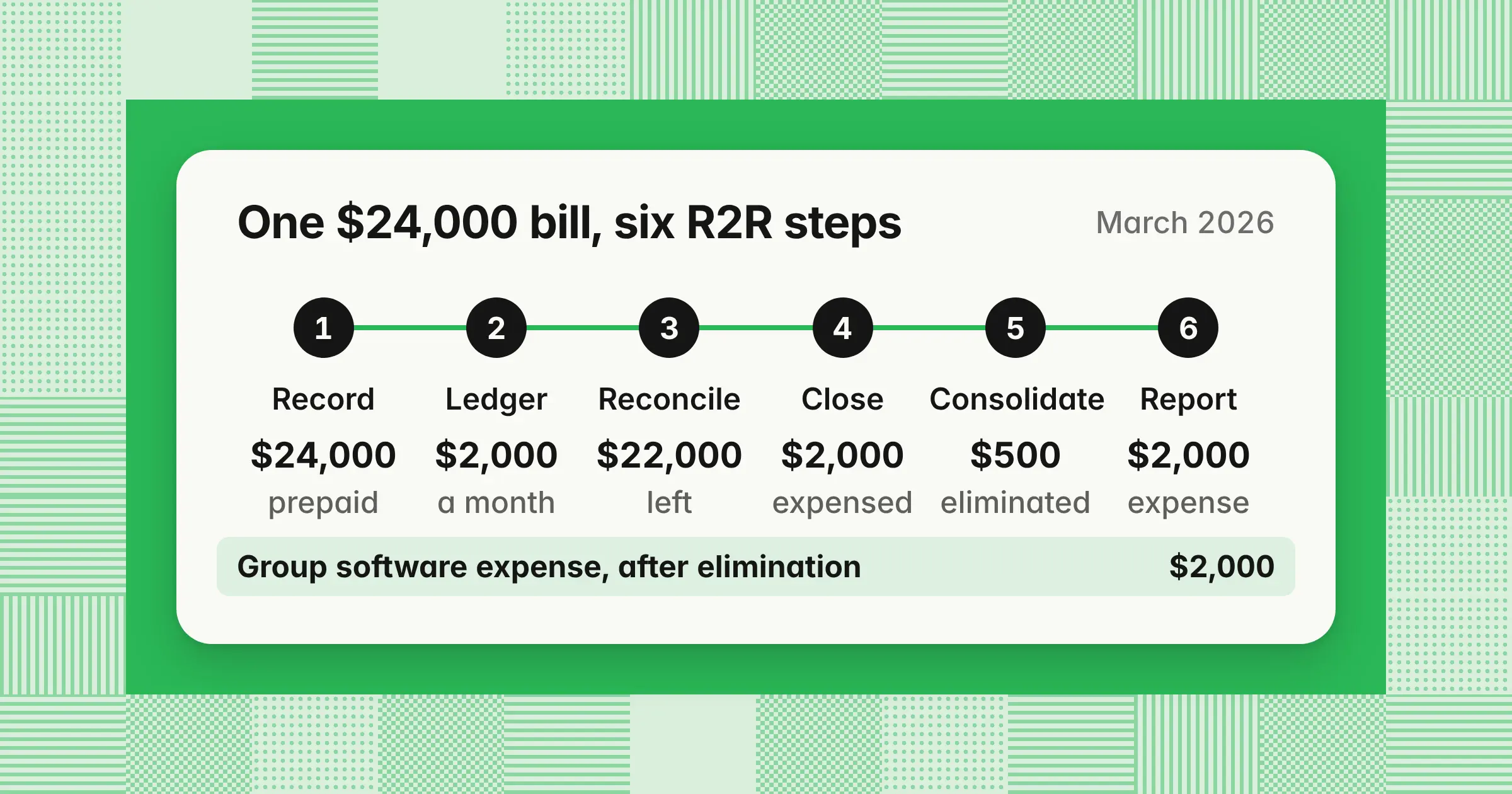
A $24,000 annual software bill is recorded as a prepaid, amortized at $2,000 a month, reconciled, closed, partly recharged to a subsidiary, eliminated in consolidation, and reported as $2,000 of software expense.
A US parent is billed $24,000 on March 1, 2026, for a 12-month subscription covering March 2026 through February 2027, and pays it on March 5. Its UK subsidiary uses 25% of the seats. To keep the example simple, the recharge is billed in US dollars. All amounts are illustrative. Under US GAAP accrual accounting, the bill is deferred and expensed over the 12 months of service. Many teams expense small bills at once under a policy threshold, but that threshold is a judgment to agree with your auditors, not a fixed rule, and a $24,000 annual bill is usually deferred.
| Step | When | What happens | Entry or check |
|---|---|---|---|
| 1. Record | March 1 and March 5 | AP posts the bill as a prepaid, then pays it | Debit prepaid expenses $24,000, credit accounts payable $24,000.Then debit accounts payable $24,000, credit cash $24,000. |
| 2. Maintain the GL | March 1 | The bill is coded to prepaid expenses and the R&D department, and a 12-month schedule is set up | $24,000 ÷ 12 = $2,000 a month |
| 3. Reconcile | BD2, April 2 | The bank reconciliation shows the payment cleared. The prepaid reconciliation finds the ledger at $24,000 and the schedule at $22,000. | $24,000 − $22,000 = $2,000 difference, the March amortization that hasn't posted |
| 4. Close | BD3–5, April 3–7 | The senior accountant posts the amortization and the 25% recharge, and the controller locks both entities | Parent: debit software expense $2,000, credit prepaid expenses $2,000.Parent: debit intercompany receivable $500, credit software expense $500.UK: debit software expense $500, credit intercompany payable $500. |
| 5. Consolidate | BD5–6, April 7–8 | The consolidation lead matches the two intercompany balances and eliminates them | Debit intercompany payable $500, credit intercompany receivable $500 |
| 6. Report | BD6–8, April 8–10 | The consolidated statements show the month's cost and the remaining prepaid | Software expense: $1,500 parent + $500 UK = $2,000.Prepaid expenses: $22,000.Intercompany balances: $0. |
Every entry balances, and the reconciliation in step 3 stops a $2,000 understatement of expense from reaching the report. The recharge is $2,000 × 25% = $500, so group expense stays at $2,000 however the cost is split. The schedule behind step 2 is explained in prepaid expenses, and recharges and eliminations in intercompany accounting.
What is the difference between record to report and the month-end close?
Record to report is the full cycle from recording a transaction to reporting it, and the month-end close is the checkpoint inside R2R where one month's books are reconciled, adjusted, reviewed, and locked. R2R runs every day, and the close runs in the first business days after month-end.
| Aspect | Record to report (R2R) | Month-end close |
|---|---|---|
| Scope | All six steps, from recording through reporting and analysis | Steps 2–5: cutoff, reconciliations, adjusting entries, review, consolidation, and the period lock |
| When it runs | Every day of the month | From BD1 until the period locks |
| Ends with | Financial statements and the management pack | A reconciled, adjusted trial balance and a locked period |
| Owner | Controller, with financial reporting and FP&A | Controller and the close team |
| Clock | Days to report | Days to close |
The financial close is the same checkpoint at any period end. Month-end, quarter-end, and year-end closes all sit inside R2R. For the close on its own, start with what is month-end close.
What are the month-end activities in R2R?
The month-end activities in R2R are subledger cutoff, accruals and other journal entries, account and intercompany reconciliations, adjusting entries, trial balance review, consolidation, the period lock, and reporting. The lock accounting period guide covers who can still post after the lock.
Quarter-end often adds deeper account analysis and the tax provision. Year-end typically adds counts, roll-forwards, closing entries, and the audit, all covered in the year-end close checklist.
R2R vs P2P vs O2C: Where each process hands off
Procure to pay (P2P) buys and pays, creating payables and expenses, and order to cash (O2C) sells and collects, creating receivables and revenue. Record to report takes what both post, plus payroll and fixed assets, and produces reconciled balances and reports.
| Aspect | Procure to pay (P2P) | Order to cash (O2C) | Record to report (R2R) |
|---|---|---|---|
| Starts with | A purchase request | A customer order | A posted transaction from any feeder |
| Ends with | A vendor payment | Cash collected and applied | Statements and the management pack |
| Main owner | Procurement and AP | Billing, credit, and AR | Controller and the accounting team |
| Accounts it drives | AP, accrued expenses, expenses, and cash | AR, revenue, unbilled and deferred revenue, and cash | Every account, plus equity and consolidation entries |
| Common KPI | Cost per invoice processed | Days sales outstanding (DSO) | Days to close and days to report |
P2P and O2C don't hand off to each other directly. Each hands its subledger and a set of period-end artifacts to R2R, and a late artifact becomes an R2R delay.
| Feeder | Handoff artifact | What R2R does with it | Cutoff | Handoff owner |
|---|---|---|---|---|
| P2P | AP subledger closed for the month | Ties the AP aging to the general ledger | BD1 | AP lead |
| P2P | Received-not-invoiced accrual list (GR/IR in SAP) | Books the accrual for goods and services received without an invoice, usually set to reverse next month | BD1 | AP lead, with budget owners |
| O2C | Unbilled revenue schedule | Books accrued revenue for work delivered but not yet invoiced | BD2 | Billing lead |
| O2C | Deferred revenue schedule | Ties billed but unearned amounts to the ledger and recognizes the month's revenue | BD2 | Revenue accountant |
| O2C | Unapplied cash report | Clears or explains receipts not yet matched to invoices, then reconciles AR and cash | BD2 | Cash application or AR lead |
| Payroll | Payroll accrual for days worked but unpaid, plus bonus and paid time off | Books the accrual and reconciles payroll liabilities to the payroll register | BD1 | Payroll lead |
| Fixed assets | Additions, disposals, and the depreciation run | Reconciles the asset register to the ledger | BD2 | Fixed asset accountant |
| Treasury | Bank and loan statements | Reconciles cash and debt, and accrues interest | BD1 | Treasury lead |
Example
If the received-not-invoiced list arrives on BD3 instead of BD1, the accruals, the expense review, and the entity lock all slip two business days.
The entries behind these artifacts are covered in accrued expenses, accrued revenue, and deferred revenue.
Quote to cash (Q2C) is O2C with quoting, pricing, and contract steps added at the front. Hire to retire (payroll) and acquire to retire (fixed assets) are the other feeders that R2R depends on.
Who owns the R2R process?
In most mid-size companies, the controller owns record to report end to end and signs off the close, and the CFO is accountable for the reported numbers. Accountants prepare, an accounting manager reviews, a consolidation lead owns the roll-up, and FP&A explains results.
| Role | Owns in R2R | Reviews or signs off |
|---|---|---|
| CFO | The reported numbers and external reporting | Final statements and the management pack |
| Controller | The close calendar, accounting policies, and final review | Adjusted and consolidated trial balances, and manual entries above threshold |
| Assistant controller or accounting manager | Day-to-day close coordination | Reconciliations and journal entries |
| Senior and staff accountants | Accruals, adjustments, reconciliations, and schedules | Peer review of low-risk reconciliations, if your policy allows it |
| AP, AR, payroll, and treasury leads | Complete subledgers and handoff artifacts by cutoff | Their own subledger tie-outs |
| Consolidation lead | Intercompany matching, eliminations, and currency translation | Intercompany confirmations with each entity |
| Financial reporting lead | Statements, disclosures, and filings | Tie-out of the statements to the consolidated trial balance |
| FP&A | Variance commentary and forecast updates | Commentary before it goes to the CFO |
| ERP or finance systems administrator | Period open and close, integrations, and user access | Access reviews, with the controller |
For a 300-person company with four entities, one workable split is one accountant per entity for steps 1–4, a consolidation lead for step 5, and a reporting lead for step 6. The controller reviews all three. Write the split as a RACI matrix (responsible, accountable, consulted, informed) so every task has one accountable name.
If you've seen the job title, an R2R or RTR accountant is the staff or senior accountant who prepares the entries and reconciliations in steps 1–3. The core R2R skills are the same work: journal entries, reconciliations, and working in your ERP.
How long does R2R take? Days to close and days to report
After the initial trial balance, APQC's cross-industry median is 6 calendar days to the consolidated statements and 10 to management reports. Both clocks measure the close and reporting part of R2R, not the whole cycle, which runs all month.
In Ledge's 2025 survey, half of teams closed in 5 business days or fewer. The table puts each benchmark next to its day convention and date.
| Clock | Benchmark | Day convention | Measured from and to | Sample | Source and date |
|---|---|---|---|---|---|
| Days to close | 18% close in 1–3 days, 32% in 4–5, 23% in 6–7, and 27% in more than 7 | Business days | Time to close the books each month | 100 finance professionals | Ledge survey, published April 10, 2025, updated August 8, 2026 |
| Days to close | Median 6.0 days | Calendar days, including weekends | First entity trial balance to the monthly consolidated statements | 10,198 organizations | APQC Open Standards Benchmarking, measure 100162, no publication date, read November 11, 2026 |
| Days to report | Median 10.0 days | Calendar days, including weekends | First entity trial balance to the period-end management report | 3,287 organizations | APQC Open Standards Benchmarking, measure 100625, no publication date, read November 11, 2026 |
| Shared services close | Median 8.0 days | Not stated | A finance shared services center completing the monthly close | 3,123 organizations | APQC Open Standards Benchmarking, measure 104615, no publication date, read November 11, 2026 |
Convert before you compare. Six consecutive calendar days hold 4 or 5 business days, and 10 hold 6 to 8, depending on where the weekend falls. APQC also starts its clock at the first trial balance, not at period end.
Example
For March 2026, BD1 is Wednesday, April 1. The step table above locks the consolidated books on BD6, Wednesday, April 8, and sends the pack on BD8, Friday, April 10. Counted APQC's way from an April 1 trial balance, that's 7 calendar days to the consolidated statements and 9 to the management report. You'd be one calendar day slower than APQC's close median and one calendar day faster than its reporting median. By Ledge's count, 6 business days puts you in the 6–7 business day group, behind the 50% of teams that close in 5 business days or fewer.
The 8-day figure that AI tools often quote as APQC's monthly close median matches measure 104615, which covers finance shared services centers and doesn't state a day convention. Sample counts on APQC's live measure pages change as members add data, so cite the measure number and the date you read it. Targets by company size are in how long should month-end close take.
What are R2R KPIs?
Track six core R2R KPIs: days to close, days to report, reconciliations completed on time, journal entry error rate, post-close adjustments, and R2R cost per $1,000 of revenue. Write the day convention next to every timing KPI, and add manual journal entry share to see where automation would help most.
| KPI | Formula | Day convention | What it tells you |
|---|---|---|---|
| Days to close | Business days from period end to the day the consolidated books lock | Business days from period end | How long the close takes |
| Days to report | Business days from period end to delivery of the management pack | Business days from period end | When leadership gets the numbers |
| Reconciliations on time | Reconciliations signed off by their due day ÷ reconciliations due × 100 | Due days set in business days | Whether the calendar holds |
| Journal entry error rate | Entries reversed or corrected ÷ entries posted × 100 | None | The quality of the recording step |
| Post-close adjustments | Count of entries posted to a period after it locked | None | Whether the close was really finished |
| R2R cost per $1,000 of revenue | Annual R2R cost ÷ annual revenue × 1,000 | Fiscal year | Efficiency, scaled for company size |
| Manual journal entry share | Manual entries ÷ entries posted × 100 | None | Where automation would remove the most work |
Example
A company with $150 million in annual revenue closes March 2026. It has 180 balance sheet accounts and posts 640 journal entries in the month. All amounts are illustrative.
- Days to closeThe consolidated books lock on BD6, April 8, so days to close is 6 business days
- Days to reportThe management pack goes out on BD8, April 10, so days to report is 8 business days
- Reconciliations on time171 ÷ 180 × 100 = 95%
- Journal entry error rate16 ÷ 640 × 100 = 2.5%
- Post-close adjustments3 entries posted to March after it locked
- R2R cost per $1,000 of revenue$1,020,000 people (pay and benefits allocated by time spent on R2R) + $120,000 systems + $60,000 overhead = $1,200,000, and $1,200,000 ÷ $150,000,000 × 1,000 = $8.00
- Manual journal entry share384 ÷ 640 × 100 = 60%
To calculate R2R cost, allocate each person's annual pay and benefits by the share of their time spent on R2R, so a payroll lead who spends 20% of their time on R2R counts at 20%. Then add the R2R share of systems, outsourcing fees, overhead, and other costs, and track the result year over year. APQC's cost benchmarks prorate employees and hours by process the same way. If you manage the process day to day, watch reconciliations on time and post-close adjustments every week, because they move first when the calendar slips. Formulas, targets, and a free scorecard are in financial close KPIs.
What are common R2R challenges, and how do you fix them?
The most common R2R challenges are late inputs from other teams, spreadsheet-run work, reconciliations bunched at month-end, disconnected systems, intercompany mismatches, and unclear owners. Each one has a fix you can put in the calendar.
| Challenge | How it shows up | Fix |
|---|---|---|
| Late inputs from other teams | Accruals and reconciliations wait on AP, payroll, or regional teams | Give each handoff artifact an owner and a cutoff day, and track it like any other task |
| Spreadsheet-run close | Broken links, version conflicts, and support that's hard to audit | Move recurring schedules and reconciliations into a system of record |
| Reconciliations bunched at month-end | The close stalls on BD2–4 | Reconcile bank, card, and other high-volume accounts weekly |
| Disconnected systems | Re-keyed data and subledgers that don't tie to the ledger | Map each subledger to the ledger and reconcile the tie-out every period |
| Intercompany mismatches | Eliminations that don't net to zero | Confirm balances between entities by BD3, before consolidation starts |
| Manual entries without support | Audit findings and entries no one can explain later | Require support and an approval threshold for every manual entry |
| Unclear ownership | Tasks with no preparer or reviewer | Name one preparer and one reviewer for every account and task |
Ledge's 2025 survey of 100 finance professionals, published April 10, 2025 and updated August 8, 2026, puts numbers on the first four. 56% named dependence on other departments and regions as a blocker, and 40% named legacy systems that don't integrate. 94% use Excel in the close, and 50% called it a key reason the close is slow. Reconciling accounts was the most-named time-consuming task, and cash reconciliation alone took 20–50 hours a month.
How do you streamline R2R and keep it compliant?
To streamline R2R, use one chart of accounts and one close calendar across entities, apply the fixes in the table above, and automate matching and recurring entries. The step-by-step plan is in faster month-end close. For accuracy, reconcile to outside sources such as bank statements, not to other internal reports, and review account movements against your thresholds with flux analysis. Compliance comes from controls you evidence every month, not checks added at year-end. The reconciliation method is in account reconciliation.
Should you outsource record to report?
Outsource R2R execution when you need capacity you can't hire, but keep judgment, policy, review, and sign-off in house, because management still owns internal control over financial reporting. Keeping R2R in house with software that prepares the work is a third option.
| Option | What moves | What stays with your team | Fits when | Check before you sign |
|---|---|---|---|---|
| Outsource execution to a BPO or managed services provider | Recurring entries, reconciliation preparation, intercompany matching, and fixed asset runs | Judgment accruals, policy, review, sign-off, and reporting | Volume is high, entities are many, and roles are hard to hire | A SOC 1 Type 2 report covering your period, service levels by business day, and access controls |
| Co-source with an accounting firm | Specialist work such as technical accounting, consolidation, or catch-up | The day-to-day close and sign-off | You need expertise for months, not headcount for years | Scope, rates, and who reviews the firm's work |
| Keep in house with software that does the work | Preparation moves to software, and people review | Everything, including the data | You want control and audit evidence in your own systems | A named reviewer on every task, a log of every step, and no posting without approval |
R2R in BPO usually means a provider's team runs steps 1–3 from its delivery center, working in your ERP. The AICPA describes SOC 1 as an examination of controls at a service organization, written for the companies that use it and their auditors. Read the report's list of complementary user entity controls, because those controls stay your job. You can also hire a consulting firm to redesign the process first, then decide whether to outsource.
How do you automate R2R, and what can AI do today?
Automate the high-volume, rules-based parts of R2R first: bank, card, and intercompany matching, recurring and accrual entries, reconciliation workpapers, and first drafts of flux commentary. AI agents can now prepare this work, while people approve judgment entries and sign off.
The step-by-step split between what software does and what a person signs off is in the tool map in the next section.
Robotic process automation (RPA) repeats fixed clicks and can break when a screen or file changes. AI agents can read source documents and handle more variation, but both still need a reviewer. Cloud ERPs with APIs make either easier, because the software can read and post without file exports.
Adoption is still early. In APQC's survey of more than 600 finance leaders, reported by APQC's Kelley Pruetz on April 3, 2025, 31% of organizations actively used AI in R2R and 39% were in early adoption. Gartner's survey of 183 CFOs and senior finance leaders, published November 18, 2025, found 59% use AI in finance, and 34% of those use it for error and anomaly detection. The step-by-step method is in financial close automation, and the evidence on accuracy is in does AI make the month-end close more accurate.
What is R2R software? Tools that track the close vs tools that do the work
R2R software splits into tools that track the close, with checklists, owners, due dates, and sign-offs, and tools that do the work, such as matching, reconciliations, accruals, and workpapers. Most teams run an ERP plus one or both.
| R2R step | Tools that track the close | Tools that do the work | What a person signs off |
|---|---|---|---|
| Record | Due dates for each subledger cutoff | Recurring entries and accrual proposals with support | Judgment entries and entries above threshold |
| Maintain the GL | A checklist item for the suspense review | Mapping checks and suspense alerts | Chart of accounts changes |
| Reconcile | The status of each reconciliation and who owes it | Transaction matching and a workpaper with every difference | Each reconciliation |
| Close | The calendar, owners, sign-offs, and the lock | Draft adjusting entries and flux explanations | The adjusted trial balance |
| Consolidate | Each entity's status by business day | Intercompany matching, eliminations, and currency translation | Consolidation entries |
| Report | The pack's delivery date | Statements and report packs built from the ledger | The pack before it goes out |
A tracker tells you the prepaid reconciliation is late, and a work-doing tool prepares it. When you evaluate vendors, ask each one to run one task in front of you, from source data to an approved entry. Measure the benefit with the KPIs above: days to close, reconciliations on time, and manual journal entry share.
Your ERP holds the ledger, subledgers, and period controls, and often consolidation. In NetSuite OneWorld, for example, the Period Close Checklist lets you lock periods by subsidiary, calculate consolidated exchange rates, and eliminate intercompany transactions (NetSuite Help, "Using the Period Close Checklist," read November 11, 2026). Reconciliation support and accrual calculations can still sit in spreadsheets unless you add a module or a separate tool.
Choose by the work that takes your team's hours, then by your ERP, entity count, and audit needs. The best month-end close software guide compares options by the work each one does.
How we approach it
Our Close Agent works the R2R steps that take your team's hours: it reconciles the ledger to bank statements, subledgers, and invoices, and prepares each balanced entry with its workpaper for a named reviewer. Nothing posts to NetSuite, Oracle, SAP S/4HANA, Microsoft Dynamics 365, Business Central, or QuickBooks until an approver signs off the exact lines, and the month can't lock until every task is signed off. Explore our Close Agent to see your R2R work prepared before your team starts reviewing.
Share this article